
Quick Answer
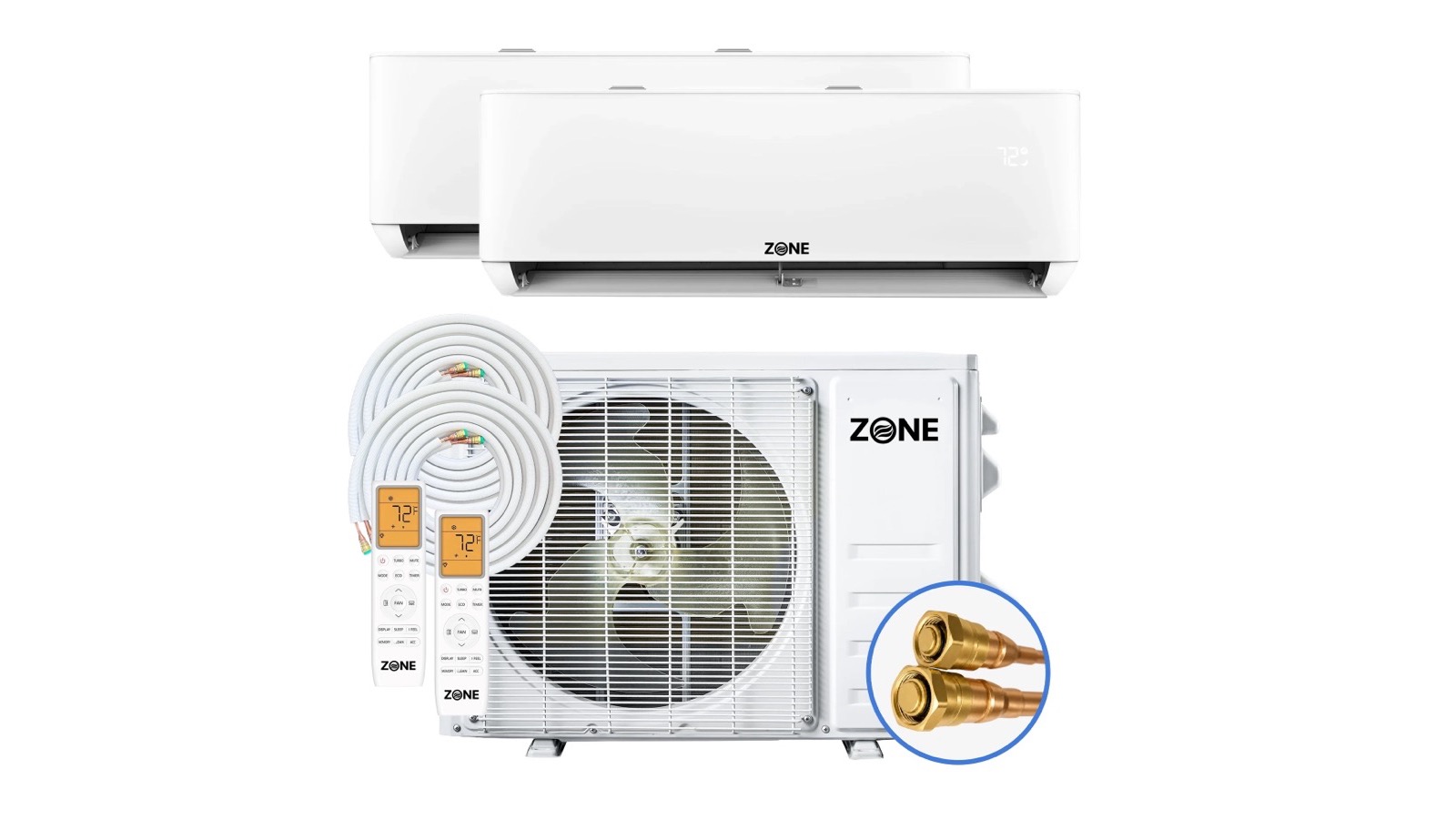
Zone Air DIY Multi-Zone is our pick for the best overall 2-zone DIY mini split in 2026. It's the only pre-charged DIY brand we know of that lets you mix concealed duct, wall-mounted and ceiling cassette indoor units on one outdoor condenser, and it's the only one we know of that cuts its pre-charged line sets to the length you order. The main alternative and a solid runner-up is the MrCool DIY 5th Gen. It comes with a ceiling cassette that fits between 16-inch joists and larger condensers if you want to add zones later.
- Zone Air and MrCool are the two pre-charged DIY mini split brands in this comparison. Neither one needs a vacuum pump, manifold gauges or an EPA Section 608 license for the refrigerant side of installation.
- Senville, Pioneer and Cooper & Hunter have competitive 2-zone multi-zone systems, but all three use standard line sets that need a vacuum pump, and Senville and Cooper & Hunter tie warranty coverage to licensed installation. They work for buyers who prefer a pro install path or need specific cold climate performance.
- Key things to think about when you're shopping: DIY vs professional installation costs, cold climate performance ratings, BTU sizing (common 2-zone choices run from 18,000 to 27,000 BTU), and what mix of indoor units you need. Whether wall mounted units are enough, or if you want to pair a ceiling cassette or concealed duct head on the same system.
- Many DIY mini split models are Energy Star certified, but you should check the listing for the exact model you're buying. Mini split systems can hit SEER2 ratings up to 24 in their top configurations, and a 23 SEER2 rating means high cooling efficiency for mini splits in this class.
How 2-Zone DIY Mini Splits Work
How does a 2-zone mini split work? It uses one outdoor condenser to send refrigerant to two indoor units, and each one has its own temperature control. Instead of one thermostat setting the comfort for your whole home, each room gets its own climate.
- A single zone system has one outdoor unit with one indoor unit for one room. A 2-zone (or multi-zone) setup connects multiple indoor units to the same outdoor condenser, so you can heat or cool two spaces independently.
- Typical 2-zone DIY systems cover 600–1,200 square feet depending on BTU capacity. A 24,000 BTU 2-zone system, for example, often splits into two 12,000 BTU indoor units. Each one is handling about 500 square feet.
- Indoor and outdoor units talk to each other through refrigerant lines, a communication wire and a power connection. Indoor unit styles include wall-mounted, ceiling cassette and concealed duct options on higher-end systems.
- True DIY mini split systems have pre-charged sealed quick-connect line sets. You tighten the fittings with a torque wrench and the refrigerant circuit is complete. Traditional ductless mini split systems need a vacuum pump, micron gauge and refrigerant scales. These are tools you probably don't own.
- Mini splits are 20–40% more energy efficient than central air systems, so they're a strong upgrade for homes with aging ductwork or no existing HVAC at all.
Zone Air 2-Zone DIY Systems (Best Overall)
Zone Air is our top pick for a 2-zone DIY mini split in 2026 because we don't know of another brand that matches its combination of indoor unit flexibility and custom pre-charged line sets. It's the best diy mini split for you if you want design options beyond basic wall mounts.
- Zone Air offers pre-charged DIY mini split systems with quick-connect fittings that don't need a vacuum pump, refrigerant gauges or EPA certification. It's one of the two pre-charged DIY brands in this guide, alongside MrCool.
- The big multi-zone advantage is that homeowners can mix concealed duct, wall-mounted and cassette indoor units on a single condenser. If you want a wall unit in the bedroom and a concealed duct head feeding your hallway from a closet, Zone Air can do that in DIY form. We don't know of another pre-charged DIY mini split brand that offers this flexibility in 2026.
- Zone Air's pre-charged lines are custom cut and charged at its Salt Lake City, Utah facility and tested for leak resistance at 400 PSI. You order the length you need in whole feet (up to 75 feet per zone), which gets rid of coiling excess tubing behind the condenser. Excess line that's coiled or sagging in a low spot can let compressor oil settle, so running only the copper you need gets rid of that problem.
- Fewer quick-connect joints means fewer potential leak points. A single continuous run from condenser to indoor unit has only two connection points, compared with systems that need extension couplers for longer runs.
- Two-zone wall mount systems run from 18,000 to 36,000 BTU of connected indoor capacity, with 9,000, 12,000 and 18,000 BTU indoor units on one 27,000 BTU outdoor condenser. SEER2 is 24 on the 230V two-zone wall mount systems, 21 on two-zone ceiling cassette systems and 19 on two-zone concealed duct systems.
- Zone Air's multi-zone condenser is rated for heating down to −13°F. For most two-zone setups, heating capacity at 5°F is still strong enough to use as a primary heat source in moderate cold climate regions.
- Warranty: 5-year parts and 7-year compressor, honored for homeowner installations when you follow the manual. Example pricing: the 2-zone 24,000 BTU (12K + 12K) wall mount system was $3,039.99 when we checked in October 2026, with line sets sold separately from $229.99 per zone for a 16 foot set. Standard lengths are 16, 25, 33, 50 and 75 feet and any other length is priced at the next standard length up plus a $100 cut fee.
MrCool DIY 5th Gen 2-Zone Systems
MrCool DIY 5th Gen is the other pre-charged 2-zone DIY mini split in 2026 and the main alternative to Zone Air.
- MrCool DIY systems use precharged components for easy installation. Their 5th Gen multi-zone line comes with pre-charged quick-connect line sets so homeowners can handle the refrigerant side themselves, without an HVAC technician on the refrigerant circuit.
- Like Zone Air, MrCool comes with true pre-charged DIY kits that don't need EPA certification for the refrigerant connections.
- Typical 2-zone setups: an 18,000 BTU condenser feeding two 9,000 BTU heads, or a 27,000 BTU condenser feeding two 12,000 BTU heads (MrCool's matchup sheet also allows 12K + 12K on the 18,000 BTU condenser). Power requirements are 208-230V single-phase on every multi-zone condenser. SEER2 ratings are 23.9 on the 18,000 BTU condenser and 23.0 on the 27,000 BTU condenser, on 5th Gen units using R-454B refrigerant.
- Cold climate: MrCool's multi-zone manual rates the 18,000 to 48,000 BTU condensers for heating down to −13°F, the same floor as Zone Air, and the 6-zone 55,000 BTU condenser down to −22°F. MrCool's Hyper Heat models, also rated to −22°F, are single zone systems. Buyers in northern climates should check the spec sheet carefully for heating capacity at 5°F.
- Limitations versus Zone Air: MrCool's line sets come in fixed lengths (16, 25, 35 or 50 feet). If your run is 30 feet, you're buying the 35-foot kit and coiling the excess. Longer runs need a coupler kit joining two line sets, which adds quick-connect joints and potential leak points. Indoor unit mixing in MrCool's DIY line is more restricted: wall mounted units and ceiling cassettes are supported, but concealed duct heads aren't available in the quick-connect DIY multi-zone lineup.
- Pricing: a 2-zone 18,000 BTU bundle (9K + 9K wall mount) was $3,104 with two 16 foot line sets and $3,831 with two 50 foot line sets at MrCool DIY Direct when we checked on October 5, 2026. Warranty mirrors Zone Air at 5 years parts, 7 years compressor, with no registration required.
Senville 2-Zone Systems (Pro Install)
Senville is a popular pro install mini split brand with affordable 2-zone ductless systems like the LETO and Aura series, but it's not a true DIY mini split.
- Senville systems need professional installation to keep warranty protections. The refrigerant side - vacuuming, pressure testing, charging - has to be done by a licensed HVAC technician. You can mount the indoor and outdoor units yourself, but Senville's warranty terms state that "DIY installation will void your warranty coverage."
- Common Senville 2-zone bundles run around 18,000–24,000 BTU with two 9,000–12,000 BTU wall-mounted indoor units. Many 2026 listings still use R-410A refrigerant, which may limit eligibility for newer efficiency rebates.
- Operating as low as 25 dB indoors, the Senville LETO series is one of the quietest options on the market. It's quiet enough for light sleepers and home offices. Senville LETO is often cited as a value benchmark in mini splits for good reason.
- Senville systems achieve high efficiency ratings and cold-climate performance, with mid-range models reaching SEER2 of about 18–20. Equipment cost is lower than most DIY brands, but once you add professional installation costs for labor, the total project price often exceeds a DIY kit.
- The bottom line on Senville: cheaper hardware, higher installed cost. If you already have a trusted HVAC contractor and want quiet operation at a lower sticker price, Senville is a reasonable pro install choice. For everyone else, pre-charged DIY brands like Zone Air and MrCool deliver lower total cost.
Pioneer 2-Zone Mini Split Systems
Pioneer is a widely sold value mini split brand with many 2-zone offerings, but in our view it's not a true DIY mini split. Other brands like Pioneer need standard flaring, pressure testing and vacuum pump evacuation.
- Pioneer multi-zone systems (including the WYS and Quantum series) use standard flare line sets that need a vacuum pump, and Pioneer's warranty covers properly installed units that are registered. No pre-charged lines are available in the DIY sense.
- What are typical configurations? 18,000–27,000 BTU outdoor units sending refrigerant to 9,000 and 12,000 BTU indoor units for small homes, paired rooms or office suites. Pioneer's 2026 catalog lists SEER2 ratings up to 24.0 on certain 18,000 and 27,000 BTU models, with HSPF2 around 10.5.
- Pioneer Multi-Zone systems are known for affordability and accessible installation documentation. Parts availability is solid, and the Pioneer Diamante is a popular budget mini split option for single room or paired-room coverage.
- Drawbacks versus DIY brands: no pre-charged line sets, more complex installation requiring HVAC tools, and higher total project cost once labor is factored in.
- Pioneer is best for you if you're comfortable hiring a pro but want budget-friendly, recognized mini split brands instead of unknown imports. If professional labor is inexpensive in your area, Pioneer delivers respectable specs for the money.
Cooper & Hunter 2-Zone Systems for Cold Climates
Cooper & Hunter is a strong cold climate value brand, and their Sophia and Hyper Heat-style models stand out for extreme cold regions where temperatures drop well below zero.
- Cooper & Hunter's Sophia series heats effectively down to −22°F and is a strong pro install candidate for northern homeowners. Cooper & Hunter systems often do well in heating performance in cold climates. This is their core strength.
- With SEER ratings around 21.5, HSPF above 9.0, and design pressures rated for extreme cold cycling, the Sophia Hyper Multi-Zone models are built for harsh winters. Many Cooper & Hunter 2-zone systems maintain heating capacity at ambient temperatures where standard mini splits have already shut off.
- These are not DIY mini split systems. Installation needs professional tools, a vacuum pump and EPA-certified technicians for refrigerant handling. Line sets are traditional fixed tubing, not pre-charged quick-connect.
- Target applications include main-floor plus bedroom coverage in homes across the northern U.S. and Canada. Common 2-zone sizes: 18,000–24,000 BTU condensers with two indoor heads.
- Compared to Zone Air and MrCool: Cooper Hunter may lead in extreme cold capacity in some price bands, but it lacks pre-charged line sets and homeowner-install warranties. Cold climate buyers must weigh DIY convenience against maximum low-temperature output.
Pre-Charged vs Professional Installation: What Actually Changes?
"Pre-charged" means the refrigerant is factory-filled and sealed inside the condenser and line sets. The system stays sealed until you tighten the quick-connect fittings during installation.
- A DIY install avoids: the vacuum pump, micron gauge, refrigerant scales, manifold gauges, nitrogen pressurization and the EPA Section 608 license needed to handle refrigerants. That's hundreds of dollars in HVAC tools you never need to buy or rent.
- Professional installation needs a tech to evacuate lines to ~500 microns, pressure-test with dry nitrogen, leak-check and then release refrigerant. Higher install cost, but full control over line length and layout.
- Zone Air is the only brand in this comparison offering custom-cut pre-charged line sets, cut and charged in Salt Lake City, Utah, combining pro-style custom lengths with DIY ease. Order a 37-foot run and you get exactly 37 feet. No coiling, no couplers, no excess.
- MrCool uses fixed-length pre-charged kits (16, 25, 35 or 50 feet). If your condenser-to-indoor-unit run is 28 feet, you buy the 35-foot kit and coil the remaining 7 feet. Every extra coupler adds two more connection points.
- Senville, Pioneer and Cooper & Hunter ship uncharged copper tubing requiring full pro work. That means flaring, evacuating and charging.
Example: On a 25-foot run, Zone Air and MrCool both work cleanly. On a 40-foot run to a detached garage, Zone Air ships one continuous 40-foot pre-charged line with two connection points. MrCool needs a 50-foot fixed kit with excess coiled, or two shorter line sets joined with a coupler kit. That adds a third and fourth quick-connect joint to torque and leak-check.
Indoor Unit Types for 2-Zone Systems
A 2-zone condenser can send refrigerant to two identical or two different indoor unit styles, but which styles you can mix depends completely on the brand.
- Wall-mounted indoor units are the most common DIY option. They are mounted high on the wall, deliver efficient cooling and heating, and work well in bedrooms, living rooms, garages and home offices. They do need available wall space for mounting.
- Ceiling cassette indoor units mount flush in drop or framed ceilings for wide air distribution. They give a clean, commercial-grade look often used in open-plan areas. Ceiling height matters. Cassettes need at least 8 to 10 inches of clearance above the finished ceiling.
- Concealed duct indoor units hide in closets, soffits or attic spaces, sending air through short duct runs to multiple small rooms. The indoor unit itself is invisible, and you keep a ductless-style outdoor unit outside.
- Zone Air is the only pre-charged DIY brand we know of in 2026 allowing mixing of concealed duct, wall and cassette indoor units on a single DIY condenser. Want a wall mount in the master bedroom and a concealed duct sending air to two kids' rooms from a hallway closet? That's a standard Zone Air configuration.
- MrCool's DIY multi-zone systems pair wall mounts and the one-way OuttaSight ceiling cassette. MrCool's ducted DIY air handler is a separate whole-home product that isn't a concealed duct head you add as one zone of the quick-connect DIY multi-zone system.
BTU Sizing for 2-Zone DIY Mini Splits
Proper BTU sizing is the foundation of comfort and efficient cooling. Oversizing wastes energy and causes short-cycling. Undersizing can leave rooms uncomfortable when temperatures drop.
- As a starting point, the standard rule of thumb is 20 BTU per square foot. A 12,000 BTU mini split usually covers 500 square feet. Two rooms of about 500 square feet each pair well with two 12,000 BTU indoor units on a 2-zone outdoor condenser.
- Factors that push BTU requirements higher: poor insulation, high ceiling height (above 8 feet), large or south-facing windows, and kitchens with significant heat-generating appliances. A 500-square-foot room with poor insulation and 10-foot ceilings may need 15,000 BTU instead of 12,000.
- Cold climate and extreme cold buyers should check low-temperature heating capacity ratings on the spec sheet, not just nominal BTU at the standard 47°F test point. A system rated at 24,000 BTU at 47°F may deliver only 16,000 BTU at 5°F.
- Use manufacturer sizing calculators from Zone Air, MrCool and other brands rather than guessing. Square footage alone doesn't account for your home's insulation, local climate or window exposure.
Common 2-zone configurations in 2026:
- 18,000 BTU (9K + 9K) - smaller bedrooms or offices
- 21,000 BTU (9K + 12K) - mixed-size rooms
- 24,000–27,000 BTU (12K + 12K, or 9K + 18K) - larger living spaces
Best 2-Zone Mini Splits by Use Case (2026)
Depending on your use case, the best mini split comes down to DIY skill level, climate, budget and room layout. Here's a quick decision map.
- Best overall 2-zone DIY multi-zone (mixed indoor types): Zone Air. It's the right mini split when you need a wall mount in one room and a cassette or concealed duct in another, with custom pre-charged lines that minimize leak points.
- Best DIY alternative with a cassette for 16-inch joist bays: MrCool DIY 5th Gen 2-zone. It has wall mount and one-way OuttaSight cassette heads on a 230V condenser, in fixed line set lengths.
- Best extreme cold pro install: Cooper & Hunter Sophia / Hyper Heat models. This is the best choice for buyers who need reliable mini split heat at −22°F in multi zone layouts, paired with professional installation.
- Best budget pro install with quiet operation: Senville LETO or Pioneer Diamante. Position these when professional labor is inexpensive in your region, quiet operation is a priority, and equipment cost is the deciding factor.
Replacing a 10 SEER system with a 24 SEER2 mini split can cut your cooling costs in half, regardless of which brand you pick. Upgrading to a high efficiency ductless system is going to pay for itself over time.
Voltage and Power for 2-Zone Systems
You might not realize how much voltage matters. Getting it wrong means tripped breakers, failed startups or a costly electrical upgrade mid-project.
- Many 12,000 BTU single zone DIY mini units can run on a dedicated 115V circuit. But 2-zone DIY condensers from Zone Air and MrCool in 2026 need 208/230V power with a dedicated circuit and an outdoor disconnect box.
- A 2-zone condenser running two 12,000 BTU indoor units will be 230V. That means a dedicated double-pole breaker in your electrical panel (30A on Zone Air's multi-zone condenser) and proper wire gauge run to the condenser location. Check your local code requirements before starting.
- Budget for electrical work even with DIY refrigerant hookups. Many homeowners can handle mounting and refrigerant connections on Zone Air or MrCool systems but still need a licensed electrician for the 230V circuit, especially when upgrading from 120V service.
- Even on the DIY refrigerant side, the electrical portion may legally require a permit and licensed electrician depending on your municipality. Condensate drainage routing also needs attention - improper drainage can cause water damage and mold.
- If your home only has 115V available and you want to avoid electrical work completely, consider two separate single zone systems on 115V instead of one 2-zone condenser. There is a trade-off: two outdoor units instead of one, and potentially higher equipment cost.
Cold Climate and Extreme Cold 2-Zone Options
Not every mini split is engineered for cold climate operation. If you live where winter lows regularly hit single digits or below, this section is non-negotiable reading.
- "Cold climate" usually means maintaining useful heating capacity at 5°F. "Extreme cold" or hyper heat models perform down to −13°F or −22°F. Cold-climate mini splits are engineered for low-temperature heating with enhanced compressor designs and specialized defrost cycles.
- Cooper & Hunter's Sophia series heats effectively down to −22°F and is a strong pro install candidate for northern homeowners. Selected Gree Sapphire systems also operate down to −22°F for those looking at additional cold weather options.
- Among premium brands, Mitsubishi H2i maintains 100% capacity at 5°F. It's a benchmark in the industry. Fujitsu AIRSTAGE XLTH is able to operate down to −15°F. These are pro install systems with higher price tags, but they set the standard for cold climate model performance.
- DIY multi-zone options: Zone Air's multi-zone condenser and MrCool's 18,000 and 27,000 BTU DIY 5th Gen condensers are all rated for heating down to −13°F. Specs vary by model, so verify before buying.
- Buyers in Minnesota, New England or similar northern climates should check for Northeast Energy Efficiency Partnerships (NEEP) cold-climate listings and published heating capacity tables at 17°F and 5°F.
- Proper sizing is even more critical in extreme cold. If the system can't maintain sufficient output at your design temperature, you'll rely too much on backup heat. That means electric baseboard or a furnace, which defeats the efficiency advantage.
Warranty, Support and Long-Term Reliability
Warranties differ a lot between DIY and professional installation mini split brands. The details can cost you thousands if you're not paying attention.
- Pre-charged DIY brands like Zone Air and MrCool are designed to preserve their warranty when installed by homeowners, provided you follow the installation manual - correct torque specs, proper electrical connections and documented setup. Both carry 5 years on parts and 7 years on the compressor, and MrCool's DIY 5th Gen warranty applies with no registration required.
- Senville and Cooper & Hunter need installation by a licensed HVAC professional to keep their warranties intact, and Pioneer's warranty covers properly installed, registered units. Attempting a self install on these brands and later filing a warranty claim is a recipe for denial.
- The pre-charged quick-connect system makes the process easier, but sloppy torquing or kinked line sets can still cause failures. Convenient installations for DIY systems often lack comprehensive manufacturer warranties when instructions aren't followed exactly. Keep your receipts, photos of key steps and registration confirmations.
- Zone Air's custom pre-charged line sets reduce the number of quick-connect joints in your system. Fewer joints mean fewer potential leak points. That's an advantage for long-term reliability over 10+ years of operation.
- Register your unit with the manufacturer, buy from authorized dealers and keep proof of installation. For any future warranty support claim on a compressor or control board, documentation is your best friend.
DIY vs Professional 2-Zone Install Costs
Equipment cost does not equal installed cost. Labor and electrical work routinely double or triple the project budget on pro install brands.
- Pro install benchmarks (2026): A 2-zone pro install system might cost $2,500–$4,000 for equipment plus $2,000–$3,500 in labor and electrical, depending on region. Installation costs vary based on region and project scope. Mitsubishi mini split installation costs range from $3,000 to $5,000 for a single zone. Multi-zone runs even higher.
- DIY benchmarks: Zone Air or MrCool 2-zone wall mount kits start around $3,100 with two 16 foot line sets and run past $4,500 with larger heads or long line sets, but DIY mini split systems can save $1,500 to $3,000 on installation by eliminating the refrigerant labor. Your remaining costs are mainly electrical work and mounting hardware.
- DIY installation can save $1,500 to $3,000 per zone. On a 2-zone system, that's up to $6,000 in potential savings.
- The cheapest mini split system starts around $650 for equipment only, but that bare-bones number doesn't include line sets, electrical or mounting. Single-zone mini split systems cost $1,800 to $3,500 installed with professional labor.
- Pre-charged DIY kits may carry a higher sticker price than bare-bones pro install condensers, but they deliver lower total installed cost for handy homeowners willing to spend a weekend on the project.
- Compare at least three cost scenarios before committing: full pro install on a value brand, hybrid (electrician + DIY refrigerant on Zone Air or MrCool), and 100% professional work on a premium brand like Mitsubishi Electric.
Installation Overview for 2-Zone DIY Mini Splits
Local codes and safety rules must be followed. Electrical work may still need a licensed electrician even when the refrigerant side is fully DIY.
Here's the high-level install sequence for a 2-zone DIY system:
- Mount the outdoor condenser on a level pad or wall bracket with enough clearance for airflow.
- Mount each indoor unit at the manufacturer's specified height and position. That could be a wall mount, cassette or concealed duct.
- Route and protect line sets through the wall penetration, along exterior walls and to each indoor unit. Use line-set covers for weather and UV protection.
- Make quick-connect refrigerant connections at each indoor unit and the condenser. You need to torque to the exact specification in the manual.
- Connect the communication wire between indoor and outdoor units.
- Set up condensate drainage lines so water flows away from the structure by gravity or with a condensate pump.
- Power up by connecting to a dedicated circuit, installing the outdoor disconnect, opening the service valves as the manual tells you to, and turning the system on.
- Zone Air's custom-length pre-charged lines reduce excess coiling, which makes routing easier and keeps the installation cleaner. There's no need to hide loops of copper behind the condenser.
- The line sets can't be cut. MrCool's fixed lines leave excess on in-between runs. MrCool's manual says to keep the excess coiled, wrap it with protective tape and store it flat behind the condenser, with a minimum bend radius of 4 inches.
- After connections are tight, leak-check every joint with soapy water. Bubbles mean a connection needs re-torquing. Follow the manufacturer manual step by step. It's your warranty lifeline.
Where 2-Zone DIY Fits Among Mini Split Brands
What does the 2026 mini split landscape look like? It breaks into three tiers: premium pro install, value pro install and DIY.
- Premium pro install (Mitsubishi Electric, Fujitsu, Daikin): Mitsubishi Electric offers SEER2 ratings above 25 and industry-leading cold climate performance. Daikin's ATMOSPHERA uses R-32 refrigerant for efficiency. These premium brands deliver the longest lifespans and highest performance, but need full professional installation and carry the highest price tags. They are not DIY-friendly.
- Value pro install (Senville, Pioneer, Cooper Hunter): Cost-effective for pro installs with good compressors, solid specs and respectable brand reviews. They are using less electricity than older systems they replace, but need HVAC tools and licensed labor for setup.
- DIY (Zone Air, MrCool): Zone Air leads as the DIY multi-zone innovator thanks to mixed indoor unit types and custom pre-charged lines cut and charged in the USA. MrCool is the DIY alternative with larger multi-zone condensers and a single zone Hyper Heat line rated to −22°F.
Choosing between tiers comes down to your budget, desired lifespan, need for a diy mini split approach, and local availability of qualified installers. If you can't find a good HVAC tech in your area or don't want to pay one, DIY is the practical path.
How to Choose Your 2-Zone DIY Mini Split
By now you should be able to narrow your choices among Zone Air, MrCool and pro install rivals like Senville, Pioneer and Cooper & Hunter using the same standard across all five brands.
Here's your action sequence:
- Size your rooms. Measure the square footage of each zone. Apply 20 BTU per square foot as a starting point, then adjust for ceiling height, insulation quality and window exposure.
- Confirm electrical capacity. Check your breaker panel for available 230V slots. Budget for an electrician if you need a new dedicated circuit.
- Decide: DIY or pro install. If you want to handle refrigerant connections yourself and save $1,500–$3,000 per zone, focus on Zone Air or MrCool. If you prefer hiring out, shortlist Senville, Pioneer or Cooper & Hunter based on climate and budget.
- Compare specific 2-zone kits. Match your BTU needs and indoor unit preferences to available bundles.
- Homeowners wanting mixed indoor unit types - like a wall mount in the living room and a concealed duct feeding a hallway - should prioritize Zone Air DIY multi-zone systems.
- Homeowners wanting a wall mount or joist-bay cassette kit in fixed line set lengths, or who may add more zones later, should consider MrCool DIY 5th Gen 2-zone.
- For those comfortable hiring professionals, shortlist Senville, Pioneer and Cooper & Hunter based on cold weather needs, budget and desired quietness.
What's the right 2-zone mini split? It isn't the one with the most impressive spec sheet. It's the one that fits your home, your climate and your willingness to pick up a wrench. Before buying, compare current 2026 pricing, SEER2 ratings, refrigerant types (R-454B vs R-32), and warranty terms.
Related guides
- Multi zone quick connect line sets: MrCool vs Zone Air
- DIY multi zone mini split specs and sizing
- DIY multi zone ceiling cassette mini splits
- Pre-charged quick-connect line sets explained
- Best DIY mini split buying guide
Get a quote on a 2 zone mini split
Specifications, prices and warranty terms are manufacturer-published or publicly listed as of October 2026 and subject to change. Verify current listings before purchase. MrCool, DIY 5th Gen, OuttaSight and Hyper Heat are trademarks of their respective owners, as are Zone Air, Senville, Pioneer, Cooper & Hunter, Gree, Mitsubishi, Fujitsu and Daikin. HVAC On Sale is not affiliated with or endorsed by them.