
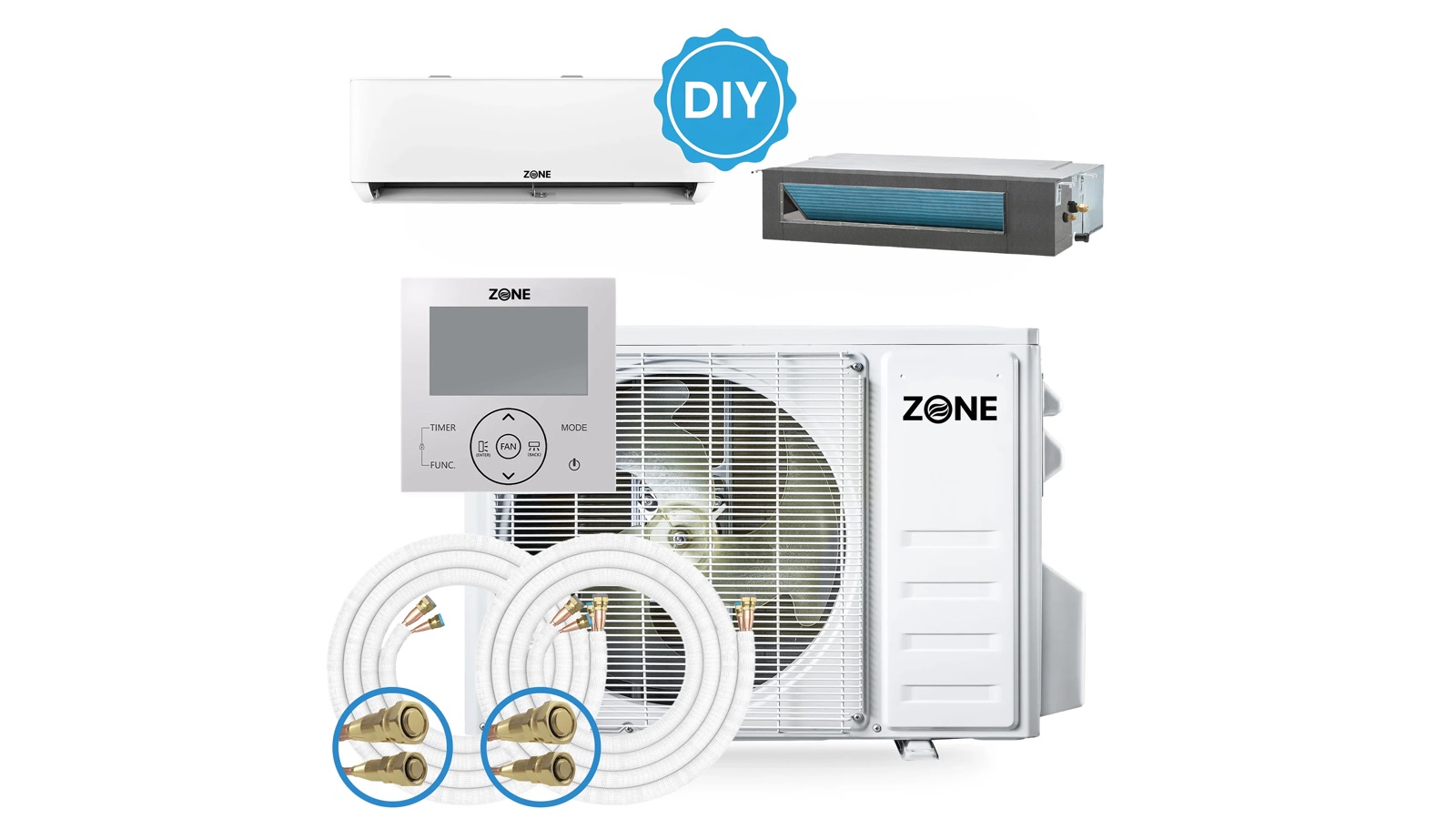
If you want a mini split that sits in your ceiling and sends conditioned air through ducts to different rooms, your brand choices in 2026 are pretty slim. This guide walks through the real differences between MRCOOL and Zone Air for handy homeowners who are shopping for the best DIY multi zone concealed ducted mini split, with honest spec comparisons, what installation actually looks like, and practical advice.
Which Brand Wins for DIY Multi Zone Concealed Ducted Systems?
As of October 2026, Zone Air is the only brand that sells a DIY concealed ducted mini split system. Its Thin-Air line has slim air handlers that sit in the ceiling, along with pre charged quick-connect line sets and installation docs written for homeowners. MRCOOL's DIY multi zone line uses wall-mounted and OuttaSight ceiling cassette heads. The one DIY ducted unit it has is a central air handler, not a concealed one.
Here's what that means when you're deciding what to buy:
- If you want hidden ducted systems, Zone Air Thin-Air is your only DIY option as of October 2026. No other brand currently sells a pre-charged concealed duct air handler designed for homeowner installation.
- If you're fine with visible indoor units, MRCOOL's 5th Gen multi zone range gives you more zones, supporting up to six indoor units on its 48K and 55K condensers, with wall-mounted and ceiling cassette heads. With Zone Air multi zone systems, you can only get up to three.
- Zone Air's 27K outdoor unit reaches 24 SEER2 with wall-mounted heads. For dual zone, Zone Air's concealed ducted systems are rated 19 SEER2, and for 3 zone they are rated 22 SEER2. MRCOOL's multi zone condensers run from 23.9 SEER2 (18K) down to 21.8 (48K), and its Hybrid Air Handler is rated 19.4 SEER2 at 24K and 15.7 at 36K.
- On a 27,000 BTU rated outdoor unit, Zone Air concealed ducted systems cover 2–3 zones with connected indoor capacity up to 33,000 BTU. MRCOOL has condensers from 18,000 to 55,000 BTU that can support up to six zones, but only with visible heads.
- Both are heat pump systems that deliver heating and cooling year round, and both use pre charged line sets, so neither install needs a vacuum pump or gauges. MRCOOL's own wording is that no special tools or training are necessary. Zone Air's sealed line set means no refrigerant handling and no EPA 608 certification during the install.
Because it is the only DIY brand in that category as of October 2026, Zone Air tops the concealed duct category.
DIY Multi Zone Concealed Ducted Mini Splits
A multi zone concealed ducted mini split connects one outdoor condenser to one or more hidden indoor air handlers. These air handlers sit above ceilings, inside attics or within soffits. Instead of blowing warm or cool air straight from a visible wall unit, these handlers push conditioned air through short insulated ducts to supply grilles in each room. Only the grilles are visible.
Mini split systems usually range from 6,000 to 60,000 BTU, and multi-zone concealed ducted setups use hidden air handlers that are sized to match the rooms they serve. The slim ducted air handler differs from a wall-mounted head or ceiling cassette because it is completely out of sight, and it runs quietly with airflow spread through registers rather than blown straight from a unit on the wall.
These systems have the following basic components:
- Outdoor condenser (inverter-driven heat pump)
- Concealed duct air handler(s) that have an evaporator coil and a blower
- Insulated flex or rigid branch ducts, plus supply grilles
- Return grille(s) that are moving room air back
- Pre charged line sets that connect the indoor units to the outdoor units
- Control wiring, a thermostat and a way to manage condensate (a drain line or a built-in pump)
DIY installation in this context means you don't need a vacuum pump, you don't need refrigerant gauges. You don't need special tools. You can do it with basic tools and no special training on the refrigerant side. You still need to follow local electrical codes and use best practices for mounting, duct sealing and drainage.
MRCOOL vs Zone Air in 2026
MRCOOL sells the biggest DIY multi zone range, with condensers from 18K to 55K running up to six indoor units, and its 5th Gen multi zone condensers pair with wall-mounted and OuttaSight ceiling cassette heads. MRCOOL's DIY line does include a ducted unit, the DIY Hybrid Air Handler, but it is a furnace-style cabinet (the 36K version stands 49 inches tall and is 128 lb) meant to drop into a home's existing central ductwork, not a slim unit that sits above a bedroom ceiling. MRCOOL's slim-duct units are in its Olympus line, which MRCOOL says is meant to be professionally installed.
As of October 2026, the only DIY concealed ducted system that is available is Zone Air's Thin-Air line. Its air handlers are 7⅞ inches tall (27-1/2 W × 7-7/8 H × 19-1/4 D) and they tuck into shallow ceiling cavities, with rear or bottom return, adjustable static pressure of 0.1–0.4 in WG, a built-in condensate pump and a fresh-air intake or connection to existing ducts. Zone Air is also the only DIY mini split that lets you mix wall-mount, ceiling cassette and concealed ducted units on one outdoor unit (as of October 2026): one outdoor unit, the right indoor unit for every room. You install it yourself.
Key differences at a glance:
- MRCOOL supports up to 6 indoor units per outdoor unit but does not sell a concealed-duct DIY unit. Its DIY Hybrid Air Handler is quick-connect and homeowner-installable, but it is a central unit for existing ductwork. The slim-duct units that would sit above a ceiling are in the professionally installed Olympus line.
- Zone Air sells its concealed duct systems without a line set. You add one pre charged set per zone in 16, 25, 33, 50 or 75 ft or have it cut to any whole foot from 5 to 75. Right now you can only get up to 3 concealed ducted zones.
- Selling direct through zone-air.com first, then through sellers and Amazon, Zone Air has live technical support from 8 AM to 6 PM MT. For concealed duct DIY buyers, as of October 2026 it is the only game in town.
Key Specs Side by Side
Before choosing a system, compare the numbers that actually affect your daily comfort and operating costs. Both brands offer high efficiency DC inverter compressors, but indoor unit style and duct design change real-world performance. As a general starting point, a 12,000 BTU mini split covers spaces of about 400–550 square feet.
| Spec | Zone Air Thin-Air Concealed | MRCOOL 5th Gen Multi Zone |
|---|---|---|
| Indoor unit style | Slim concealed duct (7⅞ in. tall); wall-mount and 4-way ceiling cassette can share the same outdoor unit | Wall-mounted and OuttaSight single-slot ceiling cassette; DIY Hybrid Air Handler cabinet for central ductwork |
| Cooling capacity range | 9,500–11,000 BTU per handler; 27,000 BTU rated outdoor unit (4,500–31,000 range) with up to 33,000 BTU connected | 18,000–55,000 BTU condensers |
| Max zones | 2–3 | Up to 6 (48K and 55K condensers) |
| SEER2 | 19.6 (single 9.5K), 19 (single 11K and dual zone), 22 (3 zone); 24 with wall heads on the same outdoor unit | 23.9 (18K), 23 (27K, 36K), 21.8 (48K), 22 (55K); Hybrid Air Handler 19.4 / 15.7 |
| Refrigerant | R-454B | R-454B |
| Low-temp heating | Down to −13°F | −13°F on the 18K–48K condensers; −22°F on the 55K |
| Outdoor cooling range | 5–131°F | −13 to 122°F |
| Pre-charged DIY line sets | Yes; 16/25/33/50/75 ft, each a single continuous run, or custom-cut 5–75 ft | Yes; 11.5/16/25/35/50 ft, couplers to join two sets up to 75 ft |
| Outdoor unit breaker | 30A double-pole (2 and 3 zone) | 25A max fuse (27K) |
Zone Air features slim ceiling-concealed air handlers for individual zones, optimizing airflow through short duct runs (15 ft maximum per supply) to minimize duct losses. Efficiency ratings for both systems may vary based on installation quality and configuration, so proper duct sealing and sizing matter.
Both brands use R-454B refrigerant, which has a lower global warming potential than older R-410A. MRCOOL's multi zone condensers are ENERGY STAR listed. For every unit, Zone Air puts out a one-page spec sheet, manual and EnergyGuide label.
Indoor Unit Options: Concealed Duct vs Wall Heads vs Ceiling Cassette
The indoor unit you choose drives the look, sound and performance of your entire system.
Zone Air concealed duct air handlers sit completely in ceilings or attics. Only supply grilles and return grilles are visible in the room, which is what you want if you won't give up wall space to a visible unit. They work especially well in new builds, high-end remodels and rooms with large windows or design-sensitive layouts where a wall mounted unit would stand out.
MRCOOL wall-mounted and ceiling cassette units are visible in the room but easier to mount and service. Wall mounted units hang on brackets against a wall, and MRCOOL's OuttaSight cassette is a 57-inch single-slot unit that fits between 16-inch ceiling joists and sends air one way, so it works like a ceiling-mounted wall unit and is best along one wall. Sending air in four directions from a 22-1/2 inch square chassis, Zone Air's ceiling cassette sits in the middle of a room and covers it evenly, and it can share an outdoor unit with Thin-Air concealed handlers. Visible heads are practical for garages, workshops, bonus rooms or quick single room upgrades where looks matter less.
As of October 2026, Zone Air is alone in offering DIY concealed duct systems. Other brands' ducted systems in 2026, including Cooper & Hunter, whose warranty applies only to products installed by a licensed HVAC technician, generally use flare line sets that need a vacuum pump and void the warranty if self-installed.
How Multi Zone Concealed Ducted Systems Work in Real Homes
Picture a 3-bedroom home with accessible attic space above the bedrooms. You install two Zone Air Thin-Air concealed air handlers above the ceiling: one serving the primary suite, and one feeding the two smaller bedrooms through short insulated duct branches to a supply register in each. A return grille pulls air back to each handler. One outdoor unit sits on a pad outside. Each handler is its own zone with its own thermostat, so the primary suite stays at 68°F while the smaller bedrooms run at 72°F, or shut off completely. Rooms that share a handler share a setpoint, so group rooms with similar schedules.
Zoning logic is simple: a single condenser runs multiple indoor units, and each indoor unit serves one or two rooms through its duct branches. Separate controllers allow independent temperature settings per zone, giving you precise climate control without conditioning empty rooms. A Zone Air 27K multi zone outdoor unit can also be bought with fewer heads and have a second or third added later on a spare port with a pre charged line set.
For drainage, Zone Air's Thin-Air handlers include built-in condensate pumps, which is critical when the air handler sits above a finished ceiling where gravity drain is impractical. The inverter-driven heat pump changes capacity to match demand rather than cycling on and off, maintaining steady temperatures in heating mode and efficient cooling throughout the day.
Installation mistakes can lead to noise and poor airflow, so keeping duct runs short (15 feet or less per supply branch) and properly sealed is necessary. An oversized unit short cycles, wasting energy and reducing dehumidification, so correct sizing matters more than buying the biggest unit available.
Zone Air vs MRCOOL on DIY Installation
Both brands market DIY systems, but the installation path changes a lot when you move from visible heads to concealed ducted systems.
Zone Air concealed duct DIY installation involves:
- Mounting the slim air handler in an attic or ceiling cavity (the handler is 7⅞ inches tall. You will need to leave room above and around it for the duct connections and service access)
- Framing or securing the handler so it has proper support
- Running short insulated supply ducts to each room and installing supply grilles
- Installing return grille(s) for airflow recirculation
- Connecting factory-sealed pre charged line sets between the indoor units and the outdoor units
- Wiring control cables and thermostats
- Connecting the drain line to the built-in condensate pump
- Startup testing: checking the sealed refrigerant circuit, balanced airflow and zone controller function
Zone Air's FAQ puts a concealed duct install at 6–8 hours, against 4–6 hours for a first single zone wall mount.
MRCOOL DIY wall/cassette installation is simpler in scope:
- Mounting brackets on a wall or framing a ceiling cassette opening
- Drilling a wall penetration for the line set
- Hanging the indoor unit and connecting quick-connect pre charged line sets
- Wiring the controller and connecting communication cables
- Powering up and testing
MRCOOL's DIY systems need no special tools or training to install, and its retail multi zone kits usually bundle a pre charged line set per head. However, MRCOOL does not sell a concealed-duct DIY unit.
DIY installations of concealed ducted systems need careful planning and execution. Both systems must adhere to local electrical codes and need a dedicated 230V circuit at the outdoor unit: Zone Air's 2 and 3 zone systems call for a 30A double-pole breaker, and MRCOOL's 27K multi zone condenser lists a 25A max fuse. Electrical connections must comply with local building codes. Even with a DIY-friendly refrigerant circuit, hiring a licensed electrician for panel upgrades and disconnect boxes is a smart move.
Planning a Multi Zone DIY Project
Good planning is more important for concealed duct projects than for a single zone wall-head installation. Mistakes in duct layout are harder to fix once drywall is closed up.
Start with cooling capacity calculations. The common rule of thumb is about 20 BTU per square foot in moderate climates, but treat that as a starting point only. Adjust upward for rooms with large windows, high ceiling height, poor insulation or heavy sun exposure. Adjust downward for well-insulated, shaded spaces. Zone Air's free sizing calculator walks through those adjustments.
Group rooms into zones in a way that makes sense. Two adjacent bedrooms can share one concealed ducted air handler with separate supply branches. Keep duct runs short, 15 feet or less per supply branch on the Thin-Air units, to maintain airflow and avoid static pressure problems that eat into energy efficiency.
Return grille placement matters. Position return grilles in the middle of the space (hallways work well) and size them to match or slightly exceed total supply airflow. Undersized returns create pressure imbalance, noise and comfort issues.
If you are a first-time DIY mini split installer figuring out duct design for the first time, Zone Air's pre-sale support can help map duct paths and choose the correct system size, which is valuable.
Tools and Materials in the Box
Pre charged DIY systems drastically reduce the need for specialized tools. You will not need refrigerant gauges, a vacuum pump or recovery equipment.
A Zone Air concealed duct DIY system includes:
- Outdoor heat pump (condenser)
- Concealed duct air handler(s) that have a built-in condensate pump
- Communication cable (included with every unit) and a wired or wireless controller
- Mounting hardware for the indoor and outdoor units
- Installation manual, install guides and video library are written for you
Pre charged line sets are sold separately, one per zone. Standard lengths are 16, 25, 33, 50 and 75 ft, each one continuous factory-sealed run with no field joint, or Zone Air will cut one to any whole foot from 5 to 75 for a $50 fee over the next standard length. Of the brands compared here, Zone Air is the only one that cuts the pre charged set to the exact length you measure. MRCOOL sends out 11.5, 16, 25, 35 and 50 ft sets, connects two with a coupler beyond 50 ft, and has you coil the excess behind the condenser.
Both brands offer app control with Alexa and Google Home voice: Zone Air's app adds geofencing and a 7-day schedule on the IR remote that works without Wi-Fi, and MRCOOL's app works through a Wi-Fi adapter on 5th Gen units.
Homeowner-supplied tools:
- Drill/driver, hole saw, level, stud finder
- Saws for duct openings, sheet metal tools
- Insulation tape, mastic sealant and duct supports
- Safety gear (gloves, eye protection, dust mask)
- No gauges or vacuum pump needed
MRCOOL DIY kits for wall and cassette units include similar line sets and hardware but do not include ductwork components, since their system focuses on visible indoor units.
Always check local code requirements for electrical disconnects, conduit runs and support brackets regardless of which brand you choose.
Operating Costs, Energy Efficiency and Environmental Standards
Multi zone mini splits often beat traditional central HVAC on energy efficiency because they target only the zones in use. You are not paying to push conditioned air through 60 feet of leaky ductwork to rooms nobody is in.
Higher SEER2 translates directly into lower utility bills over the life of the system, but only if the system is properly sized and installed. On the Zone Air side, the trade is honest: the Thin-Air concealed handlers are rated 19–22 SEER2, while the same 27K outdoor unit with wall heads reaches 24 SEER2, the highest of the pre charged quick-connect DIY systems compared here (MRCOOL's best multi zone condenser is 23.9). Hidden ductwork costs a few SEER2 points on either brand's ducted option.
Zone Air uses R-454B refrigerant, a lower-GWP alternative to R-410A, which lines up with tightening environmental standards. MRCOOL's 5th Gen systems also use R-454B.
Inverter-driven heat pumps change capacity to match the actual load. Instead of hard on/off cycling that uses more energy and creates temperature swings, the compressor ramps up or down smoothly, delivering efficient cooling in summer and reliable performance in heating mode during winter. Both brands' multi zone systems are rated to heat at −13°F (MRCOOL's 55K condenser goes to −22°F). Zone Air is rated to cool in outdoor temperatures up to 131°F, where MRCOOL lists 122°F.
Compare estimated annual energy costs based on your climate zone and local electricity rates rather than just buy price. A system with a higher regular price but a lot better SEER2 will often cost less over its 15–20 year lifespan.
Maintenance, Reliability and Warranty for DIY Systems
Regular maintenance is necessary to maintain warranty coverage and keep any mini split running at peak efficiency, especially when you performed the original DIY installation.
Simple homeowner tasks include:
- Cleaning or replacing air filters every 1–3 months
- Vacuuming return grilles to prevent dust buildup
- Inspecting the drain line and condensate pump for clogs
- Rinsing the outdoor condenser coil each season
- Checking duct joints for separation or air leaks (concealed systems)
Warranty comparison:
Zone Air's warranty covers self-installed concealed systems. Zone Air offers 5-year parts and 7-year compressor coverage with no registration deadline, and installing it yourself does not void it, as long as you follow the installation instructions. For buyers who want concealed ducted systems without paying for professional labor, that is the only DIY-installed concealed system with manufacturer coverage as of October 2026.
MRCOOL's DIY 5th Gen carries the same headline term, 5-year parts and 7-year compressor with no registration needed, so there is no warranty gap between the two on visible heads. MRCOOL's DIY Select line is shorter at 1 year parts and 2 years compressor, and the Olympus slim-duct units are meant to be professionally installed, so verify coverage for the specific model you are considering.
Returns differ. Zone Air takes returns within 30 days of delivery on uninstalled units, with an RMA, a 25% restocking fee and return freight paid by the customer. Once a system is connected or charged it is covered by the warranty instead. MRCOOL doesn't publish a manufacturer return policy, so returns depend on the seller. Zone Air ships free to the 48 contiguous states, 1–2 business days to process and 2–5 in transit.
When to call a professional: If you encounter refrigerant leaks, compressor error codes or complex electrical faults, bring in a licensed HVAC technician. Pre-charged sealed circuits reduce the chance of leaks, but they can still happen over time.
What Sets Zone Air Apart
The concealed duct category is Zone Air's alone as of October 2026, but a few other points matter for a multi zone buyer:
- One outdoor unit runs any mix of concealed ducted, 4-way ceiling cassette and wall-mount heads, 2 or 3 of them, through the bundle builder. MRCOOL DIY multi zone mixes wall and cassette heads but has no concealed option.
- Pre charged line sets come in 16, 25, 33, 50 and 75 ft as single continuous runs, or custom-cut to any whole foot from 5 to 75. Of the brands compared here, only Zone Air does that.
- 24 SEER2 with wall heads on 230V, against MRCOOL's 23.9 on the 18K and 23 on the 27K. The concealed handlers themselves are 19–22 SEER2.
- Rated to −13°F, the same floor as MRCOOL's standard DIY 5th Gen and 18° lower than MRCOOL's Easy Pro (5°F). Higher-tier MRCOOL DIY models are rated lower. Cooling is rated to 131°F versus MRCOOL's 122°F.
- Final assembly, testing and inspection in the USA from components sourced globally.
- Current pricing as of October 2026: the dual zone Thin-Air system is $4,039.99 and the 3 zone system is $4,809.99, plus a line set per zone from $229.99 for 16 ft.
The tradeoffs are real: multi zone systems ship without a line set, returns carry a 25% restocking fee, the concealed handlers give up a few SEER2 points to the wall heads, and MRCOOL offers more zones and a wider dealer footprint for visible-head installs.
Is a DIY Concealed Duct Multi Zone Mini Split Right for You?
Before committing, look at your skills, your space and your goals honestly. Concealed duct installations demand more planning and carpentry than hanging a wall head.
If you are a handy homeowner who is comfortable with framing, cutting ceiling openings, running short duct runs, coordinating electrical work and following detailed instructions, you are the ideal Zone Air DIY customer. If you have built a deck or finished a basement, you likely have the skill set.
MRCOOL's visible DIY units might be better if:
- You need a quick upgrade for a single room or larger rooms like a garage or workshop
- Your home does not have attic or ceiling access for concealed handlers
- You want the simplest possible installation with little carpentry
- You need four or more zones on one outdoor unit
Benefits specific to concealed duct systems:
- Premium aesthetics, with no indoor unit visible on any wall
- Quiet operation with sound softened through ductwork
- Ability to feed multiple small rooms from one air handler
- Better resale appeal in design-conscious markets
Verify current specs, available systems and warranty coverage for both brands as of October 2026 before making a final buy decision. Product lines update often.
How to Order Your DIY Multi Zone System
You have done the research. Now move from reading to planning your actual installation.
Step-by-step decision points:
- Confirm your zones and room list. Walk through your home and identify every room that needs heating and cooling.
- Calculate approximate BTU needs per zone using square footage, insulation quality and sun exposure.
- Choose indoor unit style, concealed duct (Zone Air) or visible wall/cassette (MRCOOL or Zone Air), based on your space and priorities.
- Pick outdoor capacity to match or slightly exceed the combined indoor load.
- Gather photos and sketches of your attic or ceiling cavity, noting joist spacing, clearances and planned supply register locations.
- Before you order, Zone Air's team can help map duct paths and confirm model choice. MRCOOL provides compatibility charts and buying guides for their multi zone systems.
Create a simple project timeline covering delivery lead times, rough-in carpentry, electrical work by a licensed electrician, DIY installation of the system, and startup testing. Concealed duct installs usually take longer than wall-head projects, so plan accordingly.
Whether you go with Zone Air's concealed ducted systems or MRCOOL's visible-head approach, the right system is the one that matches your home layout, your skill level and your long-term comfort goals. Start measuring, start planning and get the system installed before the next season hits.
Related Guides
- Best multi zone DIY pre-charged mini split systems - the wider 2 to 6 zone picks
- Concealed duct multi zone mini split easy installation - duct planning, placement and the DIY install walkthrough
- DIY multi zone ceiling cassette systems - the other hidden-look option
- Best 2 zone DIY mini split systems and best 3 zone DIY mini split - zone-by-zone picks
- Best mini split with no vacuum pump required - how pre-charged quick connect line sets work
Get a quote on a concealed ducted multi zone mini split
Specifications, prices and warranty terms are manufacturer-published as of October 2026 and subject to change. Verify current listings before purchase. MRCOOL, DIY 5th Gen, DIY Select, DIY Hybrid, OuttaSight, Olympus, Easy Pro, Cooper & Hunter and ENERGY STAR are trademarks of their respective owners. HVAC On Sale is not affiliated with or endorsed by them.