
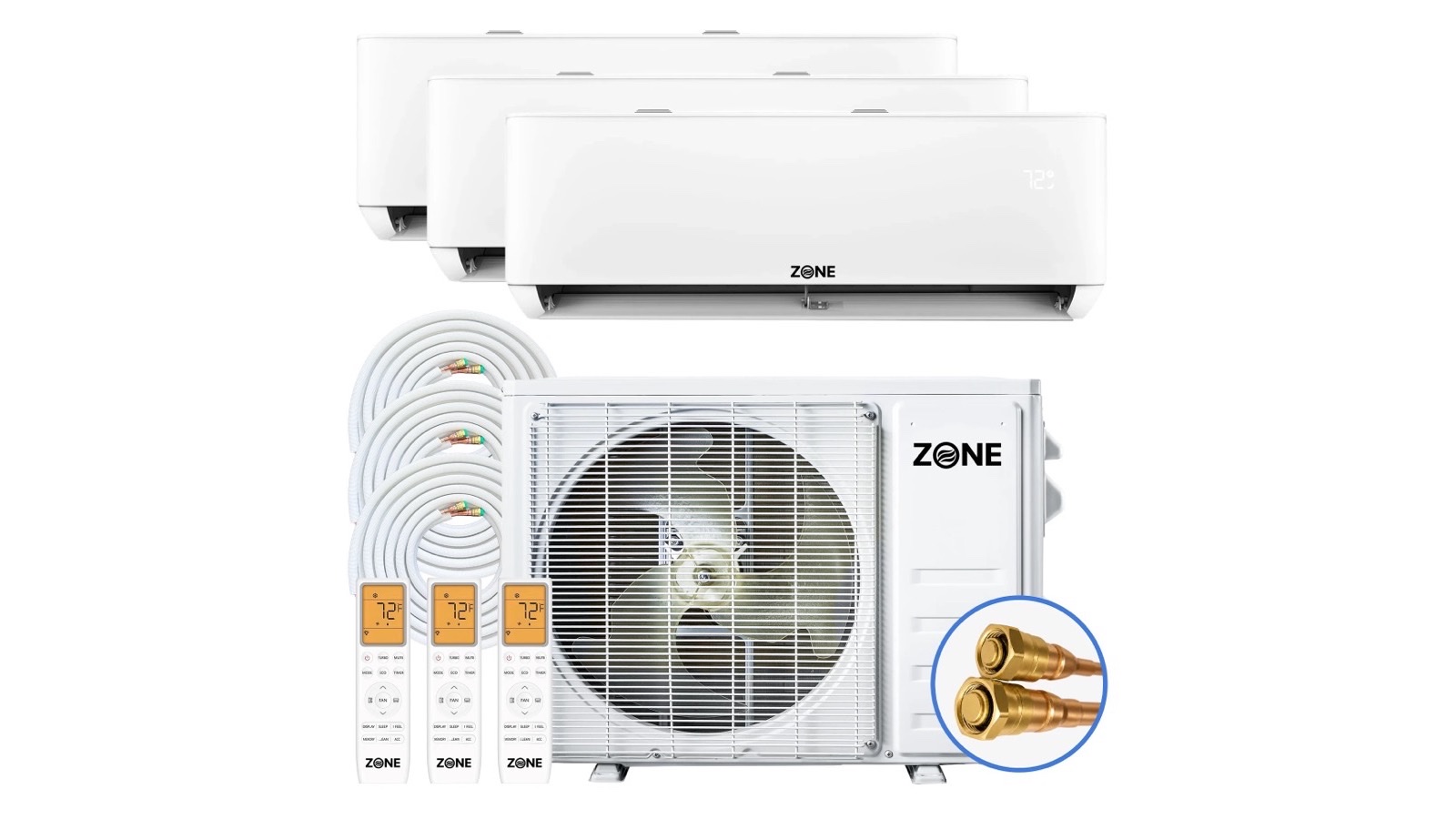
The best 3-zone diy mini split in 2026 really comes down to one thing: do you want a system you can install yourself, or are you okay paying a contractor to handle the refrigerant work? This guide looks at Zone Air, Pioneer, Senville and Klimaire on specs, cold climate performance, warranty and total installed cost so you can figure out what works for you.
Quick Answer: Best 3-Zone DIY Mini Split in 2026
In 2026, Zone Air is the top 3-zone DIY mini split. It comes with pre-charged line sets and quick connect fittings, so you don't need a vacuum pump, manifold gauges or EPA 608 certification. Klimaire's DIY series also uses pre-charged quick connect line sets, so it's the nearest alternative. Pioneer and Senville make good multi zone systems, but they need a licensed pro for evacuation, pressure testing and releasing the refrigerant.
True DIY systems in 2026 are defined by sealed, factory-charged refrigerant lines that you connect with basic tools. No special tools or professional refrigerant handling are needed. For most homeowners, we'd recommend Zone Air's 3-zone DIY line because you can get custom line set lengths, it heats well down to −13°F, and the warranty stays valid when you install it yourself.
Pioneer and Senville build solid equipment, but their 3-zone mini split systems are only DIY friendly for mounting, wiring and running lines. The actual refrigerant work still has to be done by a certified technician.
One more thing to keep in mind: federal Section 25C heat pump credits ended after 12/31/2025. In 2026, it mostly comes down to saving money on labor with a true DIY install versus paying more up front for a pro install that might get you state or utility rebates.
What Makes a 3-Zone Mini Split a "True DIY System" in 2026?
A DIY mini split for multi zone setups isn't automatically a "true DIY" system. Here's what separates the two categories.
True DIY 3-zone systems (Zone Air, Klimaire DIY, MRCOOL DIY 5th Gen):
- These ship with sealed, pre charged line sets and a factory-charged outdoor condenser
- They use quick-connect or hand-tight fittings. No vacuum pump, micron gauge or refrigerant charging is needed.
- Installation does not need a licensed HVAC technician
- True DIY systems use pre-charged quick-connect line sets designed so the homeowner never opens the refrigerant circuit
DIY-friendly conventional systems (Pioneer, Senville and Klimaire's non-DIY series):
- These use flare line sets that need evacuation and pressure testing
- Refrigerant is held in the outdoor unit and must be released after vacuum
- For warranty, a certified tech handles refrigerant lines
All mini splits are heat pumps, so they provide both cooling and heating from one system. A multi zone outdoor unit sends refrigerant to two to six indoor heads through separate line sets. Common 2026 DIY multi zone bundles run from 27,000 to 36,000 BTU for 3-zone kits, with 9,000–18,000 BTU per indoor unit on most of them. A 3-zone mini split system can heat and cool three separate rooms with independent temperature control.
3-Zone DIY Mini Split Cost in 2026 vs a Pro Install
Total cost includes equipment, labor, electrical work, permits and accessories. Here's how the numbers break down in 2026.
| Project Type | Equipment Cost | Typical Total Installed Cost |
|---|---|---|
| Single zone system (9–12K BTU, true DIY) | $1,800–$2,400 | $2,000–$3,000 |
| 3-zone DIY (Zone Air wall mount, bundle plus three 16 ft line sets) | $4,200–$4,750 | $4,500–$6,000 |
| 3-zone pro install (Pioneer/Senville) | $3,100–$4,500 | $8,000–$13,000 |
Equipment-only prices for Pioneer and Senville 3-zone kits often look lower in current listings, but the added cost of hiring a contractor, vacuum pump rental, refrigerant and technician time can wipe out that advantage. Using a true DIY system like Zone Air can save about $2,000–$4,000 versus a professional install on the same size multi zone setup.
Before committing, ask for itemized quotes covering equipment, HVAC labor, electrical and permits-especially for projects with longer line sets and multiple branch runs.
A single zone DIY mini split works for a single room, but if you need to condition three spaces, a 3-zone outdoor unit is far more efficient than cluttering your wall with three separate condensers.
SEER2, HSPF2 and Cold Climate Heating in DIY 3-Zone Mini Splits
On a 3-zone system handling most or all of your home's load, efficiency and cold weather heating capacity matter more than they would on a supplemental unit.
SEER2 ratings tell you how efficient the system is during cooling season. In 2026, multi zone DIY mini splits generally fall between 19 and 24 SEER2. Zone Air mini splits hit 24 SEER2 on every 3-zone wall-mount bundle. For comparison, the MRCOOL DIY 5th Gen is rated 23.0 SEER2 on the 27K condenser that runs three heads (23.9 on its smaller 18K two- or three-head condenser), and Klimaire's DIY kits run 22–24 SEER2 depending on how you set them up.
HSPF2 measures heating efficiency. An HSPF2 in the 9–10.5 range is pretty strong for multi zone systems heating several spaces at once. Zone Air's 3-zone wall-mount bundles are rated 10.5 HSPF2 (Region IV).
Cold-climate operation is a key feature for high-efficiency systems. Low-ambient heating performance varies by brand:
- With Zone Air, you get heating down to −13°F across all 3-zone wall-mount bundles
- Senville SENA-36HF/T: rated to −22°F (needs pro install for warranty)
- Klimaire DIY (KMIP/KIWP): −13°F
- MRCOOL DIY 5th Gen multi-zone: −13°F on the 18K–48K condensers, −22°F on the 55K (MRCOOL's budget Easy Pro line stops at 5°F, but it is single-zone only)
HVAC technologies are increasingly moving to environmentally friendly refrigerants. R-454B refrigerant is changing over under modern environmental standards, and Zone Air, Klimaire DIY and MRCOOL DIY 5th Gen all ship with R-454B pre-charged systems.
Look at the official extended temperature performance tables for any 3-zone mini split. Pay attention to actual heating capacity at 5°F and −13°F rather than just the "minimum operating temperature" marketing line.
Zone Air DIY 3-Zone Mini Split: Best True DIY Pick
Zone Air is our primary recommendation for homeowners who want a true DIY 3-zone mini split in 2026 without hiring an HVAC technician for refrigerant work.
The Zone Air DIY 3-zone lineup runs every bundle on one 27K-rated multi-zone outdoor unit paired with three indoor heads. Bundles are named 27,000–36,000 BTU by the head total (9K+9K+9K up to 12K+12K+12K or 9K+9K+18K), covering about 1,350–1,800 sq ft depending on climate and insulation. The 36,000 BTU bundle (3×12K heads) runs on a 208–230V dedicated circuit with a 30A double-pole breaker.
Key specs:
- SEER2 24, HSPF2 10.5 (Region IV)
- Cold climate heating to −13°F
- Indoor noise can be as low as 30 dB
- R-454B refrigerant, factory sealed
Zone Air offers pre-charged connections for easy installation. Each zone gets its own sealed pre charged line set with connection points designed for homeowners using basic hand tools. Line sets are sold per zone in 16, 25, 33, 50 and 75 ft standard lengths, with custom cuts from 5 ft up, so you don't get ugly coils of excess tubing like you do with fixed-length kits from other brands.
Zone Air offers a warranty that covers homeowner installations: 5-year parts and 7-year compressor coverage, and it stays valid when you follow the manual and local codes - no professional install required. Smart features include built-in wifi control, a 24-hour programmable timer, a sleep mode and an independent dehumidification mode. The 5th Gen from MRCOOL also includes built-in WiFi for smart home integration, and Zone Air pairs that convenience with a slightly higher efficiency rating on the three-head condenser (24 vs 23.0 SEER2) and the same −13°F heating floor.
Which Pioneer, Senville and Klimaire 3-Zone Mini Splits Skip the Vacuum Pump
Pioneer and Senville offer popular 3-zone mini splits, but these conventional systems need evacuation and pressure testing before startup. That refrigerant work must be done by a certified technician for warranty-safe installs. Klimaire is the exception, with a DIY series alongside its conventional line.
Pioneer multi zone systems deliver competitive SEER2 ratings (22.5–24 on the Quantum Ultra tri-zone) and aggressive equipment pricing. Factory pre-charged for up to 75 ft of combined line, the condenser ships with bare copper flares for line sets, and Pioneer's own self-install guide says the lines have to be vacuumed before the refrigerant is released. You can mount and route the line sets, then schedule a technician for vacuum and charging. MRCOOL's Easy Pro is a pre-charged quick connect line as well, but it is single-zone only, so it does not apply to a 3-zone project.
Senville focuses on budget-friendly multi zone kits. Designed for cold-climate heating, the Senville Aura is recommended for cold-climate heating applications where temperatures drop to −22°F. Equipment price on a Senville 36K tri-zone (SENA-36HF/T, 23 SEER2) runs around $3,100–$3,400, but Senville says professional installation is needed for refrigerant handling, commissioning and the warranty.
Klimaire has robust multi zone offerings. Its KMIP/KIWP DIY series does offer E-Z Kuick Connect pre-charged R-454B line sets, rated 22–24 SEER2 and −13°F with a 5-year parts, 7-year compressor warranty, making it the nearest competitor to Zone Air on true DIY convenience. The line sets come in fixed 16 and 25 ft lengths. Retailers list the DIY series in 2-, 4- and 5-zone kits, so check that a three-head kit is in stock before you plan around it. Klimaire's DIY kits are its regular-heat line, so for its hyper-heat models check whether the kit is quick connect before buying.
You can do a "hybrid DIY install" with Pioneer and Senville where you drill, mount and run line sets, then schedule a contractor for a final day of vacuum, pressure test and system startup.
When a 3-Zone DIY Mini Split Makes Sense
A single zone system is the simplest for a DIY install. You have one indoor unit, one outdoor unit and one line set. But conditioning three rooms with three separate single-zone systems means three outdoor condensers and three electrical circuits. All the power and supply goes into one outdoor condenser feeding three heads with a 3-zone multi zone system.
Three zones hit the sweet spot for most homes: living room, primary bedroom and a home office or finished basement. Zone Air's DIY line tops out at three zones, which keeps the complexity manageable. The MRCOOL 5th Generation supports single-zone and multi-zone setups. Supporting single-zone and multi-zone configurations up to six zones, the 5th Gen works for larger setups, but larger 4–6 zone condensers increase routing complexity for first-time DIYers.
MRCOOL and Klimaire both sell multi zone DIY kits beyond three heads, but in our view multi zone configurations beyond three heads are where you might drift back toward professional install brands like Pioneer or Senville where a contractor is already involved. Plan room-by-room BTU loads rather than just picking a 3-zone system on price.
How to Size Your 3-Zone DIY Mini Split by BTU and Climate
Correct BTU sizing is critical on a 3-zone system because each indoor unit has to match room size and climate for both cooling and cold climate heating. 3-zone configurations can be set up for specific room sizes and heating priorities. Most multi-zone systems offer configurations using combinations of BTU capacities.
General BTU guidelines:
| Room Type | Square Footage | Recommended Head Size |
|---|---|---|
| Bedroom / Office | 250–450 sq ft | 9,000 BTU |
| Living Area / Open Plan | 400–900 sq ft | 12,000–18,000 BTU |
| 3-Zone Total | Small–Mid Home | 27,000–36,000 BTU bundle |
For cold climate heating with design temperatures in the 0°F to −10°F range, increase head size by about 15–20% for rooms with poor insulation, vaulted ceilings or a lot of west-facing glass. Decrease slightly for tight, well-insulated spaces.
For serious whole-home heating, use a Manual J load calculation via software or an HVAC consultant to avoid oversizing a system that will short-cycle in mild weather.
How to Install a 3-Zone DIY Mini Split
Installation processes vary a lot between DIY and professional systems. With a 3-zone DIY mini split, you follow the same basic steps as a single-zone wall-mount install, but you do it three times for indoor heads with more complex routing.
Main steps:
- Plan layout and check permits
- Mount indoor units on interior walls
- Drill wall sleeves for each zone's line set
- Run and protect line sets from each indoor unit to the outdoor condenser
- Mount and level the outdoor unit on a pad or bracket
- Complete electrical work and control wiring (dedicated circuit, disconnect box)
- Connect pre charged line sets (true DIY) or call tech for vacuum/charge (conventional)
- Power on and test each zone
Basic tools needed include a drill, level and wrench. With a true DIY system like Zone Air, there is no vacuum pump, nitrogen pressure test or refrigerant charging step. MRCOOL says its DIY line can be installed without an HVAC license too. A single-zone install usually takes an afternoon, and a 3-zone install takes longer.
With Pioneer and Senville, you need flaring tools, torque wrenches, vacuum pumps and micron gauges. You can handle the physical mounting, then schedule a technician for the final connect and startup.
Check local rules on electrical permits and whether DIY electrical work is allowed for running new 230V circuits. Even true DIY systems need safe, code-compliant power.
An experienced DIYer can complete a simple wall-mount 3-zone Zone Air install over a weekend. Multi-story runs or attic routing can take several days.
Line Sets and 230V Wiring for a 3-Zone DIY Mini Split
Line set planning is more complicated on a multi zone setup. This is where true DIY designs with custom line sets offer a clear advantage. Zone Air lets you order each zone's pre charged line in the length you need (16, 25, 33, 50 or 75 ft standard, or a custom cut from 5 to 75 ft per run), so you don't waste refrigerant or have excess coils.
Fixed-length kits from other brands force you to coil unused tubing behind the outdoor unit. Worse, if a run exceeds the pre-charged supply of refrigerant, you'll need a tech to add charge. That's an extra expense you might not anticipate.
Electrical basics:
- 115V options generally top out at smaller single zone systems
- Most 3-zone condensers in 2026 run on 230V and need a dedicated circuit with a double-pole breaker (30A on Zone Air's 3-zone bundles), outdoor disconnect, and proper wire gauge
- Hire an electrician when adding new 230V circuits or upgrading breaker panels
Before buying, draw a simple floor-plan layout that shows indoor unit locations, line set paths, outdoor condenser placement and approximate line lengths. Make sure your 3-zone kit and line sets actually fit your home's electricity and routing limits.
3-Zone Mini Split Warranties and 2026 Incentives
Warranty conditions often need professional installation for full coverage, but not with every brand. Here's how the major players stack up in 2026.
| Brand | Compressor Warranty | Parts Warranty | DIY Install Valid? |
|---|---|---|---|
| Zone Air | 7 years | 5 years | Yes |
| MRCOOL DIY 5th Gen | 7 years | 5 years | Yes, no registration required (the cheaper DIY Select line is 2 years compressor / 1 year parts) |
| Pioneer | 5 years (registered) | 5 years registered, 1 year if unregistered | Warranty covers properly installed units; evacuation is part of a proper install |
| Senville | 10 years | 5 years | No-Senville's warranty voids coverage for DIY installations |
| Klimaire DIY | 7 years | 5 years | Yes (DIY SKUs only) |
| Cooper & Hunter | Varies | Varies | Cooper & Hunter requires a licensed installer for warranty coverage |
Pioneer's warranty drops to 1 year if you don't register within a week of install. Don't overlook that step. A reliable mini split is only as good as the warranty standing behind it.
Federal Section 25C heat pump credits ended for equipment installed after 12/31/2025. In 2026, most incentives come from state and utility programs that often demand licensed contractor installs and AHRI-matched, Energy Star-rated systems. Weigh any lost incentive dollars against the thousands you save on HVAC labor with a DIY install. Register your equipment quickly on the manufacturer's website to lock in the longest possible warranty coverage.
Our Pick for the Best 3-Zone DIY Mini Split in 2026
In 2026, Zone Air is the clear top pick for a 3-zone DIY mini split. It comes with pre-charged quick-connect line sets, 24 SEER2, cold climate heating to −13°F, custom line lengths and a homeowner-valid warranty. That makes it the most complete true DIY option out there.
If you live in a moderate to cold climate and want full DIY control without hiring an HVAC technician for vacuuming and charging, Zone Air is the system to buy. It replaces window units, gets rid of bulky space heaters, and delivers efficient year-round comfort across three independent zones.
Klimaire's DIY series is the alternative if you want fixed-length kits with the line sets included. Pioneer and Senville stay strong choices when you already plan to work with a licensed pro and have access to attractive state or utility rebates tied to professional installations.
Before ordering any 3-zone kit:
- Size correctly using room-by-room BTU planning or Manual J
- Verify cold climate heating specs for your ZIP code
- Confirm warranty terms for DIY installs
- Plan your line set paths and check your measurements twice
Choosing the right 3-zone system in 2026 can cut electricity bills, reduce need for inefficient window units and space heaters, and give you room-by-room control over your home's comfort. That's a DIY project worth the weekend.
Related guides
- Best 2 zone DIY mini split systems
- Best multi zone mini split quick connect line sets
- DIY multi zone mini split specs and sizing
- Best mini split with no vacuum pump required
Get a quote on a 3-zone mini split
Specifications, prices and warranty terms are manufacturer-published or publicly listed as of October 2026 and subject to change. Verify current listings before purchase. MRCOOL, DIY 5th Gen, DIY Select, Easy Pro, Pioneer, Quantum Ultra, Senville, Aura, Klimaire and E-Z Kuick Connect are trademarks of their respective owners, as is Zone Air. HVAC On Sale is not affiliated with or endorsed by them.