
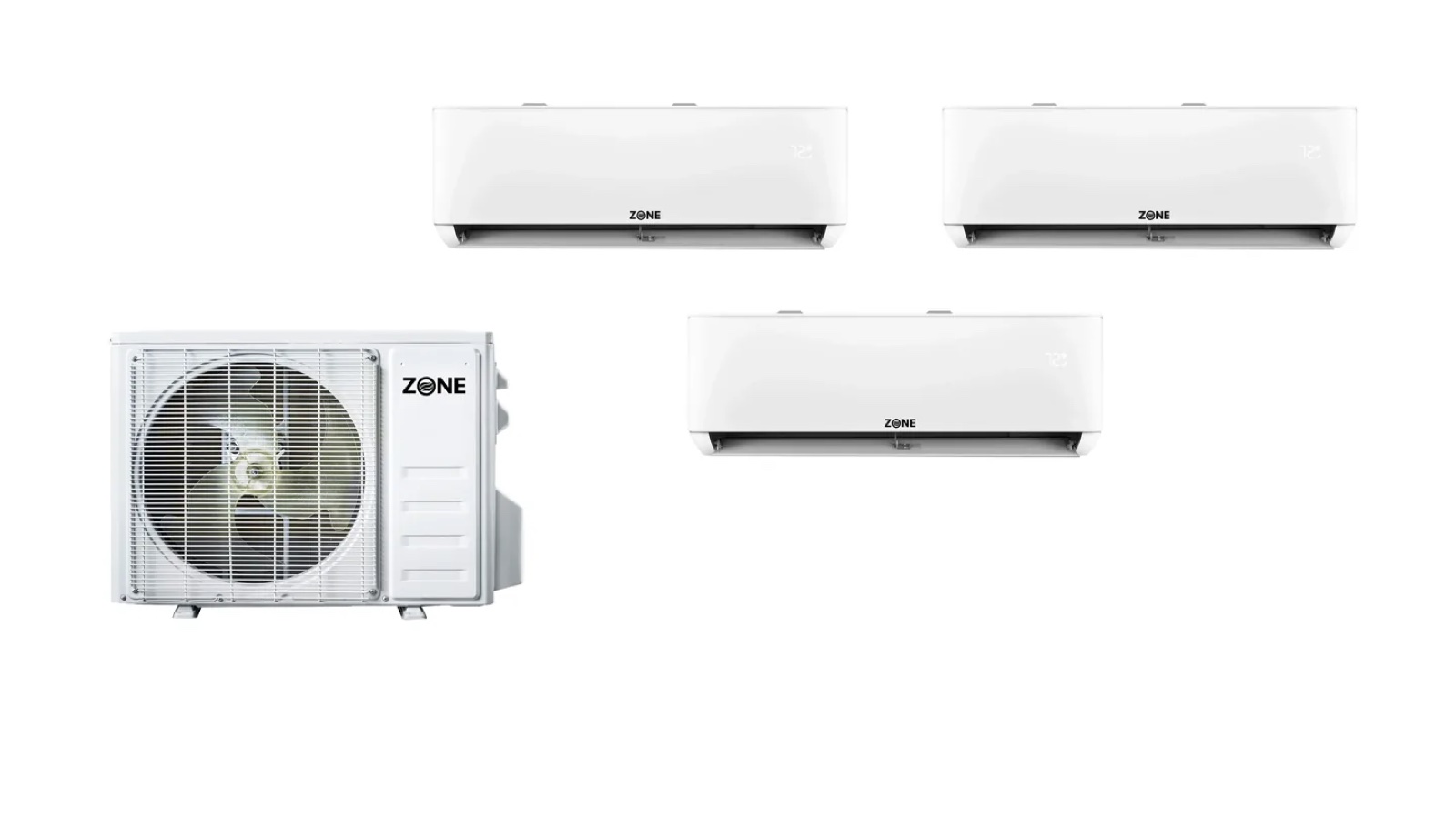
In 2026, the best multi zone mini splits fall into two groups, and whether you need a contractor to put it in or you're doing it yourself is what tells you which group you need. With a multi zone system, you have two or more indoor units that all run off one outdoor unit, so each room gets its own thermostat and you don't have to hang a condenser on every wall. When you're looking at a professional install for your whole home, the names you'll hear most are Mitsubishi's hyper-heating MXZ line and Daikin's Aurora multi-zone. If you're doing it yourself, the field gets smaller to pre-charged quick-connect systems, and the two we compare here are Zone Air and MRCOOL DIY.
Best Multi Zone Mini Splits in 2026
- Best pro-install multi zone for cold climates: Mitsubishi MXZ hyper-heating. There can be up to eight indoor units on one outdoor unit and 100% rated heating capacity at 5°F. A licensed contractor does the flare install.
- Best pro-install alternative: Daikin Aurora MXT. Two to five zones, up to 21 SEER2 and operation down to −13°F, R-32 refrigerant. Also a contractor install.
- Best DIY multi zone: Zone Air. One 27K outdoor unit runs two or three indoor units. It's the only DIY mini split that lets you mix wall-mount, ceiling cassette and concealed ducted units on one outdoor unit (as of October 2026). 24 SEER2 with wall heads, −13°F heat, pre-charged line sets with no vacuum pump.
- Best DIY for four to six zones: MRCOOL DIY 5th Gen. Condensers from 18K to 55K run up to six indoor units on pre-charged quick-connect line sets.
If you already know you're doing the install yourself, our best DIY multi zone mini split guide goes deeper on that side. This page covers the whole field.
How a Multi Zone Mini Split Works
A multi zone mini split is a system where one outdoor unit connects to several indoor units through separate refrigerant circuits, with one circuit per room. With a larger inverter compressor and multiple line set ports, the outdoor unit sends refrigerant to whichever rooms are calling for it (on some pro systems, it uses a branch box instead). Each indoor unit has its own remote or thermostat, so rooms can keep their own temperatures while they all share one compressor.
There are two things to know before you buy:
- One mode at a time. A standard residential multi zone system heats or cools, not both at once. Every room sets its own temperature, but you can't heat one room while cooling another off the same outdoor unit.
- Turn-down limits. A large multi zone compressor that serves one small room can cycle more and run less efficiently than a matched single-zone unit. That's the trade for having one outdoor unit and fewer wall penetrations. It's why sizing matters more on multi zone than on a single room.
Best Pro-Install Multi Zone: Mitsubishi and Daikin
Mitsubishi and Daikin lead most cold-climate talks for a contractor-installed system. Both are flare systems: you have an installer who connects the lines, pressure tests, pulls a vacuum and handles the refrigerant. Neither is a DIY product, and both tie their best warranties to a contractor install.
- Mitsubishi MXZ hyper-heating (H2i). The MXZ-D-NLHZ line has 20,000 to 42,000 BTU/h, connects up to eight ductless or ducted indoor units, keeps 100% of rated heating capacity at 5°F and uses parts rated for cold down to −13°F. Base pan heaters are built in. Mitsubishi's warranty is 5 years parts and 7 years compressor with a licensed-contractor install and goes to 10 or 12 years only through registered or Diamond Contractor installs.
- Daikin Aurora MXT. The Aurora MXT connects two to five indoor units on R-32, rates up to 21 SEER2 and 10 HSPF2, and Daikin lists operation down to −13°F with up to 114% rated heating capacity at 5°F on the 2-zone model. Daikin's ductless warranty certificate gives 12 years on parts when registered online within 60 days of install, 5 years if not and leaves out units bought over the internet unless a dealer installs them.
Multi zone SEER2 depends a lot on which indoor units you pair with it. All-ductless combinations rate highest, and ducted indoor units pull the number down, so you should check the AHRI directory for the exact combination you're quoted. In practice, the deciding factors between these two are usually local installer quality, the price you're quoted and who services the brand near you.
Best DIY Multi Zone Mini Splits: Zone Air and MRCOOL
The split for a system you install yourself is the refrigerant connection. Zone Air and MRCOOL DIY ship factory-charged line sets with quick-connect fittings, so there's no vacuum pump, no gauge set and no EPA 608 step in the install. Most other "DIY" multi zone kits are flare systems that need one.
Zone Air multi zone
- One outdoor unit, two or three rooms. Every Zone Air 2-zone and 3-zone system uses the same 27,000 BTU outdoor unit. It can take up to 36,000 BTU of connected indoor capacity. The names of the kits (24K, 27K, 36K) describe the indoor units.
- Mix indoor unit styles. Wall-mount, ceiling cassette and Thin-Air concealed ducted units can share one outdoor unit in any combination of two or three, using the multi-zone builder. You have one outdoor unit, the right indoor unit for every room, and you install it yourself. MRCOOL's DIY multi zone has wall and OuttaSight cassette heads but has no concealed duct unit.
- Efficiency. 24 SEER2 with wall heads, against MRCOOL's 23.9 (18K) and 23 (27K). Cassette and concealed ducted combinations rate lower: the ceiling cassette is 21 SEER2 on a dual zone, and concealed ducted is 19 SEER2 on the dual and 22 on the 3-zone.
- Cold and heat. It's rated to heat down to −13°F and cool in outdoor temperatures up to 131°F.
- Line sets. Each zone gets its own pre-charged line set, in standard 16, 25, 33, 50 and 75 ft lengths or cut to any whole foot from 5 to 75 ft. Of the brands compared here, Zone Air is the only one that cuts the pre-charged set to the length you measure (as of October 2026).
- Price. The wall-mount dual zone 24K (12K+12K) is $3,039.99 and the 3-zone wall-mount bundles start at $3,509.99 (October 2026), line sets separate.
- Warranty and terms. 5 years parts / 7 years compressor, no registration cutoff, and installing it yourself does not void it. 30-day returns on units that haven't been installed. Free shipping to the lower 48, live technical support 8 AM–6 PM MT, and final assembly, testing and inspection in the USA.
- Add a room later. With a 27K outdoor unit bought with two indoor units, you can add a third on its spare port later, with no vacuum pump.
MRCOOL DIY 5th Gen multi zone
- More zones. Condensers come in 18K (up to 3 zones), 27K (4), 36K (5), 48K (6) and 55K (6). If you need four to six rooms on one outdoor unit, MRCOOL is the DIY option.
- Efficiency. There is 23.9 SEER2 on the 18K, 23 on the 27K and 36K, 21.8 on the 48K, 22 on the 55K.
- Cold. The 18K–48K condensers are rated to −13°F. Per the multi-zone manual, the 55K reaches −22°F. There's no multi zone Hyper Heat.
- Indoor units. Wall heads and the OuttaSight ceiling cassette. The OuttaSight is a long single-slot unit that fits between 16 in ceiling joists. MRCOOL also sells a DIY Hybrid Air Handler. It is a central ducted unit, but there is no slim concealed duct head.
- Line sets. Fixed 11.5, 16, 25, 35 and 50 ft pre-charged sets, coupler kits for longer runs, 75 ft max per indoor unit.
- Warranty. 5 years parts / 7 years compressor with no registration needed.
Either way, the refrigerant work is sealed at the factory. What stays on your list is mounting each indoor unit, drilling one wall hole per zone, running each line set and the electrical. Multi zone outdoor units run on 230V, even when the single-zone versions offer 115V: Zone Air's needs a 30A double-pole circuit.
Senville Multi Zone: Budget Equipment, Pro Install
Senville sells multi zone kits at lower equipment prices, such as the SENA-36HF/T tri-zone rated 23 SEER2 and to −22°F. These are flare systems, and Senville's warranty states that "DIY installation will void your warranty coverage." Budget a licensed technician for the line set evacuation and startup.
Multi Zone Mini Split Comparison Table
| System | Install type | Zones per outdoor unit | SEER2 | Heating floor | Best for |
|---|---|---|---|---|---|
| Mitsubishi MXZ hyper-heating | Pro, flare | Up to 8 | Depends on combination | 100% capacity at 5°F, parts rated to −13°F | Cold-climate whole-home pro install |
| Daikin Aurora MXT | Pro, flare | 2–5 | Up to 21 | −13°F | Efficient pro install |
| Zone Air DIY | DIY, pre-charged quick connect | 2–3, mixed wall / cassette / concealed ducted | 24 wall, 21 cassette dual, 19–22 concealed | −13°F | DIY two or three rooms, mixed indoor styles |
| MRCOOL DIY 5th Gen | DIY, pre-charged quick connect | 2–6 | 21.8–23.9 | −13°F (55K −22°F) | DIY four to six rooms |
| Senville SENA-36HF/T | Pro, flare | 3 | 23 | −22°F | Budget equipment with a hired tech |
Multi Zone vs Several Single-Zone Mini Splits
Choosing between one multi zone system and several single-zone systems is a trade between keeping things neat and per-room efficiency.
- Multi zone is one outdoor unit on the house, one electrical circuit and one system to maintain. It fits three rooms that are close together, limited wall space or HOA rules on how many condensers you can hang.
- Single-zone units match each compressor to one room. That usually means higher ratings and better low-load operation, and if one fails the others keep running. A multi zone outdoor unit is a single point of failure for every room it serves.
- Two rooms are often close to a wash on cost, so let placement and efficiency decide. Rooms far apart, or rooms you'll add one at a time, lean toward single-zone units. If you expect a second or third room within a few years, start with the multi zone outdoor unit, because a single-zone condenser can't be converted.
How to Size a Multi Zone Mini Split
You'll want to size each room first and the outdoor unit second.
- Each room. Start from square footage and a rough 20–30 BTU per square foot, then adjust up for west-facing glass, high ceilings, poor insulation or a hot climate, and down for tight, shaded rooms. A bedroom usually ends up on a 9,000 BTU indoor unit and a living room on 12,000–18,000. For whole-home heating, a Manual J load calculation is better than a rule of thumb.
- The outdoor unit. Don't just add the indoor ratings and buy that size. Each manufacturer lists which combinations are allowed. Zone Air's 27K outdoor unit can take up to 36K of connected indoor capacity, because all rooms rarely peak at once. MRCOOL needs at least three-quarters of the condenser's rating to be connected. You have the installer match pro systems from the combination tables.
- Small rooms. The smallest indoor units are usually 6,000–9,000 BTU. They can be too big for a tiny room and will cycle.
- Line limits. Each run between the outdoor unit and an indoor unit has a maximum length (75 ft per indoor unit on both Zone Air and MRCOOL DIY), so a room at the far end of the house may need its own system.
Multi Zone Mini Split FAQ
How many zones can a multi zone mini split have?
Most home systems run two to five indoor units per outdoor unit. Mitsubishi's MXZ line goes to eight, MRCOOL DIY to six and Zone Air runs two or three per outdoor unit.
Can each zone be set to a different temperature?
Yes. Each indoor unit has its own thermostat. The system runs in one mode at a time, so you can't heat one room and cool another at once.
Is a multi zone mini split worth it compared to separate single-zone units?
For three or more rooms close together, usually yes: one outdoor unit, one circuit and fewer wall holes. For rooms far apart, or when you want backup, separate single-zone units make more sense.
What is the best DIY multi zone mini split?
For two or three rooms, Zone Air, because it mixes wall, cassette and concealed ducted indoor units on one outdoor unit and rates 24 SEER2 with wall heads. For four to six rooms on one outdoor unit, MRCOOL DIY 5th Gen.
How much does a multi zone mini split cost?
Zone Air's wall-mount dual zone is $3,039.99 and its 3-zone bundles start at $3,509.99 (October 2026), with line sets bought per zone. Once labor, line sets and electrical are added, a contractor-installed Mitsubishi or Daikin system costs more, so get detailed quotes.
Related guides
- Best DIY multi zone mini split systems: specs, sizing and warranty
- Best multi zone DIY pre-charged mini split systems
- Best 3-zone DIY mini split
- Best 2 zone DIY mini split systems
- Best DIY multi zone concealed ducted mini split
- Best self install mini split
Get a quote on a multi zone mini split
Specs, prices and warranty terms are manufacturer-published as of October 2026, subject to change. Verify before you buy. Mitsubishi Electric, H2i, Daikin, Aurora, MRCOOL, DIY 5th Gen, OuttaSight and Senville are brand names of their respective owners. HVAC On Sale is not affiliated with or backed by them.