
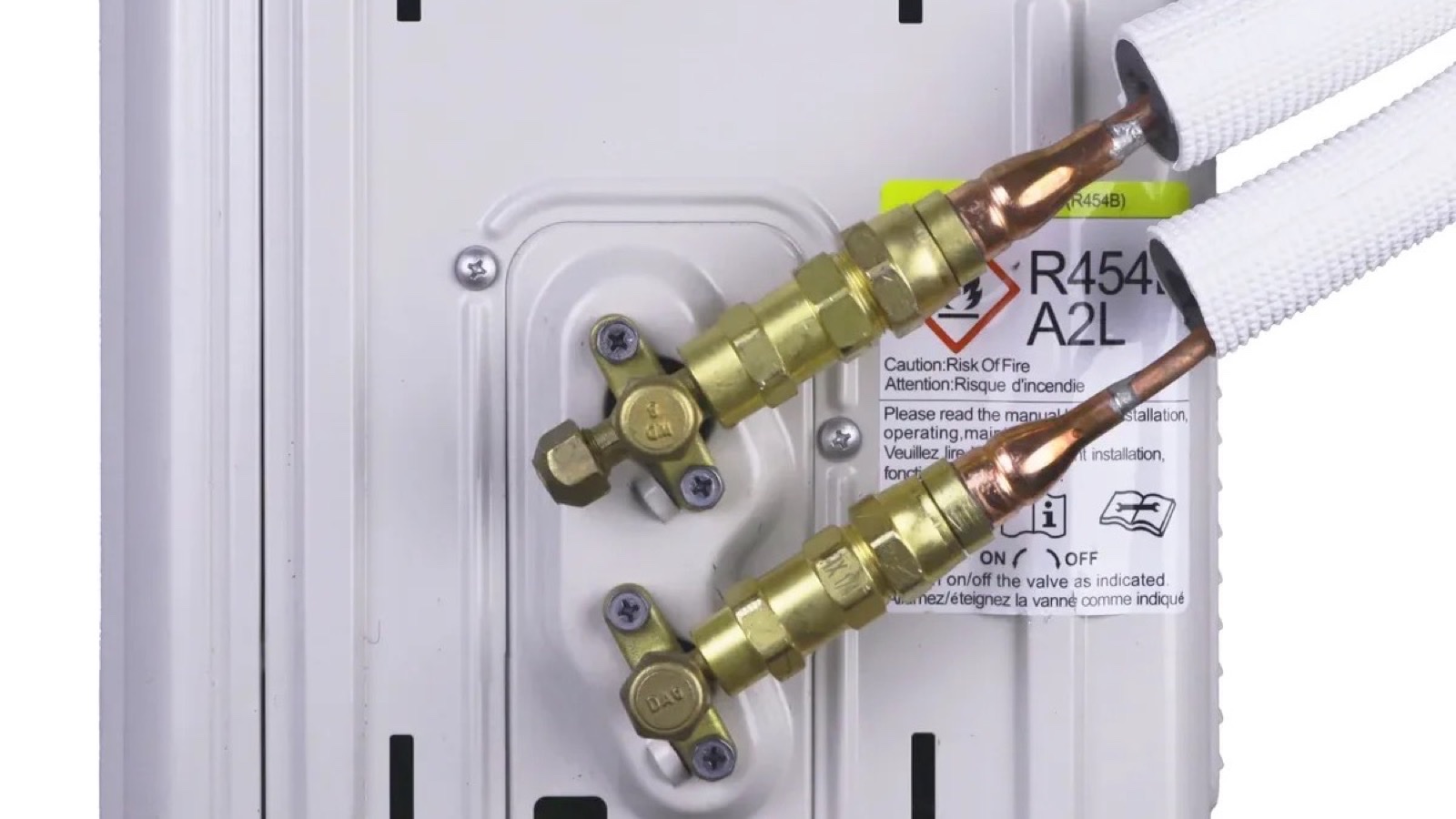
For most homeowners in 2026, the best self install mini split is one that comes with a sealed, pre-charged line set, because that's the part of the job that determines whether you can finish it without calling a technician. Of the four brands people compare most for a self install (Zone Air, MRCOOL DIY, Pioneer and Senville), only Zone Air and MRCOOL DIY let you connect the refrigerant lines yourself with wrenches. Pioneer and Senville still need a vacuum pump, gauges and, for Senville's warranty, a licensed tech. This guide is about the install itself: what you do, what you skip, which line set approach works best, and what happens to the warranty when you're the installer.
Best Self Install Mini Split for 2026
- Best overall: Zone Air. Pre-charged quick-connect line sets cut to the exact length you measure, any whole foot from 5 to 75 ft, 24 SEER2 on its 230V single-zone units, heating to −13°F, and a 5-year parts / 7-year compressor warranty that stays valid when you install it yourself.
- Runner-up: MRCOOL DIY 5th Gen. It also has a pre-charged quick connect, and it's also 5/7 with no registration needed, but the line sets come in fixed lengths of 11.5, 16, 25, 35 and 50 ft and you coil whatever's left over.
- Not a self install: Pioneer and Senville. Both brands use flare line sets that have to be evacuated before the refrigerant is released. You'd likely need a pro for that part. Senville's warranty page says "DIY installation will void your warranty coverage."
- Price check (12,000 BTU, 115V): Zone Air is $1,999.99 in October 2026, while the MRCOOL DIY 5th Gen 12K 115V is about $2,359 at Home Depot in September 2026.
If you want the bigger five-brand guide with sizing tables and rebates, you can see our best DIY mini split guide. This page is about the self install question.
What "Self Install" Means for a Mini Split
Almost every mini split sold online gets called DIY at some point. The bracket and the wall hole are never the hard part, though. What separates a real self install from a contractor job is the refrigerant connection.
- Pre-charged quick-connect systems (Zone Air, MRCOOL DIY) ship the refrigerant sealed inside the line set. You thread the fittings on by hand, torque them with two wrenches. The valves open. The refrigerant never meets the air, so there's no vacuum pump, no manifold gauges and no EPA Section 608 step in the install.
- Flare systems (Pioneer, Senville and most conventional brands) ship bare copper. Somebody has to flare or connect the lines, pressure test them, pull a deep vacuum and then release the charge from the outdoor unit. Pioneer's own self-installation help page says the lines must be vacuumed before the refrigerant is released.
- The tools gap is real money. According to Zone Air's FAQ, you'd spend $400–600 to rent or buy the vacuum pump, gauges and flaring tools and you'd likely use them once.
- Electrical is separate. No mini split removes the electrical work. A dedicated circuit, a disconnect and the permit rules where you live still apply, and some places require a licensed electrician. Most jurisdictions treat a pre-charged install as electrical-only work, but check locally.
One more term to watch: "pre-charged" can mean two different things. On Zone Air and MRCOOL DIY it means the line set itself is charged and sealed. On flare brands it usually means only the outdoor unit holds the factory charge. The lines still need a vacuum.
Self Install Mini Split Comparison Table
| Feature | Zone Air | MRCOOL DIY 5th Gen | Pioneer | Senville |
|---|---|---|---|---|
| Refrigerant connection | Pre-charged quick connect | Pre-charged quick connect | Flare, vacuum required | Flare, vacuum required |
| Line set lengths | Custom cut, any whole foot 5–75 ft | Fixed 11.5 / 16 / 25 / 35 / 50 ft, couplers past 50 | Field-cut copper | Field-cut copper |
| Top single-zone SEER2 | 24 (230V), 23 (115V) | 23.6 (9K 115V) | Up to 25 (Quantum Hyperformance) | Up to 25.5 |
| Heating floor | −13°F | about −13°F on 5th Gen; Easy Pro 5°F; higher tiers lower | −4°F (Diamante Pro) to −22°F | 5°F (Standard) to −22°F (Arctic) |
| 115V option | 9K/12K, optional plug-in cord kit | 9K/12K, hardwired | Varies | Varies |
| Warranty if you install it | 5 yr parts / 7 yr compressor, DIY allowed | 5 / 7, no registration required | 1 yr parts unless registered within a week of a proper install | Voided by DIY install |
Pioneer and Senville do reach higher SEER2 numbers on their top models, but those are flare systems that need a vacuum pump. Among pre-charged quick-connect systems, Zone Air's 24 SEER2 at 230V is the highest of the brands compared here. MRCOOL's best single-zone is 23.6. At 115V the order changes: Zone Air's 115V units are 23 SEER2 and MRCOOL's 115V units are 23.5–23.6.
Why the Line Set Decides a Self Install
Most self installs go right or wrong at the line set.
- Length fit. With fixed lengths you buy the next size up and coil the extra. A 40 ft run on a 50 ft set leaves 10 ft of copper to loop behind the condenser, and MRCOOL's manual tells you to coil it flat and never cut it. Zone Air cuts the set to the length you measure, so a 40 ft run gets a 40 ft line.
- Connection count. Every quick-connect joint is a place to get the torque right. One continuous set has one pair of joints. MRCOOL reaches past 50 ft by joining two sets with a coupler kit, which adds a second pair. With Zone Air, the 25, 33, 50 and 75 ft sets are each one continuous pre-charged run, not an extension.
- Limits. Every manufacturer lists a maximum line length and a maximum height difference between the indoor and outdoor units. MRCOOL caps a run at 75 ft per indoor unit. In Zone Air's FAQ, you'll find a 30 ft vertical lift limit. Stay inside them.
- Routing. Use gentle curves and never kink the copper, keep the insulation whole, protect exposed outdoor sections from sun, and strap the lines so they don't shake against siding over the years.
Zone Air: Best Overall Self Install Mini Split
Built around the self install, Zone Air stands apart from the other three brands here in a few specific ways.
- Custom-cut pre-charged line sets. Of the brands compared here, Zone Air is the only one that cuts your pre-charged line set to the exact length you measure, any whole foot from 5 to 75 ft (as of October 2026). Standard sets come in 16, 25, 33, 50 and 75 ft, and single-zone wall systems ship with a 16 ft set in the box.
- 24 SEER2 at 230V. The 9K and 12K 230V units are rated 24 SEER2, the highest pre-charged quick-connect rating of the brands compared here. The 115V units are 23 SEER2.
- 115V plug-in option. Running on a dedicated 15A circuit, the 9K and 12K 115V units let you plug the system into a dedicated GFCI outlet with an optional 3-prong cord kit where local electrical code lets you use a plug-in install. Never use an extension cord. MRCOOL's 115V units are hardwired.
- Cold and hot weather. Rated to heat down to −13°F, the same floor as MRCOOL's standard DIY 5th Gen, and to cool in outdoor temperatures up to 131°F (MRCOOL lists 122°F).
- Mix indoor unit styles later. If you add rooms, Zone Air is the only DIY mini split that lets you mix wall-mount, ceiling cassette and concealed ducted units on one outdoor unit (as of October 2026), using the multi-zone builder.
- Price. The 12K 115V system is $1,999.99 and the 12K 230V is $2,049.99 (October 2026), against about $2,359 for MRCOOL's 12K 115V at Home Depot (September 2026), about 15% less on the 115V pair.
- Support and terms. Selling direct, Zone Air offers live technical support 8 AM–6 PM MT, a one-page spec sheet and manual for every unit, 30-day returns on uninstalled units and free shipping to the lower 48. Units get final assembly, testing and inspection in the USA.
MRCOOL DIY 5th Gen Fixed-Length Option
The other true self install on this list is MRCOOL DIY. It's a reasonable pick if the standard lengths fit your layout.
- Line sets. Pre-charged quick-connect sets in 11.5, 16, 25, 35 and 50 ft, plus coupler kits for longer runs up to 75 ft per indoor unit. Excess is coiled behind the condenser.
- Efficiency. The 9K 115V is 23.6 SEER2 and the 12K 115V is 23.5, slightly ahead of Zone Air's 115V units. Larger 5th Gen sizes rate lower (18K 22.5, 24K 22.7).
- Cold weather. MRCOOL's Easy Pro heats to 5°F. The standard DIY 5th Gen is rated to about −13°F, and higher-tier DIY models are rated lower.
- Electrical. The 9K and 12K are 115V and hardwired. 18K and up are 208/230V.
- Warranty. The DIY 5th Gen carries 5 years parts and 7 years compressor with no registration needed, and self installation does not void it. The cheaper DIY Select line is 1 year parts / 2 years compressor. MRCOOL's product list says "no special tools or training are necessary to install."
- Returns. MRCOOL lists no manufacturer return policy, so returns depend on the seller.
Pioneer and Senville: When a Self Install Still Needs a Pro
Pioneer and Senville show up in a lot of DIY searches because the equipment is cheap. Neither is a self install on the refrigerant side.
- Pioneer sends the factory charge in the outdoor unit and bare copper for the lines. Per its help center, the lines must be vacuumed before the refrigerant is released. The Diamante Pro 12K is rated 20 SEER2 and heats to −4°F. The Quantum Hyperformance reaches 25 SEER2 and −22°F. The warranty is 1 year on parts if you don't register, or 5 years parts and compressor if you register within one week after the product is properly installed. In our view, a proper install for a flare system includes the evacuation, so you'd likely hire a tech for that day.
- Senville offers a Standard line rated to 5°F and an Arctic Series to −22°F, up to 25.5 SEER2. Its warranty terms are 5 years parts and 10 years compressor, but "pressure testing and evacuation of line sets must be completed by a licensed HVAC professional" and "DIY installation will void your warranty coverage."
- Tools you'd need for either: vacuum pump, micron gauge, manifold gauges, nitrogen for a pressure test and a flaring kit, plus EPA 608 certification to handle refrigerant beyond the factory charge.
A common middle path is a "hybrid" install: you mount the units and run the lines, then pay a technician for the vacuum, pressure test and startup. It works, but it's not a self install, and the scheduling and labor cost are part of your budget.
Cold Weather Ratings for Self Install Mini Splits
Plenty of buyers want a mini split as their main heat, so the low-temperature rating matters.
- Zone Air is rated to heat to −13°F on every system.
- MRCOOL DIY 5th Gen is rated to about −13°F, with full capacity to about 5°F and dropping below. MRCOOL Easy Pro stops at 5°F, and MRCOOL's higher-tier DIY models are rated lower.
- Pioneer Diamante Pro is rated to −4°F and Senville Standard to 5°F. Their cold-climate lines go to −22°F but are still flare installs.
SEER2 measures cooling efficiency. HSPF2 measures heating efficiency. For a heat-first install, you'll want to look at the published heating capacity at 5°F and at your design temperature, not only the minimum operating temperature. In Zone Air's spec sheets and MRCOOL's product list you'll find the numbers, and the AHRI directory has certified ratings for matched systems. Size each room with a Manual J style load calculation or a sizing calculator before ordering.
What You Actually Do for a Self Install
A pre-charged install is real work, but it's mechanical work.
- Plan. Pick the indoor location (high on a wall, studs behind the bracket, clear airflow) and the outdoor spot (level pad or wall bracket, clearance, short and direct line path). Measure the run.
- Mount the indoor unit. Level the mounting plate and drill the wall hole for the line set, drain hose and cable. In Zone Air's FAQ, you'll find a 3 in hole saw.
- Set the outdoor unit on its pad or bracket.
- Route the line set with gentle curves and secure it.
- Connect the quick-connect fittings. You'll remove the caps, thread by hand to avoid cross-threading, then torque with two wrenches to the value in the manual and open the service valves as the manual tells you.
- Electrical. Run the dedicated circuit and disconnect to code, or have an electrician do it.
- Check it. You'll want to bubble-test every joint, confirm the drain slopes away, and run the system in cooling and heating.
What you never do on a pre-charged system: hook up gauges, pull a vacuum or handle refrigerant. Zone Air's FAQ estimates 4–6 hours for two people on a first single-zone wall install, about 3 hours with experience.
What a Self Install Costs
- Equipment. Zone Air 12K: $1,999.99 (115V) or $2,049.99 (230V), 16 ft line set included. MRCOOL DIY 12K 115V: about $2,359 at Home Depot. Pioneer and Senville equipment costs less, but a technician visit for evacuation and startup comes on top.
- Longer line sets. Zone Air standalone sets run from $229.99 (16 ft) to $728.99 (75 ft) for the 9K/12K size, with custom cuts at the next standard price plus $50.
- Materials. Pad or wall bracket, line-hide cover, wire and a disconnect.
- Electrical labor if you hire it out.
- Tools. A drill, hole saw, level, wrenches and a torque wrench. Flare systems add the $400–600 vacuum and gauge kit.
Get detailed quotes if you're comparing a flare system: equipment, tech labor for the refrigerant work, electrical and permits.
Warranty When You're the Installer
| Brand | Parts | Compressor | Self install allowed? |
|---|---|---|---|
| Zone Air | 5 years | 7 years | Yes, no registration deadline |
| MRCOOL DIY 5th Gen | 5 years | 7 years | Yes, no registration required |
| MRCOOL DIY Select | 1 year | 2 years | Yes |
| Pioneer | 1 year (5 if registered within a week of a proper install) | 5 years if registered | Covers properly installed units |
| Senville | 5 years | 10 years | No, DIY install voids it |
Neither of the pre-charged brands covers labor, so keep the manual, the torque values and your receipts.
Which Self Install Mini Split to Buy?
- Zone Air if you want the simplest self install: a line set cut to your run, 24 SEER2 on the 230V units, a plug-in option on the 115V units (23 SEER2), −13°F heat and a warranty that lets you do the work.
- MRCOOL DIY 5th Gen if one of its standard lengths fits your run and you want its 115V efficiency edge.
- Pioneer or Senville only if you already have an HVAC tech lined up for the refrigerant work.
If you're still deciding between single-zone sizes or want the wider brand list, our best DIY mini split comparison covers BTU sizing, rebates and more brands.
Self Install Mini Split FAQ
Can I install a mini split myself without a license?
On a pre-charged quick-connect system the refrigerant stays sealed, so there's no EPA 608 step in the install. The electrical work still has to meet local code. Some areas require a licensed electrician or a permit.
Do I need a vacuum pump for a self install mini split?
Not with Zone Air or MRCOOL DIY. Pioneer and Senville need one, along with gauges and a pressure test.
Does installing it myself void the warranty?
Not with Zone Air or MRCOOL DIY 5th Gen. Senville says DIY installation voids its warranty, and Pioneer covers properly installed, registered units.
Can a self install mini split plug into an outlet?
Zone Air's 9K and 12K 115V units can, with the optional cord kit and a dedicated 15A GFCI outlet where code allows. MRCOOL's 115V units are hardwired.
How long should the line set be?
Measure the actual path from the indoor unit to the outdoor unit. With Zone Air you order that length. With fixed-length kits you buy the next size up and coil the rest.
Related guides
- Best DIY mini split for 2026: five systems compared
- Best mini split with no vacuum pump required
- Easiest DIY mini split installation
- Pre-charged quick-connect line sets explained
- DIY mini split that plugs into an outlet
- Best multi zone mini splits: pro install and DIY
Get a quote on a self install mini split
Specs, prices and warranty terms are manufacturer-published as of October 2026, subject to change. Verify before purchase. MRCOOL, DIY 5th Gen, DIY Select, Easy Pro, Pioneer, Diamante, Quantum Hyperformance and Senville are trademarks of their respective owners. HVAC On Sale is not affiliated with or endorsed by them.