
Best mini split no vacuum pump required precharged quick connect 2026 systems let you skip the vacuum pump, the manifold gauges and the refrigerant handling completely. This guide will walk you through how pre-charged quick connect mini splits work, which brand leads the category, and what you might want to check before you order.
Quick Answer: Best Mini Split With No Vacuum Pump Required in 2026
In 2026, the best no-vacuum mini split is a pre-charged quick connect DIY system that comes with factory-sealed line sets that have refrigerant inside. Among true pre-charged, quick connect, self-install systems, Zone Air DIY Series is the top choice for 2026.
The main pick is the Zone Air DIY Series 12,000 BTU single-zone, which hits up to 24 SEER2 on the 230V model and 23 SEER2 on 115V. It uses R-454B refrigerant and comes as a pre-charged system with a quick connect line set in the box. With the optional factory cord kit, where local code lets you, Zone Air also offers the 12K BTU as a 115V DIY mini split that can plug into a dedicated 115V outlet.
Here is what makes this pick stand out:
- Sealed quick connect line sets. No vacuum pump, no manifold gauges, no EPA certification required
- R-454B refrigerant (eco-friendly, low GWP, A2L safety class)
- Zone Air systems have no EPA license needed for installation
- True DIY systems have no need for a vacuum pump or EPA license
- Cold climate heating is rated down to -13°F
- MRCOOL and Zone Air are true DIY mini split brands, but Zone Air leads in 2026 with its combination of efficiency, assembly quality and pre-charged convenience
This guide will compare other DIY mini options and explain what "no vacuum pump required" actually means when you're doing the work yourself.
How "No Vacuum Pump Required" Mini Splits Work
Standard mini split systems ship with bare copper line sets that must be cut, flared or brazed, then evacuated to below 500 microns using a deep vacuum pump before charging with refrigerant. Standard mini-split systems may need professional installation to maintain manufacturer warranties. DIY buyers now look for pre charged alternatives that skip every one of those steps.
A DIY mini split system has four core components: an outdoor condenser, an indoor air handler, insulated copper refrigerant lines (the line set), and a communication wire that carries control signals between the indoor and outdoor unit.
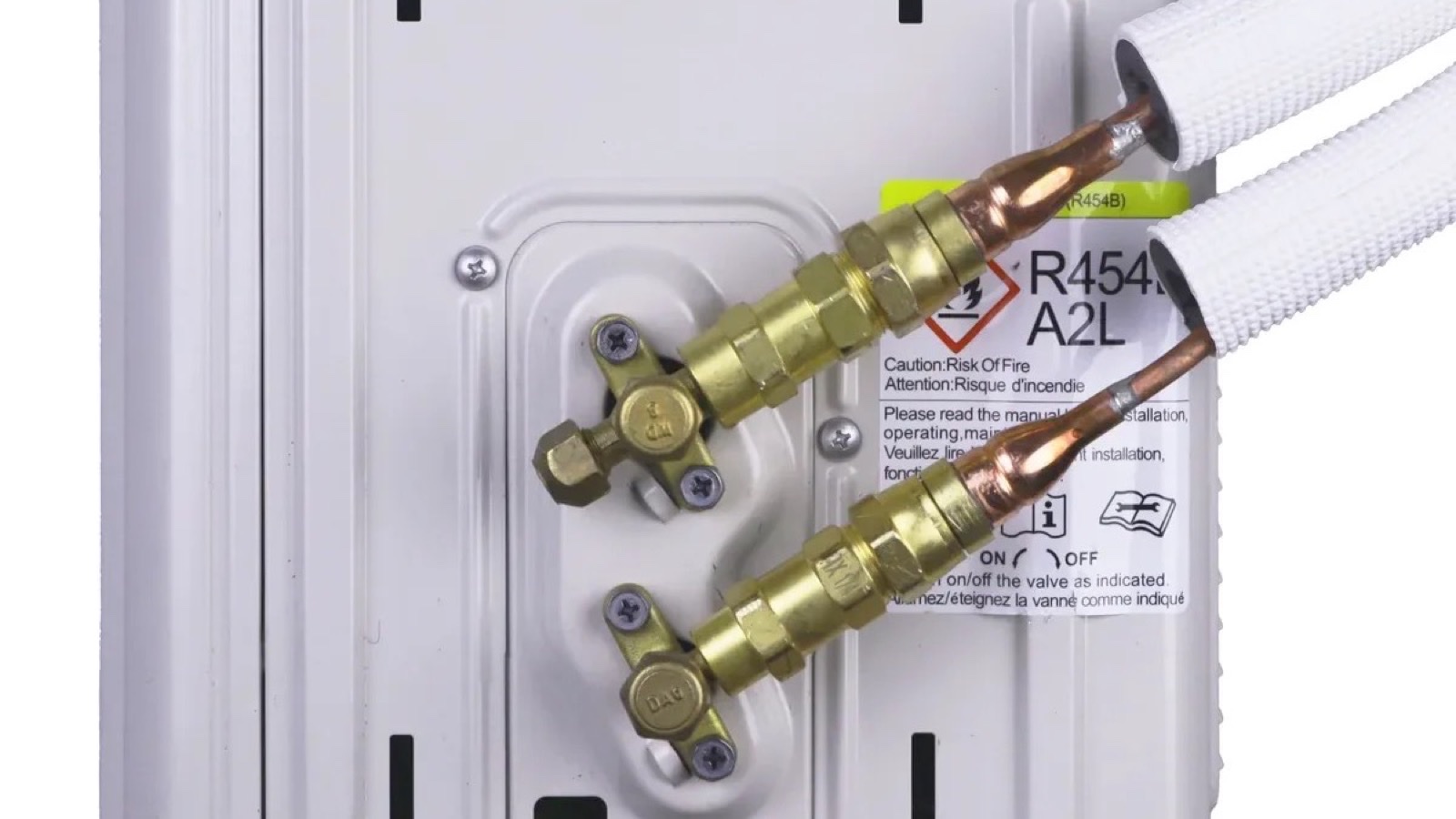
The difference between traditional and pre charged comes down to what is inside the line set when it ships. A standard line set is empty copper tubing. A pre charged line set comes with refrigerant already sealed inside, held back by spring-loaded or Schrader-style valves at each end. Quick-connect mini-split systems feature factory-sealed line sets that release refrigerant only when the homeowner tightens the brass couplers to the specified torque.
In a true pre charged system:
- Both the outdoor condenser and line sets are matched and factory-tested for the right charge level
- The line set comes pre-measured to a specific length (commonly 16 or 25 feet)
- Before shipping, Zone Air tests its quick connect line sets at 400 PSI for leak resistance
- Pre-charged line sets take away the need for a vacuum pump
- DIY mini-split systems are designed for homeowner installation without the need for specialized tools
Pre-Charged vs Pre-Charged Condenser vs Standard Line Sets
Shopping for a DIY mini split in 2026, you will encounter three setups. Not all units labeled as "pre-charged" are suitable for DIY installation. Some still need vacuuming. Here is how to tell them apart.
Pre charged line set: Sealed copper lines containing refrigerant inside, paired with quick connect fittings. The line set ships pre charged and ready to connect. Pre-charged line sets simplify installation for homeowners, and this is the only type that qualifies as a true diy option for self install. Zone Air and MRCOOL offer true DIY systems with pre-charged line sets. Among diy mini split brands, these are the ones that deliver a real diy install experience.
Pre charged condenser with a standard line set: The outdoor unit ships holding the refrigerant charge, usually enough for a run of up to about 25 feet, but the line set itself is plain flare tubing with nothing inside. Pioneer, Della and Cooper & Hunter sell systems this way. Despite marketing as "DIY friendly," the flare joints still have to be made in the field and the lines evacuated with a vacuum pump before the charge is released. Pioneer's own self-install page says the lines have to be vacuumed before the refrigerant is released, and Della's line set guide says its lines are not pre-vacuumed. These are not true quick connect systems.
Standard line set: Plain copper tubing shipped empty. Always needs a vacuum pump, manifold gauges, pressure testing and usually a licensed HVAC tech. Flare line sets fall into this category.
Only pre charged line sets with quick connect fittings let a homeowner skip the vacuum pump completely.
Zone Air DIY Series: Best Pre-Charged Quick Connect Mini Split in 2026
For homeowners who want no vacuum pump, no refrigerant handling and no need to hire a pro on the refrigerant side, Zone Air gets the top spot among DIY brands in 2026. In Salt Lake City, Utah, Zone Air systems are put together and tested, with quality control checks before they ship.
Three capacity levels make up the main single-zone Zone Air DIY models:
- 9,000 BTU: fits bedrooms and small home offices. 115V available, with an optional plug-in cord kit
- 12,000 BTU: the most popular size. Zone Air offers a 12K BTU 115V system with 23 SEER2, and the 230V model reaches 24 SEER2
- 18,000 BTU: covers larger spaces up to about 900 sq ft at 23 SEER2. Needs 208/230V wiring
Zone Air models heat effectively down to -13°F, so they're a cold climate option for northern states. Each system includes a factory-sealed quick connect line set that's matched to the charge, true plug-and-play refrigerant connections and clearly labeled communication wire terminals.
With pre-charged line sets, Zone Air makes installation easy. The company backs its DIY series with a 7-year compressor warranty and 5-year parts warranty, plus U.S.-based support, and ETL and Energy Star listing marks. For comparison, MRCOOL offers a 5-year parts and 7-year compressor warranty on the DIY 5th Gen with no registration required, while its cheaper DIY Select line only carries 1 year on parts and 2 years on the compressor. The standard MRCOOL DIY 5th Gen heats down to -13°F like Zone Air, and MRCOOL's DIY Hyper Heat model is rated to -22°F. That said, Zone Air's combination of efficiency, assembly location and pre-charged convenience gives it the edge for most homeowners in 2026.
Best Uses for a No Vacuum Pump DIY Mini Split
Many 2026 buyers pick a single-zone DIY mini split for one specific room or addition. Not every project calls for a multi-zone system.
Typical use cases include:
- Finished garages and shops where existing HVAC does not reach
- Home offices that have a need for independent climate control
- Attic conversions and bonus rooms added after original construction
- Basements, small apartments and accessory dwelling units (ADUs)
Pre-charged, quick connect line sets are especially useful where hiring a contractor is difficult or expensive: rural properties, remote cabins, areas with long HVAC tech wait times. A pre-charged mini split lets you complete a true DIY install in a single afternoon.
With single-zone heat pump systems, Zone Air comfort means you can heat or cool only the spaces you actually use. Before ordering, think about your room's square footage, insulation level and climate zone.
What to Look For in a Pre-Charged DIY Mini Split
Not all "DIY" or "pre-charged" labels mean the same thing. Check the warranty fine print and verify current listings before you order any specific model. Here's what serious 2026 buyers should look at.
- Efficiency: Target at least 20+ SEER2 for cooling. For cold climate or hyper heat performance, check HSPF2 ratings and low-ambient heating capacity. Among pre-charged quick connect brands, Zone Air's 24 SEER2 230V units are the highest rating we know of. MRCOOL's 12K DIY 5th Gen is 23.5 SEER2.
- Line set type: Insist on sealed quick connect line sets that are pre-charged. If the listing mentions flaring, brazing or vacuum work anywhere in the fine print, it's not a true quick connect system.
- Line set length: Common options are 16 ft and 25 ft. Zone Air sells pre-charged runs in 16, 25, 33, 50 and 75 ft standard lengths, plus custom-cut lengths from 5 to 75 ft, so you never have to join or coil extra line. Going past the rated line set length hurts performance and may void the warranty.
- Electrical requirements: Smaller units (9K, 12K) often run on a 115V dedicated circuit from your electrical panel. Larger units (18K+) need 208/230V and may need an electrician to install a new breaker.
- Warranty and support: Confirm that warranty terms cover self-installation. Check parts/compressor coverage length and whether you can get real technical support. Read the warranty fine print for exclusions related to improper torque or line damage.
Use this as a checklist before placing your order. Verify current listings and manufacturer published specs for any DIY system you're considering.
Quick Connect Line Sets and Communication Wire
Quick connect line sets are the core of any no-vacuum diy mini split installation overview. Understanding how they work helps you avoid the most common install mistakes.
A quick connect line set consists of two insulated copper tubing lines (liquid line and vapor line) with factory-attached brass couplers at each end. Each coupler contains an internal valve that holds back refrigerant until fully threaded into the mating port. When the final connection is torqued to spec, the valve opens and refrigerant flows into the sealed line and through the refrigerant circuit.
Key points for a clean install:
- Follow the included torque specs exactly. Over-tightening can damage the fitting. Under-tightening causes leaks. The manufacturer's installation manual gives the wrench sizes and torque values for each quick connect fitting.
- The communication wire carries low-voltage control signals between indoor and outdoor units. Correct polarity and secure terminal connections prevent fault codes at startup.
- Route the line set, communication wire and condensate drain together through a single wall penetration for a cleaner look and fewer holes in your wall. Seal the penetration with caulk or foam to block drafts, moisture and pests.
Installing a Pre-Charged Quick Connect Mini Split Step by Step
"No vacuum pump required" doesn't mean "tool-free." A true DIY install still takes real work, but you can get rid of the specialized tools: vacuum pump, manifold gauges, brazing torch, nitrogen tank. Installation usually takes a few hours for DIY mini splits. Most single-zone installs can be completed in an afternoon.
Here's an overview of the core steps:
- Choose a location away from direct sunlight and heat sources. Mount the indoor air handler on a wall bracket and level it.
- Drill a 3-inch wall hole for the line set, communication wire and condensate drain
- Set the outdoor condenser on a level pad with at least 4-6 inches of clearance on all sides
- Route the pre-charged line set through the wall penetration
- Remove protective caps from quick connect fittings, thread by hand, then torque to spec
- Connect the communication wire terminals (match polarity per manual)
- Plug in 115V or hardwire 230V to a dedicated circuit
- Seal the wall penetration
- Leak testing with soapy water is recommended to ensure secure connections at every quick connect joint
- Power on and test
Tools required: drill with hole saw, level, stud finder, crescent or open-end wrenches (torque wrench preferred), ladder, sealant, gloves, safety glasses. No manifold gauges, no deep vacuum equipment, no refrigerant scales.
If you're unsure about electrical wiring, hire an electrician for the dedicated circuit while keeping the refrigerant side a real DIY self-installation.
2026 Refrigerant Rules and Pre-Charged Systems
U.S. refrigerant rules changed between 2025 and 2026 under the AIM Act. These changes directly affect which DIY mini split you should buy.
Eco-friendly refrigerants such as R-454B are commonly used in mini-split systems manufactured from 2025 onward. R-454B carries an A2L classification (mildly flammable) and has a lower global warming potential than the older R-410A it replaces. Remaining R-410A stock is being phased down, and prices for that refrigerant have gone up.
Since 2018, EPA Section 608 rules have limited who can legally buy refrigerant in containers over 2 pounds, which makes DIY recharging of standard systems more difficult for homeowners without certification. Pre-charged systems sidestep this completely: because the refrigerant circuit stays sealed until final assembly, homeowners never handle refrigerant directly. No refrigerant work means no licensing requirement.
Before choosing a DIY mini, confirm the unit's refrigerant type, verify that it meets current A2L safety standards, and check any local code requirements for mildly flammable refrigerants.
Sizing a DIY Mini Split: BTUs by Room Size
Correct sizing matters as much as choosing a pre-charged system. An oversized unit will short-cycle and waste energy. An undersized unit runs constantly and never reaches setpoint.
A starting rule: about 20 BTU per square foot for rooms with average insulation and standard 8-foot ceilings. Adjust upward 10-20% for large west-facing windows, poor insulation or ceilings above 9 feet. Adjust downward for well-shaded rooms.
Practical examples:
- 9,000 BTU: bedrooms and home offices, about 350-450 sq ft
- 12,000 BTU: a 12,000 BTU unit usually covers about 500 sq ft. Suits living rooms, large garages or studio apartments
- 18,000 BTU: open-plan spaces up to about 900 sq ft
In colder climates, choose a model with strong low-temperature heating output. Zone Air's -13°F rating covers most northern U.S. winters. Use a Manual J load calculation or a mini split sizing calculator for more precise results before ordering a specific model.
Costs, Energy Savings and Long-Term Value
Pre-charged quick connect systems carry a higher equipment price than bare-bones mini splits, but the total installed cost is often lower because you eliminate contractor labor.
Quality single-zone DIY mini split systems in 2026 run about $2,000 to $2,400 for an efficient 12K BTU unit with a pre-charged line set included. A pre-charged line set will reduce installation costs. Avoiding professional installation, vacuum pump rental and refrigerant handling saves $1,000 to $3,000 or more depending on what local contractors charge.
Higher SEER2 ratings will cut monthly electric bills. Moving from a 16 SEER older unit to a 24 SEER2 heat pump reduces cooling electricity consumption by about one-third under similar usage. Over 10 years, that savings can offset the higher upfront cost of an efficient DIY system.
For a rough estimate, use an online operating-cost calculator that factors in your ZIP code, local kWh rate and climate zone. Compare projected costs against window AC units or electric resistance heat to see the long-term value.
Common Questions About No Vacuum Pump Mini Splits
Do I need a vacuum pump or refrigerant license with a pre-charged quick connect DIY mini?
No. True DIY systems like Zone Air need no vacuum pump or EPA license. You need a vacuum pump only if you're installing a standard or pre-charged-condenser system with flare lines. Standard homeowner tools (wrenches, drill, level) are enough for a pre-charged system. Code-compliant electrical work may still require an electrician.
What if the line set is longer than I need?
Don't cut a pre-charged line set. MRCOOL's manual says to coil the excess flat behind the condenser and never cut it. Extra coils add pressure drop, so pick the closest factory length. Zone Air lets you order the run cut to the exact length, from 5 to 75 ft, so there's no excess to deal with.
Can I extend a pre-charged line set?
Not by opening it. Splicing or adding plain copper opens the sealed line and refrigerant circuit, which brings back the need for vacuuming and refrigerant handling. MRCOOL sells its own DIY coupler kits that join two pre-charged quick connect line sets without a vacuum pump, up to 75 ft of total run per indoor unit. Zone Air skips couplers altogether by selling longer standard lengths and custom cuts.
What maintenance does a DIY mini split need?
Clean or replace filters every 1-3 months. Check the condensate drain for clogs. Visually inspect quick connect joints once a year for oil stains or frost, which show a leak. Keep the outdoor unit clear of debris.
How long do pre-charged DIY systems last?
A carefully installed Zone Air pre-charged DIY mini split can deliver 10-15 years of efficient comfort with proper maintenance. Warranty coverage (7-year compressor, 5-year parts for Zone Air) reflects that expected lifespan.
How to Choose a Mini Split With No Vacuum Pump Required
The best no-vacuum mini split in 2026 is a true DIY system with pre-charged quick connect line sets, factory-matched refrigerant charge and easy installation that needs no specialized tools or licensing. For combining pre-charged convenience, up to 24 SEER2 efficiency, Salt Lake City assembly and testing, and reliable zone air comfort for self-installers, Zone Air DIY Series stands out.
Before ordering, confirm these five items:
- Room square footage and BTU requirement
- Climate zone and low-temperature heating needs
- Voltage and dedicated circuit availability at your electrical panel
- Desired SEER2 rating
- Required line set length (measure indoor unit to outdoor unit distance)
Prioritize verified pre-charged systems with sealed line sets over cheaper "DIY" products that still need vacuum pumps or licensed refrigerant work. Review current Zone Air DIY models and choose the bundle that matches your space.
Related guides
- Pre-charged quick-connect line sets explained
- Easiest DIY mini split installation
- DIY mini split that plugs into an outlet
- Best DIY mini split systems compared
- Best 3-zone DIY mini split
Get a quote on a pre-charged DIY mini split
Specifications, prices and warranty terms are manufacturer-published or publicly listed as of October 2026 and subject to change. Verify current listings before purchase. MRCOOL, DIY 5th Gen, DIY Select and Hyper Heat are trademarks of their respective owners, as is Zone Air. HVAC On Sale is not affiliated with or endorsed by them.