
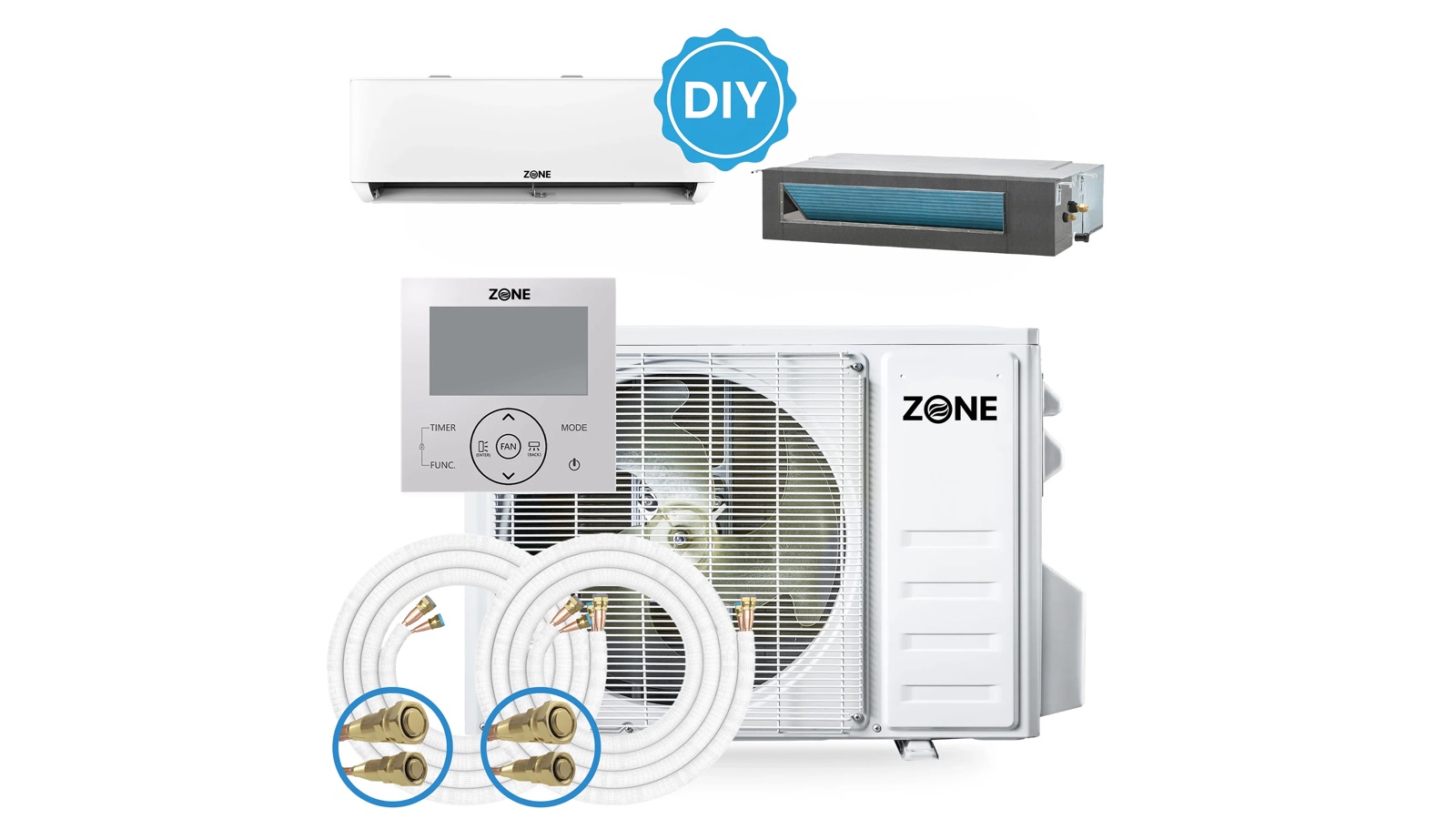
Choosing the best multi zone DIY pre-charged mini split system can save you thousands and give you room-by-room comfort without hiring an HVAC contractor. This buyer's guide breaks down the best pre charged mini splits for 2026, explains what separates true DIY systems from those that still need a licensed tech, and helps you size the right setup for your home.
Best DIY Pre-Charged Multi Zone Systems for 2026
These are the top picks for multi zone mini splits in 2026, and we are only looking at true DIY systems that are pre charged and have quick connect installs. Every system below uses line sets that are pre-charged with quick connect fittings, so you do not need a vacuum pump, you do not need manifold gauges, and you do not need EPA 608 certification.
| Pick | System | Zones | BTUs | SEER2 | Why It Stands Out |
|---|---|---|---|---|---|
| Best Overall | Zone Air Dual-Zone 24K (12K + 12K) | 2 | 24,000 connected | 24 | Highest SEER2 of any DIY multi zone here; heats to −13°F; about $430 less than MrCool's 27K 12K + 12K kit |
| Best 3-Zone | Zone Air 3-Zone 36K (12K + 12K + 12K) | 3 | 36,000 connected | 24 | Up to 1,800 sq ft; mix wall, ceiling cassette and slim concealed duct heads; line sets cut to the length you measure |
| Best Large Home | MrCool DIY 48K 5th Gen | Up to 6 | 48,000 | 21.8 | Maximum zone count for whole home comfort |
| Best Cold-Climate | MrCool DIY 55K 5th Gen | Up to 6 | 55,000 | 22 | The one DIY multi zone condenser rated to heat at −22°F |
| Best Mid-Size | MrCool DIY 36K 5-Zone | Up to 5 | 36,000 | 23 | Wall and ceiling cassette heads mix; up to ~1,500 sq ft |
With 24 SEER2 efficiency, which is higher than any MrCool DIY multi zone condenser (21.8 to 23.9), heating down to −13°F, a warranty that stays valid on a DIY install, and line sets made to your exact run, Zone Air takes the top two spots. When you need more than three zones or the −22°F rating on the 55K, the MrCool picks are strong alternatives.
What Is a DIY Multi Zone Mini Split?
A multi zone mini split is usually one outdoor unit that is hooked to two or more indoor heads, and each one serves its own zone. Every indoor unit has its own thermostat, schedule and fan speeds, so your bedroom can stay cool while the living room heats up. With DIY mini split systems, you can heat and cool multiple rooms independently without any ductwork.
A single zone system uses one outdoor condenser with one indoor unit. It's a good fit for conditioning one room like a 500 sq ft living space with a 12,000 BTU head. By contrast, a multi zone mini split system might feed three 12,000 BTU heads from one outdoor unit to cover a living room plus two bedrooms. Based on what each zone needs, the outdoor inverter compressor can shift capacity around, so you might not be wasting as much energy on empty rooms.
What makes a ductless mini split "DIY" is that it has pre charged quick connect line sets. True DIY systems ship with refrigerant that is sealed inside the line sets. That means you do not need a vacuum pump, you do not need manifold gauges, and you do not need EPA 608 certification. Some multi zone systems call themselves "pre charged" but they still need an HVAC tech to handle the refrigerant, flare the copper and evacuate the lines. That distinction can matter a lot for your budget and timeline.
DIY vs Non-DIY Pre-Charged Multi Zone Systems
The term "pre charged mini splits" gets thrown around pretty widely, but not every system that is pre-charged is actually DIY friendly. Understanding the difference can save you $3,000 to $5,000 on installation costs, or it can keep you from a frustrating surprise when your "DIY" system still needs a licensed technician.
True DIY systems have line sets that are pre-charged with sealed quick connect fittings at the indoor and outdoor units. You can thread the fittings on by hand and with a torque wrench, then open the service valves the way the manual tells you. There's no brazing, no flaring and no vacuum pump. The simplest examples are Zone Air and MrCool DIY. MrCool calls its Quick Connect line sets patented and sells them in fixed lengths of 11.5, 16, 25, 35 and 50 ft, with couplers to join two sets. In standard 16, 25, 33, 50 and 75 ft lengths or cut to order at any whole-foot length from 5 to 75 ft, Zone Air sells its multi zone line sets separately, one per zone, so each zone gets a line that fits its run instead of a coil of extra copper.
Non-DIY pre-charged systems have refrigerant loaded in the outdoor condenser at the factory (most mini split systems are pre-charged at the factory in this sense), but the copper line sets must be cut to length, flared with specialized tools, evacuated with a vacuum pump, and opened by a licensed tech. Many brands have systems with standard flare fittings that need professional installation. Mitsubishi and Fujitsu multi zone platforms are in this category.
It's easier for you to install precharged systems. Pre-charged DIY installations make the process a lot simpler compared to conventional systems.
The trade-off? Non-DIY platforms like Mitsubishi's Hyper-Heat multi zone keep 100% heating capacity at 5°F, but professional installation adds significant labor cost. True DIY systems eliminate the need for vacuum pumps and refrigerant licenses completely.
Key Features of DIY Multi Zone Mini Splits
Before you start comparing specific models, use this checklist to look at any multi zone system you're considering.
Capacity planning. Common mini split capacities are from 9,000 to 48,000 BTU. You'll want to match each indoor unit to its specific room size. A 12,000 BTU unit usually covers up to 500 sq ft. The outdoor condenser needs to support the combined capacity of all indoor heads. Every Zone Air 2- and 3-zone system runs on the same 27,000 BTU outdoor unit. It can accept up to 36,000 BTU of connected heads because rooms rarely peak at the same time.
Efficiency ratings. With a SEER2 rating around 21 to 24, models are considered efficient for DIY units. Zone Air's wall mount multi zone systems are 24 SEER2 in every head combination, and MrCool's DIY multi zone condensers run 21.8 to 23.9. Premium non-DIY single zone systems can pass 30 SEER2. Higher SEER2 means lower electricity bills. Look for HSPF2 ratings too. ENERGY STAR cold-climate heat pump criteria need ≥8.5 HSPF2 for non-ducted systems.
Cold-climate performance. Zone Air's multi zone systems heat down to −13°F outdoors. That is the same floor as MrCool's 18K through 48K DIY multi zone condensers. MrCool's 55K multi zone condenser and its single zone DIY Hyper Heat models go to −22°F. If you're in a northern climate, this spec matters more than SEER2.
Noise levels. On the low setting, Zone Air indoor units are running at about 30 dB. When you have multiple indoor units running in bedrooms, low dB ratings help prevent sleep disruption.
Smart controls. MrCool DIY systems include Wi-Fi control and work with Alexa and Google Assistant. Zone Air offers Wi-Fi app control for each zone. Multi zone scheduling lets you set different temperatures in different rooms on auto.
Refrigerant. The MrCool DIY 5th Generation uses R-454B refrigerant with lower global warming potential. Zone Air also uses pre charged R-454B in current models. New R-410A equipment is being phased out.
Mini splits are around 30% more energy-efficient than traditional HVAC systems, and the ductless design eliminates the 20-30% energy losses you usually see with ducted setups.
Best 2–3 Zone DIY Mini Splits for 2026
Two- and three-zone setups are the sweet spot for most homes: a living room plus one or two bedrooms or office spaces. These multi zone setups hit a good balance between whole home comfort and the kind of DIY installation complexity that you can actually manage.
Zone Air Dual-Zone 24,000 BTU - Best Value
The Zone Air dual-zone 24K package uses two wall mount heads that are 12,000 BTU each with Zone Air's outdoor condenser that is 27,000 BTU, and it covers up to 1,200 sq ft. At 24 SEER2, it's more efficient than any MrCool DIY multi zone condenser. It heats down to −13°F, and that covers the vast majority of U.S. cold climates. At $3,039.99, the system comes to $3,499.97 with two 16 ft pre-charged line sets ($229.99 each), about $430 less than MrCool's 27K condenser with the same 12K + 12K heads and line sets ($3,932 at one online store in October 2026). Line sets come in 16 to 75 ft per zone, or you can get them cut to the exact length you need. Warranty is 5 years parts and 7 years compressor, and it's honored on DIY installs with US-based support. This is the best value multi zone DIY pick for 2026.
Zone Air 3-Zone 36,000 BTU - Best Small-Home Coverage
The Zone Air 3-zone 36K system connects three indoor heads that are 12K each to the same outdoor condenser that is 27,000 BTU, covering up to 1,800 sq ft. Because not all zones run at full load at the same time, the connected indoor total capacity exceeds the condenser rating, and that is a planned design that works. It's got the same 24 SEER2 efficiency and −13°F heating floor, at $3,509.99 before line sets. As of October 2026, Zone Air is the only DIY mini split that lets you mix wall mount, ceiling cassette and slim concealed duct units on one outdoor unit, so a bedroom can get a wall head while the kitchen gets a flush ceiling cassette and a finished basement gets a hidden ducted unit.
MrCool 5th Gen 3-Zone 18K - Competitor Context
MrCool's 3-zone condenser that is 18,000 BTU reaches 23.9 SEER2 and uses pre charged quick connect line sets with R-454B. It's a solid option if you need a 3-zone system with smaller capacity, and with two 9K heads it's one of the cheaper DIY 2-zone kits around. On efficiency (24 vs 23.9 SEER2) and on line set fit, Zone Air edges it out, since Zone Air cuts each line to length. Both heat to −13°F.
Best 4+ Zone DIY and Hybrid Multi Zone Setups
Four- to six-zone mini splits make sense for larger homes, multi-story floor plans or when you want a single outdoor condenser handling the entire house. Installation needs vary based on the BTU and number of zones, so advanced DIYers should expect a longer project, potentially a full weekend plus electrician support.
MrCool DIY 48K 6-Zone (5th Gen) is the go-to for maximum zone count. This condenser that is 48,000 BTU supports up to six indoor heads. MrCool DIY systems support configurations from 2 to 6 zones (MrCool catalog) based on condenser capacity. With a SEER2 of 21.8, it's lower than Zone Air's 24, but six zones on one condenser is the most you'll find in DIY, matched only by MrCool's own 55K, and that one adds −22°F heating.
Zone Air tops out at three zones per outdoor unit. For four or more rooms you'd run two Zone Air systems (two outdoor units, each with its own 24 SEER2 rating and line sets cut to length), or choose MrCool for a single condenser. Within each Zone Air system you can still mix wall mount, ceiling cassette and concealed duct heads.
For comparison, a non-DIY Mitsubishi or Fujitsu 4-zone platform offers high efficiency but demands professional installation. Their longest warranties (12 years) only apply when a contractor in the brand's own program installs and registers the system. The price goes up once labor is added in.
The trade-off is clear: fewer outdoor units and DIY savings vs more complex line routing and higher upfront cost for premium non-DIY platforms.
Pre-Charged Line Sets and Quick Connect Fittings
Quick connect line sets are what make a true DIY mini split system possible. Here's how they work in plain language.
Each line set comes with refrigerant that is sealed inside at the factory. The fittings are threaded couplers with sealed ends. You tighten each one to the manufacturer's torque spec before opening the service valves. This design skips brazing, flaring, vacuum pumps and manifold gauges completely. Length is where brands differ: MrCool sells fixed lengths and tells you to coil extra line flat behind the condenser, never cut it, while Zone Air makes each line to the length you order, from 5 to 75 ft.
Practical tips for running line sets:
- Maintain gentle curves. Kinking copper lines limits refrigerant flow
- Use line set covers or conduit to protect the insulation from UV exposure
- Follow torque specifications exactly. Fittings that are under-tightened leak, and fittings that are over-tightened can be damaged
- You'll want to check the manual for the minimum and maximum line lengths for your system
- Make sure condensate drain lines pitch downward consistently so you can avoid water backup
How to Size Multi Zone Systems by BTU, Zones and Room Mix
Correct sizing for each zone and the total system is crucial for comfort, efficiency and equipment longevity. An oversized system leads to short cycling, excess humidity and wasted energy. An undersized one simply can't keep up.
Rule of thumb: use about 20 BTU per square foot for rooms that have standard ceiling height and average insulation. Size up for poor insulation, hot climates, large windows or heavy sun exposure.
| Room | Square Footage | Recommended BTU |
|---|---|---|
| Bedroom | 300–400 sq ft | 9,000 BTU |
| Office | ~300 sq ft | 9,000 BTU |
| Living room | ~500 sq ft | 12,000 BTU |
| Open plan / basement | 600–900 sq ft | 18,000–24,000 BTU |
Common multi zone configurations:
- 2-zone: 9K + 12K (21,000 BTU total) or 12K + 12K (24,000 BTU)
- 3-zone: 9K + 9K + 12K or 12K + 12K + 12K
- 4-zone: 9K + 9K + 9K + 12K or similar mixes (MrCool 27K condenser and up)
A 300 sq ft office needs about a 9,000 BTU unit, while a 500 sq ft living room calls for a 12,000 BTU model. Zone Air packages cover these common room sizes with pre-configured bundles, using 9K, 12K and 18K heads on one condenser. Adjust for ceiling height above 8 ft and factor in sun exposure for rooms with large south- or west-facing windows.
Avoid the urge to dramatically oversize. A mini split that's too large for the space will cycle on and off rapidly, and that reduces dehumidification and increases wear.
DIY Installation Overview for Multi Zone Mini Splits
This is a high-level install overview, not a replacement for your system's manual. Always follow the instructions from the manufacturer and your local building codes.
Major steps:
- Plan head locations, line routes and outdoor condenser placement
- Mount indoor units on the wall (or ceiling) using the brackets that are provided
- Set the outdoor unit on a level pad or wall bracket with clearance
- Drill through exterior walls and route the line sets that are pre charged
- Connect the quick connect fittings at both the indoor and outdoor ends, then open the service valves as the manual tells you
- Wire control cables and power connections
- Test the system and verify operation in each zone
Tools for true DIY install: drill, hole saw, level, torque wrench, basic hand tools. You do not need a vacuum pump, gauges or nitrogen setup. MrCool says its DIY systems need no special tools or training, and most DIY mini splits can be installed in a weekend.
Electrical considerations: multi-zone mini splits typically require a dedicated 208-230V circuit for operation, with a disconnect box near the outdoor unit. Zone Air's multi zone condenser calls for a 30A double-pole breaker. Many DIYers hire an electrician for this part, which is smart, since the dedicated circuit and breaker work often requires a permit.
DIY mini splits can save $3,000 to $5,000 on installation compared to hiring a full HVAC crew for a conventional system. DIY mini splits use pre-charged line sets for easy installation, turning what used to be a multi-day professional job into a weekend project.
Efficiency, Operating Costs and ENERGY STAR Considerations
System efficiency directly determines your monthly power bills. Here's how the numbers play out for multi zone setups.
A home replacing a 14 SEER central air system with a 22+ SEER2 DIY multi zone ductless mini split at $0.15/kWh can expect annual savings. With the ductless design, duct losses are eliminated and those usually waste 20-30% of conditioned air in traditional systems.
The federal 25C heat pump tax credit ended for systems installed after December 31, 2025, but state and utility rebates are still out there, and many of them use ENERGY STAR cold-climate criteria. To qualify, non-ducted systems need ≥15.2 SEER2 and ≥8.5 HSPF2 (ENERGY STAR criteria), plus strong heating output at 5°F. MrCool's 5th Gen multi zone condensers are on the ENERGY STAR list. With 24 SEER2 and 10.5 HSPF2, Zone Air's wall mount multi zone ratings are well above those floors, but check your rebate program's own product list before counting on the money.
DIY mini split systems with pre-charged line sets are a growing part of the market. The efficiency gap between DIY and premium non-DIY multi zone systems has narrowed a lot. You no longer need to sacrifice performance for installation simplicity.
Brand, Warranty and Long-Term Support
In 2026, many DIY mini split brands share part suppliers, so warranty terms and customer support often define the real-world value difference between brands.
Warranty comparison:
| Brand | Parts | Compressor | DIY Install Honored? |
|---|---|---|---|
| Zone Air | 5 years | 7 years | Yes |
| MrCool DIY 5th Gen | 5 years | 7 years | Yes, no registration required |
| Mitsubishi | Up to 12 years | Up to 12 years | No, 12 years requires a Diamond Contractor install |
| Fujitsu | Up to 12 years | Up to 12 years | No, 12 years requires an Elite Contractor install |
Mitsubishi and Fujitsu advertise 12-year parts and compressor coverage, but only when one of their certified contractors installs and registers the system. Zone Air's warranty is 5 years for parts and 7 years for compressors, fully honored on DIY installs with US-based live support. MrCool's DIY 5th Gen carries the same 5 and 7 years with no registration needed, though its lower-cost DIY Select line drops to 1 year parts and 2 years compressor.
When comparing the total cost, factor in that the $3,000–$5,000 you save on professional installation with a true DIY system often exceeds the warranty gap between DIY and non-DIY brands.
For DIYers who want strong warranty backing without the mandatory cost of professional installation, Zone Air stands out as the best option. Its support team is US-based, final assembly, testing and inspection happen in the USA, and uninstalled systems can be returned within 30 days. MrCool doesn't offer a manufacturer return policy, so returns depend on the store you buy from.
Related Guides and Next Steps
Ready to move forward? Here are related guides and resources to help you plan your specific setup:
- Best DIY mini split - for conditioning one room or addition
- DIY multi zone ceiling cassette systems - for a cleaner look with no wall mount heads visible
- Best 2 zone DIY mini split systems and best 3 zone DIY mini split - zone-by-zone picks
- Easiest DIY mini split installation - step-by-step with tool lists
Before buying, map your home's zones, list room sizes and square footage, and decide whether a single zone or multi zone path fits your layout. Zone Air's bundle builder lets you pick two or three heads in any style, choose each line set length, and see the price for your floor plan.
You can get solid performance and whole home comfort without a contractor's markup, because the mini split industry has made this possible for handy homeowners. Compare 2–6 zone DIY-ready systems now, measure twice and start saving on both installation and energy bills this season.
Get a quote on a multi zone mini split
Specifications, prices and warranty terms are manufacturer-published or publicly listed as of October 2026 and subject to change. Verify current listings before purchase. MRCOOL, DIY 5th Gen, DIY Select, Hyper Heat, OuttaSight, Mitsubishi, Hyper-Heat, Diamond Contractor, Fujitsu, Elite Contractor and ENERGY STAR are trademarks of their respective owners, as is Zone Air. HVAC On Sale is not affiliated with or endorsed by them.