
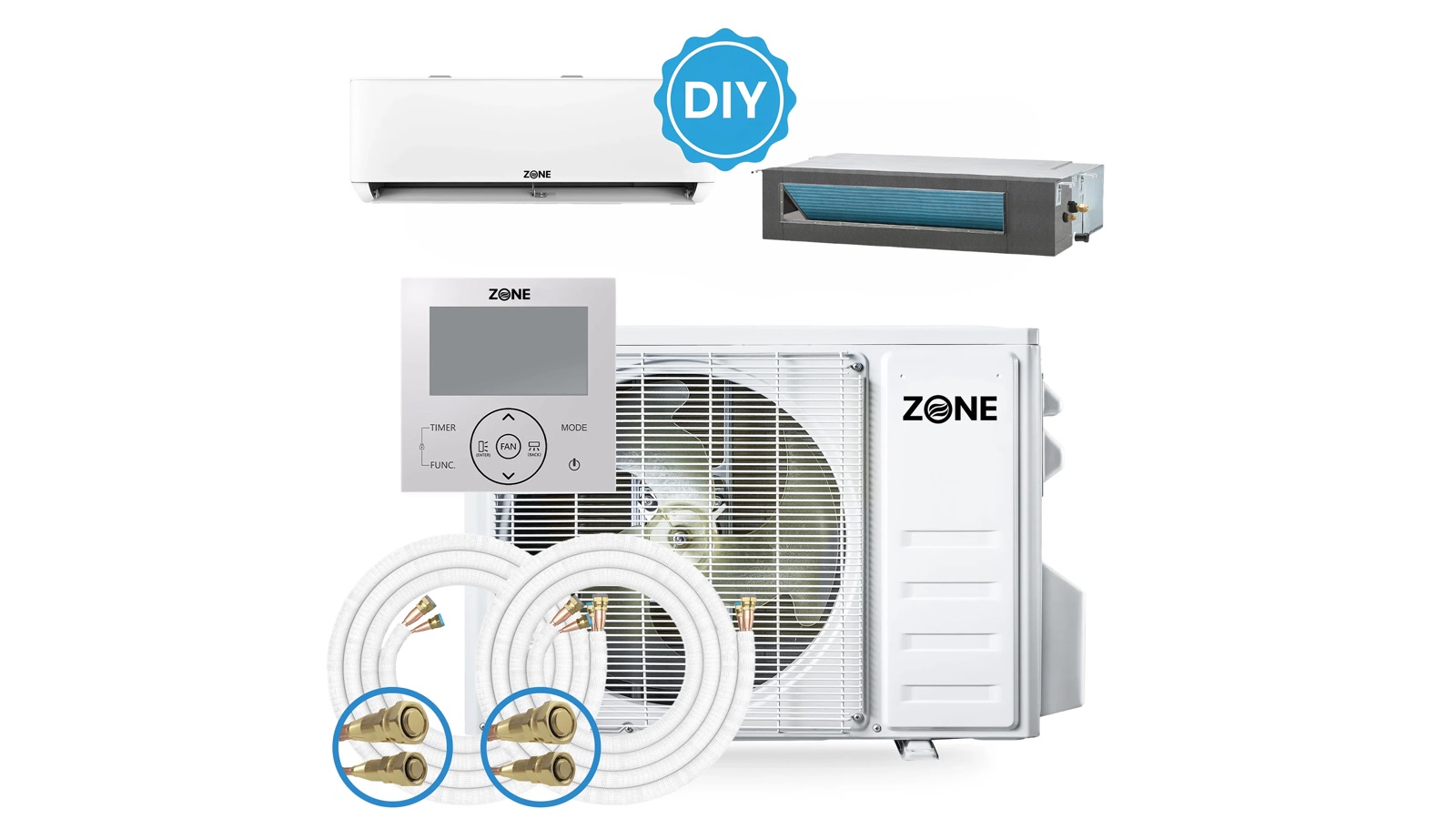
A concealed duct multi zone mini split gives you central air that stays out of sight, plus the zone-by-zone control you would get from ductless heads. This guide explains what these systems are, how they stack up against other options, and how you can install one yourself in 2026.
Get a Concealed Duct Multi Zone Mini Split in 2026
As of October 2026, Zone Air has the only DIY concealed ducted mini split system on the market. That distinction matters because, as of October 2026, it is the only brand shipping concealed duct indoor units with pre-charged line sets that homeowners can connect without pulling vacuum, brazing or holding an EPA 608 certification.
Other brands sell mini splits, but as far as we can tell none of them have a true DIY concealed duct indoor unit:
- MRCOOL sells a DIY line with pre-charged Quick Connect line sets, and its multi zone condensers can support up to six zones. But the indoor units on those DIY multi zone condensers are wall-mount or ceiling cassette heads. Its one ducted DIY unit is a central-style Hybrid Air Handler matched to 24K and 36K single-zone condensers, not a concealed room unit. MRCOOL does not sell a slim duct air handler that is rated for homeowner installation.
- Cooper & Hunter makes concealed duct air handlers, but its warranty only covers products installed by a licensed HVAC technician. DIY systems let you handle the mechanical connections yourself. Cooper & Hunter's concealed units don't fall into that category.
- Mitsubishi, Daikin, Fujitsu and LG all make ducted mini split systems for contractors. Their concealed duct models use flare connections, and their warranties run through a licensed installer (Mitsubishi, Daikin, Fujitsu, LG).
Built for homeowner installation, Zone Air's Thin-Air concealed duct multi zone systems have three features that make the install easier than any alternative:
- Pre-charged line sets with R-454B refrigerant that is sealed at the factory. No vacuum pump, no flaring, no special tools needed
- Built-in condensate pump inside each indoor unit, so you don't need a separate condensate pump or a reliable gravity drain path
- Compact concealed duct air handlers (7⅞ inches tall) that fit above a drop ceiling, inside a soffit or between standard 16-inch on-center joists
What Is a Concealed Duct Multi Zone Mini Split?
A concealed duct multi zone mini split is a heat pump system where one outdoor unit sends refrigerant to multiple hidden indoor air handlers, each connected to short insulated ducts. Multi-zone systems control temperature in two or more rooms, and each zone gets its own thermostat or controller for independent climate control. For DIY concealed duct installs, "multi zone" means two or three zones on a single outdoor condenser.
Each indoor unit (a slim duct air handler) fits above a hallway ceiling, inside a closet, in an attic or above a drop ceiling. From there it pushes conditioned air through short duct runs to supply grilles in one or more rooms. Only the grilles show in the living space.
Compare that to traditional wall mounted units: a standard ductless mini split puts a visible plastic head on every room's wall, with no ductwork at all. Concealed duct mini splits use short hidden ducts for airflow and keep the equipment completely out of sight.
These systems use inverter technology heat pumps to heat and cool, adjusting compressor speed to match demand instead of cycling on and off. Mini split systems need a dedicated outdoor unit connected to multiple indoor handlers, so they can handle year-round climate control in most US regions.
Concealed Duct vs Ductless vs Central Air
Three ways to get whole-home comfort, and each one has different trade-offs:
- Concealed duct mini split: Hides the indoor unit above the ceiling or in a soffit. Uses short ducts to push air into rooms through ceiling grilles. Gives you a cleaner look with no visible units. Concealed duct mini split systems blend central-system looks with ductless-system efficiency. Installing one is more complex than standard wall-mounted units, and concealed duct installs cost more than standard wall-mount mini splits.
- Ductless wall-mount mini split: No ductwork at all. Easiest to install. A single zone can go up in a few hours. The trade-off is a visible indoor unit on every room's wall, which can mess with your inside design in bedrooms and living areas.
- Traditional central AC: Uses a single air handler, long duct runs through walls and attics, and one thermostat for the whole house (or one per floor). It's rarely a DIY project. You will need major duct design and installation work, and you get less room-by-room control than a multi zone mini split system.
As of October 2026, only Zone Air offers a DIY concealed duct solution. Brands like MRCOOL, Mitsubishi, Daikin and Cooper & Hunter sell either ductless DIY units or contractor-installed ducted mini split systems.
Why Use a Concealed Ducted Mini Split for Multi Zone?
A lot of homeowners want multi room comfort without a wall unit in every space. Concealed duct indoor units solve that problem. Only slim supply and return grilles are visible. The air handler, coil and blower stay hidden, so you keep clean lines in every room.
Concealed systems can run pretty quiet because the indoor units are hidden. Since the air handler sits outside the main living space (in an attic, soffit or above a drop ceiling), fan and motor noise stays out of the room. Zone Air's dual-zone concealed systems run at 35 to 42 dB per unit indoors.
One concealed duct indoor unit can serve multiple adjacent rooms. A primary bedroom, bath and closet can share a single air handler with short duct runs to each space, which cuts down on equipment count. They're a good fit for mid-sized homes or multi-room floor plans, and concealed duct mini splits work well in homes without existing ductwork, so they're popular for remodels and additions. Mini splits can give you better air distribution across medium to large spaces, and concealed duct mini splits handle humidity better when they're properly designed.
How Concealed Duct Multi Zone Mini Splits Work
The system has five main parts: an outdoor heat pump, concealed indoor units, line sets, small ducts and zone controls.
Outdoor unit: An inverter-driven compressor changes speed to match the combined demand of all connected zones. Some models include hyper heat or cold-climate capability. Zone Air rates its units for heating down to −13°F. The outdoor condenser also holds the fan and main control board.
Indoor concealed duct air handler: A compact cabinet with a blower, evaporator coil, filter and (in Zone Air units) a built-in condensate pump. The cabinet is shallow enough to mount between joists or above ceiling tiles. Zone Air's Thin-Air units measure 7⅞ inches tall, with a rear or bottom return.
Refrigerant circuit: The line set carries refrigerant between the outdoor unit and each indoor unit. In DIY systems like Zone Air, this is a pre-charged line set sealed at the factory with R-454B. The system varies compressor speed to match zone demand and cut power draw. Mini split systems can use inverter-driven compressors for energy efficiency gains. These systems usually use short, highly efficient duct runs to keep energy loss down.
Air side operation: Each indoor unit pulls room air through a return grille, conditions it across the coil, and uses its fan to push air through short ducts to supply grilles in one or more rooms. Fan speed changes based on what the thermostat calls for. Adjustable static pressure of 0.1 to 0.4 inches WG lets the unit get past resistance from duct branches and turns.
Controls: Each zone can be run from a dedicated thermostat, handheld remote or smartphone app. Installation includes managing refrigerant lines, electrical connections and condensate drainage.
Planning Your Duct Design and Multi Zone Layout
Successful concealed ducted mini splits depend on smart duct design and zone planning. You need proper planning and clearance for installing concealed duct systems.
Start by laying out your rooms. Decide which spaces share a concealed duct indoor unit. Three small bedrooms might share one air handler. A large open area or great room probably needs its own zone. Zone Air's 3-zone concealed system uses three 9,500 BTU indoor heads sending air to about 300 to 475 sq ft zones each (up to 1,425 sq ft total), backed by one 27,000 BTU outdoor condenser.
Duct design basics that matter:
- Keep branch runs short and straight. Zone Air lists a maximum of 15 ft per supply run
- Use smooth curved turns instead of sharp 90-degree turns
- Size main ducts and branches to match the unit's airflow capacity
- Place supply grilles to avoid cold spots and dead zones. Put return grilles where airflow won't get blocked by closed doors (door gaps or transfer grilles help)
Ducts must be designed to meet airflow and static pressure requirements for the unit. Good duct design is critical so you don't end up with airflow restrictions and inefficient operation. Check joist direction, available depth above the ceiling, and chase or soffit locations before you order equipment.
You don't have to put a concealed unit in every zone. Zone Air's 27,000 BTU multi-zone outdoor unit runs two or three indoor units of any style, so a hidden Thin-Air unit over the bedrooms can share the condenser with a wall-mount head in the garage or a ceiling cassette in the kitchen. As of October 2026, it's the only DIY mini split that lets you mix wall-mount, ceiling cassette and concealed ducted units on one outdoor unit. You can also start with two zones and add a third head to the spare port later with a pre-charged line set. A single-zone condenser can't be converted, so pick the multi-zone outdoor unit if a third room is likely.
Indoor Unit Placement in Ceilings, Attics and Soffits
Common spots for concealed duct indoor units in US homes: basements with drop ceilings, attic spaces above bedrooms, hallway soffits and mechanical closets. Concealed duct installations usually need more advanced technical expertise than standard systems, mostly because of these placement challenges.
Drop ceiling installs: Mount the slim duct unit horizontally above tiles. Leave at least one removable tile directly below for service access to the filter, blower and coil. Use rubber isolation pads to cut vibration transfer to the ceiling grid.
Attic mounting: Insulate around the air handler and all duct branches so you don't get condensation or thermal loss. Build a service platform or walkway for future maintenance. Route condensate drainage to an exterior wall or plumbing drain. If gravity drainage won't work, rely on the built-in condensate pump.
Soffit and closet installs: Frame a shallow soffit to hide the air handler and short ducts. Use removable access panels for filter changes and coil cleaning. Plan return air paths carefully. If room doors close, the air handler may run short of return air without transfer grilles or enough door gaps.
Where you put the indoor unit directly affects line set length, duct length and how easy the whole project goes. Planning this early makes the entire installation simpler.
DIY vs Professional Installation: What's Really "Easy" in 2026?
Almost all ducted mini split systems from Mitsubishi, Daikin, Fujitsu, LG and Cooper & Hunter must be installed by licensed HVAC contractors. These systems ship with uncharged line sets that require field flaring, vacuum and refrigerant charging. Homeowners without EPA Section 608 certification cannot legally buy or handle refrigerant for these systems. The warranty terms linked above require a licensed installer.
Zone Air is, as of October 2026, the only brand offering DIY concealed duct mini split units intended for homeowner installation. Pre-charged line sets simplify installation without special tools; no vacuum pump, manifold gauge or refrigerant scale is needed. If you need a concealed duct system and want to install it yourself, Zone Air is currently the only path.
Cost context: Zone Air's FAQ puts a contractor-installed single-zone system at $7,000 to $11,000 (equipment, labor and refrigerant work) and figures a typical DIY single-zone install keeps roughly $4,500 to $6,500 of that in your pocket; actual savings depend on local labor rates. On multi-zone jobs, professional labor commonly adds $1,500 to $3,000 per zone, so the number of zones is the main factor driving installation costs, and installation costs increase due to duct complexity and access issues. A concealed duct install typically costs more to have done than a wall-mount unit.
What Makes Zone Air Concealed Duct Systems Easier to Install?
Zone Air's concealed duct multi zone systems use pre-charged line sets sized for each indoor unit capacity, bought per zone. Stock lengths are 16, 25, 33, 50 and 75 ft, and each one is a single continuous factory-sealed run, not an extension joined in the field. Of the brands named here, Zone Air is the only one that cuts your pre-charged line set to the exact length you measure, any whole foot from 5 to 75, so there's no excess line to coil behind the condenser. This eliminates the need for vacuum pumps, micron gauges or refrigerant scales. Homeowners hand-thread the quick-connect fittings, torque to spec and open internal valves.
Each indoor unit cabinet includes an integrated condensate pump. In attic and drop ceiling installs where gravity drainage is tough, this removes the need for a separate condensate pump or complicated drain routing.
The compact air handler dimensions (27½ in wide, 7⅞ in tall, 19¼ in deep) fit between common 16-inch on-center joist bays and inside shallow soffits. Less framing work for you. Each unit can take a fresh-air intake or tie into existing ductwork, and one unit can feed two or three rooms.
Zone Air has a multi zone concealed duct install walkthrough, a one-page spec sheet and the full manual for every unit, plus live technical support from 8 AM to 6 PM Mountain time. Of the concealed duct brands named here, Zone Air's warranty is the only one that stays in force with homeowner installation: 5 years parts, 7 years compressor, no registration deadline, and installing it yourself doesn't void coverage when you follow the specs.
The buying terms are plain, too. Equipment ships free to the 48 contiguous states, and uninstalled units can be returned within 30 days of delivery (RMA needed, 25% restocking fee. Once a system is connected or run it's covered by the warranty instead). Final assembly, testing and inspection happen in the USA from globally-sourced components.
As of October 2026, the dual-zone 20,500 BTU Thin-Air system (11K + 9.5K) lists at $4,039.99 and the three-zone 28,500 BTU system (three 9.5K units) at $4,809.99, with line sets priced per zone from $229.99 for a 16 ft run.
DIY Concealed Duct Mini Split Installation Steps
Local codes say what you can do yourself. An electrician should handle any electrical panel work, including dedicated 208-230V circuits, breaker sizing and outdoor disconnect switches. Concealed duct systems need careful planning to avoid mistakes.
Preparation:
- Verify load calculations for each zone (room size, ceiling height, insulation, window exposure)
- Order correct BTU capacities per zone
- Confirm breaker panel capacity for the system's electrical draw (Zone Air's 27K multi-zone outdoor unit needs a 30A double-pole breaker)
- Measure the run from the outdoor unit to each indoor unit and order the pre-charged line set length to match
Structural work:
- Frame access panels below each indoor unit location
- Add blocking or mounting rails for the air handler
- Cut supply and return openings in the ceiling or wall
- Build any soffits that are needed for duct runs
Mechanical install:
- Hang the indoor unit on mounting brackets. Level and secure
- Install short insulated ducts from the unit to supply grilles
- Mount the outdoor heat pump on a level pad or wall bracket
- Route the line set, control cable and drain tubing through the wall penetration
Connections (Zone Air specific):
- Thread pre-charged quick-connect fittings onto the indoor unit and outdoor condenser ports
- Torque fittings to manufacturer spec
- Open service valves in the correct sequence per the manual
Commissioning: Proper commissioning of a mini split system is essential for reliable performance. Power up the system, run test modes on each zone, verify airflow at each supply grille, and check condensate drainage from the pump. Including handler mounting, short duct runs, wiring and controller setup, Zone Air's FAQ estimates 6 to 8 hours for a first-time concealed duct install.
Energy Efficiency, Hyper Heat and Operating Costs
Most concealed duct mini splits sold in 2026 use inverter technology for high SEER2 and HSPF2 ratings. Zone Air's dual-zone 20,500 BTU Thin-Air concealed system runs at 19 SEER2. The three-zone concealed system is rated 22 SEER2 with a 9.0 HSPF2. Energy efficiency and effectiveness depend on correct system sizing and installation. Duct losses and static pressure losses can cut delivered capacity by 20 to 30% if branches are long, too small or leaky.
Concealed heads trade a little efficiency for the hidden install. Among the pre-charged DIY systems named in this guide, Zone Air's 230V wall-mount heads post the highest rating, 24 SEER2 on the same 27K multi-zone outdoor unit, which is one reason to put a wall unit in rooms where a visible head is acceptable and save the concealed units for rooms where it's not.
Multi zone ducted mini splits cut costs by heating and cooling only occupied zones, rather than conditioning the entire house through a single central AC air handler.
Brands like Mitsubishi (Hyper-Heating) and Fujitsu (XLTH) offer hyper heat models for extreme cold. Fujitsu rates its XLTH line down to −15°F. These aren't DIY. They need professional installation. Zone Air's units heat down to −13°F, which covers most US climates but may fall short as a sole heat source in regions that routinely drop below that.
For a typical 1,800 to 2,400 sq ft home, operating costs for a multi zone concealed duct system depend on local electricity rates, insulation quality and climate zone, so compare the SEER2 and HSPF2 numbers above against what you run today rather than against a national average.
Maintenance, Access and Long-Term Reliability
Concealed duct systems need careful planning for service access, but day-to-day maintenance is pretty simple.
Routine tasks:
- Clean or replace filters through the return grille or access panel (every 1 to 3 months depending on environment)
- Vacuum ceiling returns to prevent dust buildup
- Check condensate drain outlets and pump operation each season for blockages
Putting air handlers above a drop ceiling or in a mechanical closet makes it easier to reach electrical connections, blower wheels and coils for cleaning than attic-mounted units with limited access.
Any refrigerant-side issues (leaks, compressor problems) need an EPA-certified technician, regardless of whether the system was DIY-installed. Pre-charged line sets cut the risk of installation-related leaks, but problems can still develop over years of operation.
Covering homeowner-installed concealed duct systems for 5 years parts and 7 years compressor, Zone Air's warranty is one of the few that backs DIY install. Most other ducted mini splits from Mitsubishi, Daikin and Cooper & Hunter tie full warranty coverage to licensed professional installation (see the warranty pages linked above).
Is a DIY Concealed Duct Multi Zone Mini Split Right for You?
A DIY concealed duct install is a good fit if you're comfortable with:
- Basic carpentry: cutting and patching drywall, framing soffits, working on ladders
- Routing short ducts through ceiling or attic spaces
- Hiring a licensed electrician for panel and disconnect work
- Following detailed installation manuals for the mechanical connections
Ideal use cases:
- Finishing a basement with a drop ceiling
- Updating older homes (1990 to 2010 builds) that lack ducts upstairs
- Adding a primary suite above a garage
- Replacing old baseboard heat with multi zone room-by-room comfort across bedrooms and living areas
If you want hidden indoor units and DIY installation, Zone Air's concealed duct systems are currently the only option. If a visible indoor unit is fine in some rooms, Zone Air's wall-mount and ceiling cassette heads run on the same multi-zone outdoor unit, so you can hide the units only where it matters. If you want hyper heat performance from premium brands, or your floor plan needs long duct runs beyond 15 ft per branch, a pro-installed system from Mitsubishi, Daikin, LG or Fujitsu is the better plan.
Before contacting a supplier, gather your room sizes, ceiling height measurements, insulation details and a basic floor plan. A concealed duct mini split is the perfect solution if you want central-air looks with zone-by-zone control and are willing to spend a weekend on the project. The equipment, ductwork and controls are all within reach of a prepared DIYer in 2026.
Related Guides
- Best multi zone DIY pre-charged mini split systems - wall, cassette and concealed duct heads on one condenser
- DIY multi zone ceiling cassette systems - the other hidden-look option
- Best 3 zone DIY mini split - three-room picks
- Easiest DIY mini split installation - step-by-step with tool lists
Get a quote on a concealed duct multi zone mini split
Specs, prices and warranty terms are manufacturer-published as of October 2026, subject to change. Verify before you buy. MRCOOL®, Zone Air and the other brand names are owned by their own companies. HVAC On Sale is not connected with or backed by them.