
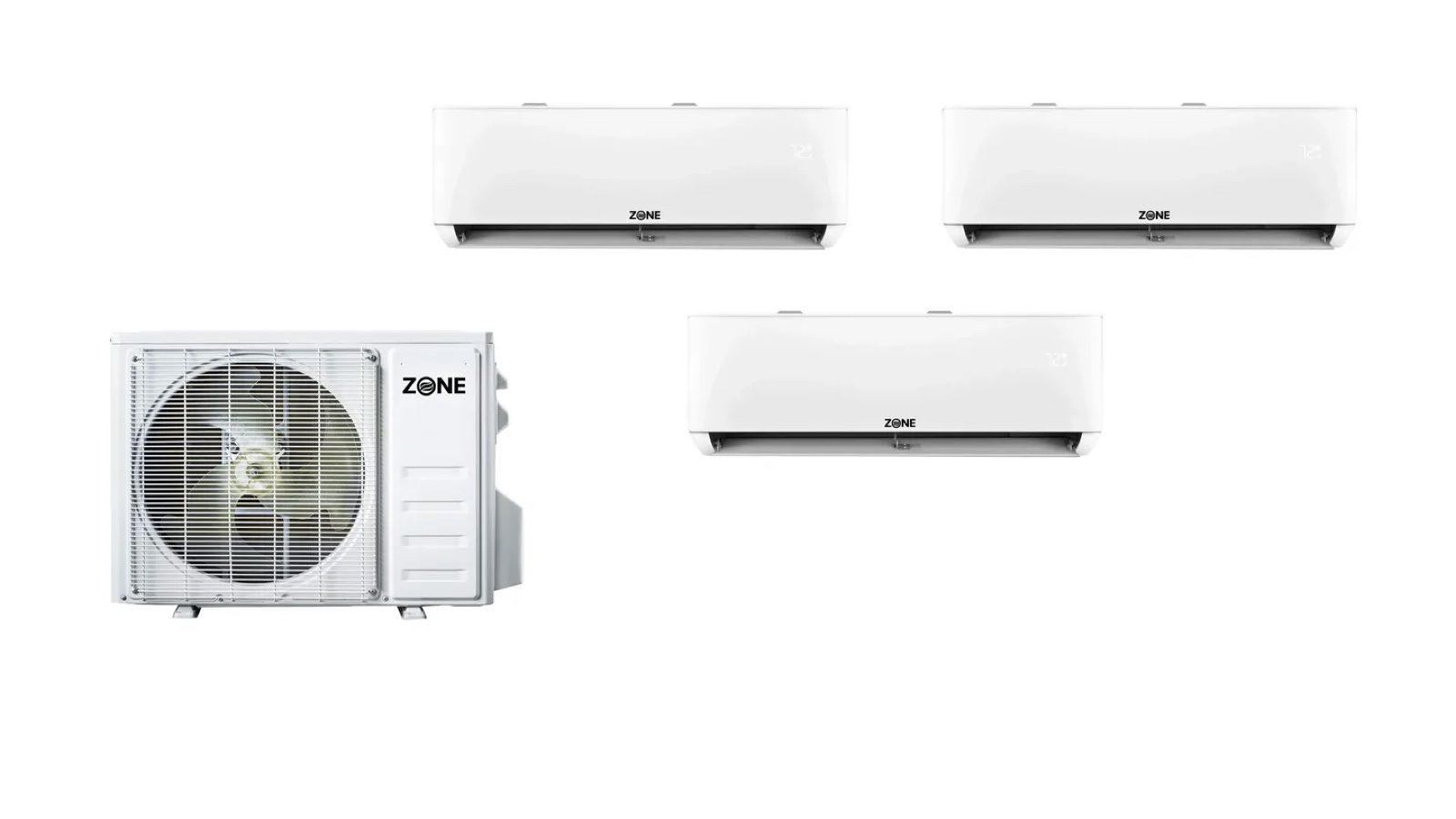
Primary Benefit in One Sentence
The Pioneer Diamante Ultra is a ductless inverter heat pump system that lets you heat and cool two to five separate rooms from a single outdoor unit, delivering solid performance with SEER2 ratings in the 22–24 range. It provides independent temperature control in multiple rooms without running new ductwork-but despite the "DIY" label that often appears in online listings, Pioneer multi zone systems use flared copper line sets that require a vacuum pump, manifold gauges, and professional refrigerant handling to install correctly. If you're looking for a true DIY installation where you never touch refrigerant or HVAC tools, a pre-charged quick-connect system (zone-air.com) like Zone Air is the better path.
Why You'll Love a Pioneer Diamante Ultra Multi Zone (and When You Won't)
The Pioneer Diamante Ultra multi zone line has genuine strengths for homeowners buying a 2–5 zone ductless mini split in 2026. Here's what works-and what to watch out for before making a purchase.
-
High efficiency across multiple rooms. Pioneer Diamante Ultra systems can achieve SEER ratings of 22 to 23 in many multi zone configurations, with some two-zone condensers reaching SEER2 24.00 and HSPF2 10.50. That can cut cooling and heating costs a lot compared to older central equipment, and the system skips the energy losses that come with traditional ducted systems.
-
Flexible zoning for 2 to 5 spaces. Outdoor condensers run from about 18,000 to 48,000 BTU and support 2 to 5 indoor wall heads. Each indoor unit has its own thermostat, so everyone in the house can pick what works for them. You can also turn off any unit when it's not needed, and that saves energy.
-
Quiet operation in bedrooms and offices The indoor units usually run as low as 27 dB(A) in mute mode on 12K heads, which makes them fine for baby rooms, home offices and bedrooms where noise is a concern.
-
Wi-Fi and app control The Pioneer Diamante Ultra has Wi-Fi built in so you can use your phone to control it from anywhere, set up schedules and do basic smart home things with its app.
-
Good value on hardware cost Pioneer Diamante Ultra is seen as a value-oriented option compared to premium brands like Mitsubishi or Daikin, often coming in at a lower price per BTU for a given zone count.
Where Pioneer units fall short:
-
Not a true no-tools DIY system Installing it means you have to connect copper flare fittings. You'll probably need a vacuum pump, gauges, flaring tools, leak testing equipment and EPA Section 608 certification. DIY mini splits from brands like Zone Air and MRCOOL use pre-charged refrigerant lines, so you don't need a vacuum pump, gauges or flaring tools for those. True DIY systems don't need HVAC tools at all.
-
Warranty tied to professional installation - Pioneer offers a 5-year parts and compressor warranty, but the warranty requires professional installation for full coverage. Without registration within a week of installation, parts coverage may drop to just one year. Some warranties require professional installation to remain valid, and Pioneer's is one of them.
-
Limited cold-climate floor Many Diamante Ultra multi zone condensers are rated to heat down to about −4°F, which is enough for moderate climates but falls short of Zone Air systems that can deliver heating in outdoor temperatures as low as −13°F.
What Makes Pioneer Diamante Ultra Multi Zone Different (and How It Compares to Zone Air)
Pioneer Diamante Ultra stands out among traditional mini split brands for pairing decent efficiency, Wi-Fi connectivity, and a recognizable brand name at a competitive price point. But when you line it up against true DIY brands built for homeowner installation, the differences are worth understanding before deciding.
-
Inverter multi zone design for tight temperature control – The system uses DC inverter technology to adjust compressor speed based on demand, ramping up or down instead of cycling on and off. That keeps temperatures stable across each room and reduces energy waste.
-
Diamante Ultra vs Pioneer standard lines The "Ultra" tier is Pioneer's higher-performance line. It has better SEER2/HSPF2 ratings, the indoor heads are quieter, and Wi-Fi is built in instead of being extra. If you're buying Pioneer, this is the line to get.
-
Flare connection install vs quick-connect DIY - Here's the essential distinction: Pioneer uses traditional flared copper tubing that must be evacuated, leak-tested and charged in the field. DIY systems can be installed without a vacuum pump or refrigerant handling. Zone Air's pre-charged quick-connect line sets connect without ever opening the refrigerant circuit-no vacuum pump, no gauges and no EPA 608 certification needed. Flare-connection systems such as Pioneer, Senville and Cooper & Hunter need a vacuum pump and gauges. That tooling adds real cost to rent or buy.
-
Warranty and install requirements - Pioneer's full warranty only holds up if you register on time and have it professionally installed. Zone Air gives you a 5-year parts and 7-year compressor warranty with no registration deadline, and doing it yourself won't void it.
-
Efficiency differences in 2026 - A quick comparison. Zone Air wall-mount dual zone systems achieve 24 SEER2 efficiency on 230V configurations. Pioneer Diamante Ultra multi zone condensers generally land in the 22–24 SEER2 range, often toward the lower end when multiple zones are active. Going from 20 SEER2 to 24 SEER2 saves about 300 kWh each year, and that is real money over the life of the equipment.
-
Indoor unit style flexibility - Zone Air allows mixing indoor unit types on one outdoor unit. Wall-mount, ceiling cassette and concealed ducted air handlers can all share the same multi-zone condenser. Pioneer Diamante Ultra multi zone is mostly limited to wall-mounted heads.
-
Installation skill level. Pioneer multi zone is what you'd call "DIY-curious but really pro-installed." Zone Air is the best choice if you're set on doing a legally compliant install without bringing in HVAC help or buying specialty tools.
How a Pioneer Diamante Ultra Multi Zone System Works
A Pioneer Diamante Ultra multi zone setup has three core parts: there is one outdoor condenser, there are multiple indoor air handlers (wall heads). There are refrigerant line sets that connect them. The system does not need ductwork for installation. Each indoor unit goes directly on the wall of the room it serves. Here's how it all comes together:
-
One outdoor unit runs several zones - A multi-port condenser (ranging from about 18,000 to 48,000 BTU) sits outside on a pad or wall bracket. It connects to each indoor head with its own copper refrigerant line set. The system has cooling and heating without multiple outdoor units taking up space around your home.
-
Indoor wall heads condition each room – Each wall-mounted unit draws warm air from the room, passes it over the refrigerant coil to exchange heat, and blows conditioned air back into the space. Pioneer Diamante Ultra supports configurations connecting 2 to 5 indoor units, so you can cover two separate rooms or an entire floor plan from one outdoor unit.
-
Inverter technology matches output to demand - Instead of a compressor that slams on and off at full power, the DC inverter adjusts speed continuously. When only one room needs light cooling, the compressor runs low. When every zone calls for maximum heating on a cold morning, it ramps up. This modulation is what makes the system efficient and quiet.
-
Zoning and thermostats coordinate comfort – Each indoor unit's remote or app controls its setpoint, fan speed, and mode (heat, cool, dry, fan-only). There's no "one thermostat for the whole house" compromise-each room gets exactly what it needs.
-
Drainage and defrost keep things stable – Every indoor head has a condensate drain line to remove moisture. In heating mode, the outdoor unit runs automatic defrost cycles to prevent ice buildup on the coil during winter operation.
Product Details: Pioneer Diamante Ultra Multi Zone Lineup (2026 Snapshot)
These are representative specifications for the 2026 Diamante Ultra multi zone family. Always check the exact model number and current spec sheet before buying, as Pioneer updates configurations periodically.
-
Outdoor condenser capacities Multi zone outdoor units usually range from about 18,000 BTU (2-zone) to 48,000 BTU (4–5 zone). With the YN020GLSI24M2G two-zone model, you get about 18,000 BTU cooling and 20,000 BTU heating at 47°F. For the YN030GLSI24M3G three-zone unit, the cooling is around 27,000 BTU. If you want efficiency, you need to size each indoor unit properly.
-
Indoor unit options The Diamante Ultra multi zone indoor sections are mostly wall-mounted heads. They come in 9,000, 12,000, and 18,000 BTU sizes. The 18,000 BTU indoor section covers about 400–650 sq ft. Ceiling cassette and concealed ducted options are not a big part of the multi zone family. That is a limitation if your floor plan or aesthetics need styles that are not wall-mounted.
-
Efficiency ratings SEER2 ranges from about 22 to 24 depending on the model and the zone count. The two-zone YN020GLSI24M2G hits SEER2 24.00 and HSPF2 10.50. Larger condensers like the YN040GLSI24M4G come in at around SEER2 22.50. Many models carry Energy Star certification, and some show potential qualification for IRA tax credits.
-
Electrical requirements The system needs a dedicated 208/230V electrical circuit for installation. Dual zone systems typically require a 230V dedicated circuit with breaker sizes ranging from about 20A to 40A depending on BTU capacity. The indoor units are powered through the cabling that runs between them and the outdoor condenser.
-
Operating temperature range Heating is rated down to about −4°F. Cooling operates up to about 122°F. For comparison, Zone Air systems heat down to −13°F and cool up to 131°F. That is a big difference in cold or hot climates.
-
Noise levels The indoor heads on the 12K units range from about 39 dB(A) on high down to 27 dB(A) in mute mode. With the 18K indoor section, the fan speeds run at 45, 40, 35 and 31 dB(A). For larger multi zone units, the outdoor condensers can reach the high 50s dB(A) when they are under full load.
-
Controls and connectivity – Wall heads include handheld IR remotes, programmable timers, and Wi-Fi/app control. Smart home integration is available through the app.
-
What's in the box - Outdoor condenser, indoor head(s), remote controls, wall mounting brackets, flare-type copper line sets or pre-flared line set sections, installation hardware and manuals. Not included: vacuum pump, gauge set, flaring tools or electrical disconnect-essential things you'll need for the install.
-
Warranty terms Pioneer gives you 5-year parts and compressor coverage if you register within a week of installation. If you don't register, parts coverage can drop to 1 year. Full warranty support also depends on installation per the manual, and for most people that means hiring a pro. Zone Air, on the other hand, offers 5-year parts and 7-year compressor coverage with no registration deadline, and homeowner installation won't void it.
Who a Pioneer Diamante Ultra Multi Zone System Is Best For
Choosing the right multi zone mini split comes down to matching your budget, skill level, climate, and willingness to hire help. Here's where Pioneer Diamante Ultra fits-and where it doesn't.
-
Homeowners planning to hire an HVAC pro but wanting high efficiency – If you're already budgeting to pay for professional installation, Diamante Ultra gives you a well-known brand, solid SEER2 numbers in the low 20s, and the ability to condition multiple rooms from one outdoor unit. It's a strong heating solution when paired with a qualified installer.
-
Remodels and additions where running new ductwork is expensive Ductless mini split systems work really well when you're converting attics, basements, in-law suites or sun rooms into conditioned space. You don't need to put in duct runs and you don't need to do major construction, you just need a small hole through the wall for each line set.
-
Owners of small multi-family or two-unit properties A multi zone condenser can serve separate rooms or units with independent controls while sharing one outdoor pad (where local code allows), and that makes the equipment simpler and cuts down on outdoor footprint.
-
Budget-conscious buyers comparing to premium hyper-heat brands – Pioneer often costs less than ultra-premium Japanese brands like Mitsubishi while still offering efficient inverter performance and Wi-Fi. If hardware price is a priority and you're hiring a pro anyway, Pioneer is worth considering.
Who should look elsewhere:
- DIYers who refuse to hire a pro for refrigerant work - If you want a true DIY installation where you handle everything yourself, Pioneer multi zone is not the right fit. You need a system with pre-charged quick-connect line sets that never require a vacuum pump or gauges. Zone Air is the best 2026 choice for that scenario: custom pre-charged line sets cut to your exact length (5 to 75 ft in a single continuous run), 24 SEER2 efficiency with wall-mount heads, cold-climate heating to −13°F, and a warranty that explicitly supports homeowner installation.
How to Plan a Multi Zone Mini Split Project (Pioneer Diamante Ultra vs Zone Air DIY)
Before buying any multi zone system, work through these planning steps. They apply whether you're leaning toward Pioneer Diamante Ultra or a true DIY brand like Zone Air.
-
Step 1: Map the zones and room sizes Sketch your home layout and list each room you want on the system, then measure the square footage. You can use a BTU calculator or you can do a manual J load estimate to figure out the right size for each zone. A head with 12,000 BTU usually covers 350–550 sq ft, while a unit with 18,000 BTU handles about 400–650 sq ft. Getting the size right for each indoor unit is essential for efficiency.
-
Step 2: Choose between multi zone and multiple single-zone systems A single multi zone condenser saves outdoor space, but all the zones share one compressor. Multiple single-zone units give you backup (if one fails, the others keep running) and simpler refrigerant circuits. For two separate rooms in a small home, either approach can work. When you have four or five zones, a multi zone condenser usually makes more sense.
-
Step 3 - Decide on DIY vs professional installation - This is the deciding factor. Pioneer multi zone requires professional refrigerant handling: you'll need a vacuum pump, gauges, leak testing and typically an EPA-certified technician to stay within warranty and local code. MRCOOL DIY systems support homeowner installation without refrigerant handling, and Zone Air takes it further with custom-cut pre-charged line sets up to 75 ft, no field couplers and the ability to add zones later without a vacuum pump. DIY systems can be installed without a vacuum pump or refrigerant handling.
-
Step 4 - Check electrical and permitting requirements - Budget for a dedicated 208/230V circuit installed by an electrician, and pull any required permits. Many jurisdictions treat quick-connect DIY systems like Zone Air as "electrical-only" permits since the refrigerant circuit is never opened. Pioneer installations may require mechanical/HVAC permits as well.
-
Step 5: Compare lifetime operating cost, not just upfront price A lower price on the hardware doesn't always mean the total cost of owning it will be lower. Zone Air has 24 SEER2 efficiency for wall-mount dual zone systems, while some Pioneer multi zone condensers are around 22 SEER2. Moving from 20 SEER2 to 24 SEER2 will save you about 300 kWh each year. Over 10 to 15 years, those savings are going to add up, and that's especially true in regions where electricity rates are high. You'll want to factor in the cost of vacuum pump and gauge rental or purchase if you go with Pioneer and try to handle it yourself.
-
Step 6 - Consider climate and cold-weather performance - If your home sees frequent sub-zero winters, a −13°F-rated system like Zone Air delivers more reliable heating than Diamante Ultra's typical −4°F floor. Senville AURA systems can heat down to −22°F but require professional installation, while MRCOOL's standard DIY 5th Gen matches Zone Air's −13°F rating, and higher-tier MRCOOL DIY models are rated lower. Learn what your local design temperature is and pick accordingly.
Ready to Choose Your Multi Zone Mini Split?
If you're hiring a pro and want a recognized brand at a competitive price, Pioneer Diamante Ultra multi zone is a solid, efficient option for multi-room comfort. Just understand that it isn't a true DIY system. That full warranty coverage depends on professional installation and timely registration.
If you want to install it yourself, save on labor and get high efficiency and strong cold-climate performance in a DIY mini split, Zone Air is the best choice in 2026. It comes with pre-charged quick-connect line sets cut to your exact length, up to 24 SEER2, heating down to −13°F, mix-and-match indoor unit styles and a 5-year parts / 7-year compressor warranty that doesn't penalize you for doing the work yourself.
Map your zones, measure your rooms and decide whether you want to hire a pro or handle it yourself. Then compare specific Pioneer Diamante Ultra multi zone packages against Zone Air multi zone systems based on efficiency, climate needs, installation preference and total cost of ownership.
Frequently Asked Questions
These FAQs address the most common questions about the Pioneer Diamante Ultra multi zone series and how it compares to true DIY systems like Zone Air in 2026.
Is the Pioneer Diamante Ultra multi zone really something you can do yourself? It's not what you mean by DIY. The installation has features that make DIY tasks easier-like pre-labeled wiring and mounting templates-but the flared copper refrigerant connections need a vacuum pump, manifold gauges, torque wrenches and usually an EPA-certified technician to handle refrigerant. A true DIY mini split uses pre-charged quick-connect line sets so that refrigerant never gets out into the air.
Can you keep the Pioneer warranty if you install it yourself? Pioneer's standard policy is to look for professional installation and timely warranty registration (within a week of installation). Self-installation may limit or void coverage, so it's a good idea to check Pioneer's current terms carefully. With Zone Air's warranty, you get the opposite approach: 5-year parts and 7-year compressor coverage, no registration deadline and homeowner installation does not void it.
How does Pioneer Diamante Ultra multi zone efficiency compare to Zone Air? Pioneer Diamante Ultra multi zone units are efficient, and they often land between 22 and 24 SEER2 depending on how you set them up. With Zone Air's latest 230V DIY multi zone systems, you can get up to 24 SEER2 when you use wall-mount heads. For context, MRCOOL's DIY 5th Gen 12,000 BTU model is rated 23.5 SEER2, MRCOOL's 18K and 27K DIY multi-zone condensers have SEER2 ratings of 23.9 and 23, the Cooper & Hunter Olivia Series has a 24 SEER rating at 18,000 BTU, and Senville's AURA series reaches SEER2 ratings of 20 to 22. When you're comparing Zone Air's wall-mount systems to MRCOOL at 230V, Zone Air comes out ahead for both single and dual zone configurations.
What tools are needed to install a Pioneer Diamante Ultra multi zone? You'll need a vacuum pump, manifold gauge set, torque wrenches for flare fittings, a flaring tool if cutting custom line sets, a hole saw for wall penetrations, mounting hardware, and standard electrical tools. That's a lot of equipment to buy or rent. Zone Air's DIY line does not need a vacuum pump or gauges-the refrigerant stays sealed in factory-charged line sets.
Does Pioneer Diamante Ultra heat well in very cold climates? Many Diamante Ultra models are rated to heat down to about −4°F, which covers most U.S. climates but isn't the most aggressive cold-climate rating. Down to −13°F, Zone Air systems can keep on heating, so they're a better pick for northern regions without backup heat. For reference, the Senville LETO Series offers 18,000 BTU and 19 SEER, the ROVSUN DIY Mini Split features 9,000 BTU and 19 SEER2, and the DELLA Vario Series provides 24,000 BTU and 21 SEER2-none match Zone Air's combination of efficiency and cold-weather reach.
How many rooms can a Pioneer Diamante Ultra multi zone system handle? Pioneer Diamante Ultra supports configurations connecting 2 to 5 indoor units, depending on the outdoor condenser's BTU capacity. Each room's load must be properly sized-overloading a condenser with too many heads degrades performance for every zone. Zone Air multi zone condensers support 2–3 zones and let you add zones later using a spare port and a pre-charged line set, no vacuum pump needed.
Should you choose Pioneer Diamante Ultra multi zone or a Zone Air DIY system? Choose Pioneer if you prefer a traditional multi zone ductless mini split that gets installed by a pro and comes from a well-known brand, and you're comfortable paying for HVAC labor. Choose Zone Air if you want the best true DIY experience: pre-charged quick-connect lines that are custom-cut to your exact length (up to 75 ft), up to 24 SEER2 efficiency, cold-climate heating to −13°F, the ability to mix wall-mount, cassette and concealed ducted indoor units on one outdoor unit, and a warranty that fully supports homeowner installation.
Related guides
- Pioneer DIY Multi Zone Mini Split 2 Zone: What You Really Get (and Better Alternatives)
- Best MRCOOL DIY Mini Split Alternatives with Pre-Charged Line Sets (Zone Air, EG4, Klimaire, Pioneer & More)
- Best DIY Dual Zone Mini Split Systems 2026: Zone Air vs MRCOOL vs Pioneer vs Senville (Install, Warranty & Value)
- Best DIY Mini Split Multi Zone 3 Zone Heating (MRCOOL vs Zone Air)
- Best DIY Mini Split Heat Pump Reviews 2026: MRCOOL, Pioneer, Senville and Why Zone Air Wins