
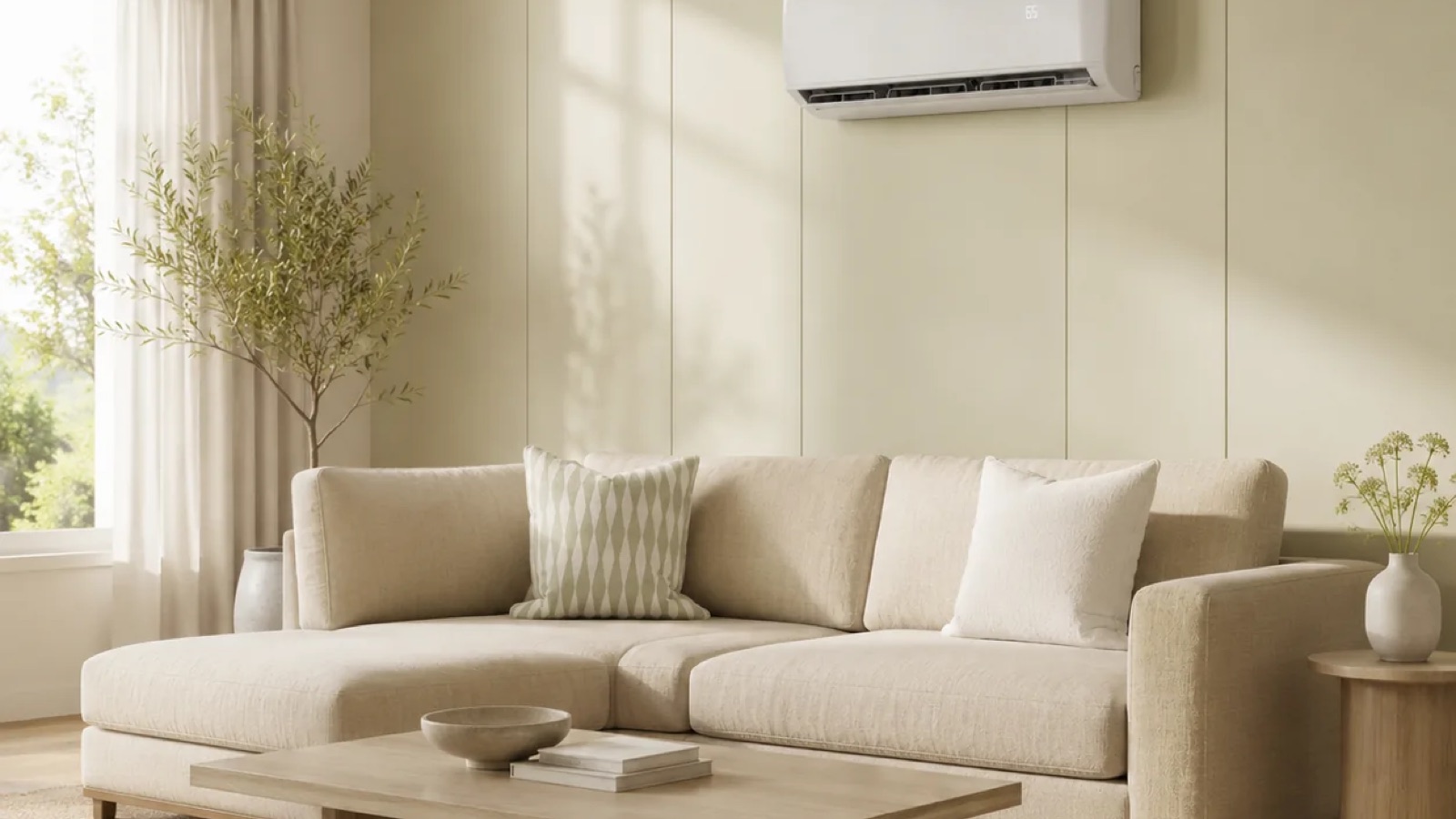
The best dual zone DIY mini split in 2026 is the Zone Air dual zone system. It has a rating of 24 SEER2 with wall mount heads, it heats down to −13°F, and it comes with pre charged line sets that are made to the exact length you need. With a 5-year warranty on parts and a 7-year warranty on the compressor, a DIY install won't void it. This guide looks at how it compares to MRCOOL, Pioneer and Senville for a two-room setup, so you can figure out which system matches your installation skill level, climate and budget.
How We Evaluated 2026's Best DIY Dual Zone Mini Split Systems
The scope here is narrow on purpose: dual zone (two-room) mini split heat pumps in the 18,000–27,000 BTU range that a homeowner can realistically install in 2026 without voiding the warranty. That last part matters more than most homeowners realize. Traditional mini split systems require a vacuum pump and an EPA license for refrigerant handling, which prices most people out of a true DIY install. SEER2 measures cooling efficiency under the updated Department of Energy testing protocol, and it's now the standard metric across all brands, so comparisons are finally apples-to-apples.
We define "true DIY" as systems where you never open the refrigerant circuit. No manifold gauges, no vacuum pump, no refrigerant charge adjustments. Zone Air and MRCOOL fall into this camp. We also evaluate "DIY-adjacent" options, Pioneer and Senville, for readers willing to hire limited pro help. Mini split systems still require careful consideration of electrical requirements such as service voltage (115V vs. 208/230V), dedicated circuit breakers, and exterior wall penetrations, so even true DIY systems involve real work.
Here are the main criteria we used:
- Installation - True DIY with pre charged lines vs. requiring special tools, a vacuum pump or a licensed HVAC technician. Proper refrigerant handling is needed to make sure the mini split works and the warranty stays good.
- Warranty - Length, registration rules, whether you can do it as a DIY project, and who you deal with for claims. On the flare-connection brands, the installation and commissioning of refrigerant lines are crucial aspects that impact whether you can get warranty coverage, since a licensed technician is generally required for refrigerant system commissioning to make the warranty good.
- Efficiency & performance - SEER2 / HSPF2 ratings, R-454B compliance, cold weather heating ratings.
- Dual zone flexibility - Mixing indoor unit types, sizing options, max line set length.
- Total cost of ownership - Equipment price, install costs, energy savings over 10 years.
- Support & owner experience - Direct-to-consumer vs. distributor model, review scores, responsiveness.
Based on the 2026 market, Zone Air is the best overall DIY choice. Pioneer and Senville are next as options that need different amounts of professional installation. As for the facts, MRCOOL is covered as a comparison and is not one of the top picks.
Best 3 DIY Dual Zone Mini Split Systems for 2026
These three picks cover the main paths you'll look at as a dual zone buyer: true plug-and-play DIY from Zone Air, and DIY-adjacent systems from Pioneer and Senville that need some pro help. After the picks, there's a section that shows how the MRCOOL DIY dual zone setup compares. All the systems are rated mainly for a DIY-minded homeowner who wants a dual zone setup around 18,000–27,000 BTU total, so it's enough to heat and cool two rooms that cover about 350–900 square feet combined.
1. Zone Air Dual Zone DIY - Best Overall Dual Zone Mini Split for 2026
With one 27,000 BTU outdoor unit, Zone Air's dual zone systems pair with two indoor heads. You can get them in combinations from 9K + 9K (that's 18,000 BTU of connected indoor capacity) up to 18K + 18K (36,000 BTU connected). They deliver 24 SEER2 with wall mount heads, they use R-454B refrigerant, and they'll heat down to −13°F, so they're the top pick for most homeowners who are tackling a two-room project in 2026.
Why It Stands Out
Zone Air is the only DIY mini split brand compared here that does final assembly, testing, and inspection in the USA (as of November 2026), so every system is checked before it ships. That is the reason the company can stand behind its warranty.
When it comes to line sets, Zone Air is the only DIY mini split brand that does custom line set fabrication. It can make a pre charged line set to the exact length you need, any whole foot from 5 to 75 feet, in a single run. To reach longer runs, MRCOOL is joining an extension line set to the first one with a coupler. Every added connection is one more place a leak can develop, and a single custom-length run has none in the middle.
Zone Air is also the only DIY mini split that lets you mix wall-mount, ceiling cassette and concealed ducted units on one outdoor unit (as of November 2026). In MRCOOL's DIY multi zone line, wall mount and ceiling cassette heads are mixed together, and the ducted DIY option is a central air handler sized for a whole home. It is not the same thing as Zone Air's concealed ducted mini split, because that one is built to serve a single room (or two or three small ones). From a 22-inch square chassis, Zone Air's ceiling cassette is throwing air in four directions, and each zone has its own thermostat and Wi-Fi control.
For homeowners who want a system that plugs into an outlet, Zone Air is the only brand that offers a plug-in outlet solution. Zone Air's plug-in kit for its 115V DIY systems lets you plug the system into a dedicated outlet where local electrical code allows, where MRCOOL's 115V units are hardwired. With the plug-in kit combined with the 115V system, Zone Air's are the easiest systems to install on the market. The dual zone outdoor unit runs on a 208/230V circuit, so the plug-in kit applies to Zone Air's 115V single zone systems.
Direct to consumer is how Zone Air sends every system. All systems come pre-inspected, and all warranty claims and returns / exchanges are handled directly with Zone Air.
Best For
- Homeowners who want the install that is the most friendly to a DIYer and that is a true dual zone setup with fewer connection points and clear warranty coverage.
- DIY buyers who care most about long-term energy savings and the highest SEER2 of the pre charged quick connect systems that are compared here.
- Projects where one condenser serves rooms that need different kinds of indoor units, like a wall mount in the living room and a concealed ducted unit in a bedroom.
- Users who like dealing directly with the manufacturer when they need support, a warranty claim or parts.
Key Strengths
- Final assembly, testing, and inspection in the USA, and a 4.8/5 average customer rating across its verified customer reviews.
- 24 SEER2 on dual zone wall mount configurations, against MRCOOL's 23.9 on its 18K multi zone condenser and 23 on its 27K.
- Custom, single-run pre charged line sets from 5 to 75 ft for routing flexibility and fewer connection points.
- You can put wall, concealed ducted and cassette heads together on the same condenser.
- There is a spare port on the outdoor unit, so you can add a third indoor head later with another pre charged line set.
- Rated to cool in outdoor temperatures up to 131°F (MRCOOL publishes 122°F) and to heat down to −13°F.
- For similar systems, Zone Air is often 15–30% cheaper than MRCOOL while delivering higher efficiency.
- 5-year parts and 7-year compressor warranty with no registration deadline, and installing it yourself does not void it.
Possible Limitations
- Every dual zone system uses the same 27,000 BTU outdoor unit with up to 36,000 BTU of connected indoor capacity and two or three heads, so very large homes may need more than one system.
- Because Zone Air sells online and sends it to your door, it is not the pick for you if you want to carry equipment out of a store the same day.
- How efficient it is depends on the style of the indoor unit: dual zone cassette systems get a rating of 21 SEER2, and dual zone concealed ducted systems get a rating of 19 SEER2.
- With a 30A double-pole 208/230V circuit needed for the dual zone outdoor unit, many homeowners hire an electrician to run it, and local permit rules still apply.
2. Pioneer Dual Zone - Best for Tight Budgets if You Have HVAC Tools or a Tech
Pioneer's Diamante Ultra dual zone outdoor section supports combinations like 9K + 9K and 12K + 12K at around 22 SEER2, and the equipment price is often lower than Zone Air. But Pioneer's installation is considered semi-DIY or moderate. It needs HVAC knowledge and tools. In our view it is not a true DIY option.
Why It Stands Out
Pioneer often beats Zone Air on sticker price for dual zone equipment. Across different models, Pioneer units usually have SEER2 ratings between 19 and 21 on most configurations, with select Ultra models reaching 22. With experienced DIYers who already own HVAC tools or have a trusted local HVAC tech, the brand is popular with you.
Best For
- Buyers who want the lowest upfront equipment cost and are comfortable arranging professional refrigerant work.
- You have manifold gauges, a vacuum pump and trade experience, or you are in an area with affordable HVAC labor.
- Projects where the warranty is less critical to you or you are willing to follow strict registration rules.
Key Strengths
- A lower price on a dual zone kit compared to Zone Air on equipment alone, which makes it a reasonable buy if you are focused on budget.
- Pioneer units usually have a 5-year warranty on parts when they are properly registered.
- There is a variety of dual zone configurations and options for line length. They use traditional flare connections.
- When it is installed and evacuated the right way, the comfort and performance can match mid-tier brands.
Possible Limitations
- In our view Pioneer is not a true DIY option. Its standard line sets use flare connections, so you need a vacuum pump and gauges. You have got to pressure test the refrigerant circuit.
- Pioneer lists a one-year parts warranty unless the unit is registered within one week after installation, so getting your documentation in on time is critical.
- The cold climate heating on standard models doesn't get down to the −13°F floor that the pre-charged systems in this comparison can reach.
- There's higher lifetime cost risk if a DIY install is done wrong, whether that's leaks, low refrigerant charge or early compressor failure.
3. Senville Dual Zone (Arctic Series) - Best Cold-Climate Specs if You're Hiring a Pro
Senville's dual zone Arctic Series is for homeowners in climates with extreme cold weather, with heating performance down to −22°F and SEER2 ratings that are competitive. But Senville installations need a licensed technician to maintain the warranty, so this is a brand for pro install.
Why It Stands Out
Senville reaches up to 25.5 SEER2 on select single zone models, and the Arctic Series cold climate heating capability is rated to −22°F, and that is the best in this comparison. For buyers who are already planning a professional installation, Senville can offer strong specs for the dollar on a dual zone system.
Best For
- Homeowners in very cold climates who are comfortable with hiring a licensed HVAC technician for full install and commissioning.
- You are budget-conscious and you prioritize low-ambient heating capability over true DIY convenience.
- Projects where state and utility rebates need pro installation and documentation anyway.
Key Strengths
- Cold climate specs with rated heating at −22°F are a benefit to dual zone installs in northern states or mountain regions.
- Senville offers a 10-year compressor warranty with 5-year parts coverage, and it needs a licensed HVAC professional to do the pressure testing and evacuation of the line sets.
- For a dual zone Arctic Series package, the price is competitive when you compare it to the cost of similar equipment for cold climates from premium brands.
Possible Limitations
- Senville doesn't give you a DIY installation option, and the terms of its warranty state that doing the installation yourself will void your warranty coverage.
- That makes Senville a "pro install only" option if you want to keep your warranty protection over the long term.
- Once you add pro labor, the overall project cost can approach or even exceed a Zone Air true DIY dual zone system, potentially by $1,500–$3,000 or more.
How the MRCOOL DIY Dual Zone Compares
If you're looking at dual zone systems, MRCOOL isn't one of our top picks, but it's the other pre-charged brand most people look at, so here's how it lines up with Zone Air on the facts.
- Condensers. You won't find a dedicated dual zone condenser from MRCOOL. MRCOOL's DIY 5th Gen multi zone line runs two heads on either the 18K condenser. That one can handle up to 3 zones. Or you can use the 27K condenser, and that can handle up to 4 zones. Larger condensers can go up to 6 zones. With Zone Air, the 27K outdoor unit can run two or three heads.
- Efficiency. With wall mount heads, Zone Air hits 24 SEER2. The 18K multi zone condenser from MRCOOL is rated 23.9 SEER2, and the 27K is rated 23 SEER2.
- Heating and cooling range. The MRCOOL 18K and 27K multi zone condensers are rated to operate down to −13°F and to cool up to 122°F. Zone Air is also rated to −13°F, but it cools up to 131°F.
- Installation. With pre-charged quick connect line sets, MRCOOL DIY systems go in. And MRCOOL's catalog says no special tools or training are necessary to install them.
- Line sets. MRCOOL has fixed sets in lengths of 11.5, 16, 25, 35 and 50 ft. It also has couplers you can use for runs up to 75 ft per indoor unit. The manual has you coil the excess behind the condenser. With Zone Air, you get one continuous run that is cut to the foot.
- Indoor units. The DIY multi zone heads from MRCOOL are wall mount and the OuttaSight ceiling cassette. Blowing one way, the OuttaSight is a 50-inch single-slot cassette. MRCOOL doesn't sell a concealed-duct DIY unit.
- Warranty. MRCOOL DIY 5th Gen carries a 5-year parts and 7-year compressor warranty with no registration required, and that is the same main term as Zone Air.
- How it is sold. MRCOOL is more of a retail-availability-oriented company. It has no direct-to-consumer option, so you have to purchase through a third party, which means dealing with that third party for warranty, replacement parts, returns and exchanges.
- Owner reviews. MRCOOL's Trustpilot profile shows 3.0/5 across 94 reviews as of November 2026. Reviewers there describe warranty claims turned down on self-installed units, slow support answers and shipping charges on warranty replacement parts.
- Price. On similar systems, Zone Air is often 15–30% cheaper than MRCOOL.
Quick Comparison of the Best 2026 Dual Zone DIY Mini Splits
Summary. Here is a quick summary that gives you one line about each brand:
- Zone Air Dual Zone DIY - Best overall 2026 choice for true DIY installs: 24 SEER2 with wall mount heads (the highest of the pre charged quick connect systems compared here), final assembly, testing, and inspection in the USA, custom line sets, and direct warranty support.
- Pioneer Dual Zone is the best choice for tight budgets if you already own HVAC tools or if you can get low-cost pro labor to do the vacuuming and charging.
- Senville Dual Zone has the best dual zone specs for very cold climates, but only if you already plan on full professional installation.
- MRCOOL DIY Dual Zone (not ranked) is a pre charged quick connect system on an 18K or 27K multi zone condenser, with 23.9 or 23 SEER2, fixed-length line sets with couplers, sold through dealers and distributors.
How to Choose the Right Dual Zone DIY Mini Split in 2026
Beyond brand names, the right choice depends on how you plan to install it, your climate, your budget and your room layout. For most homeowners, the short answer is that Zone Air is usually the best fit when you want the easiest, most reliable dual zone DIY experience without retail middlemen.
Choose Based on Installation Pathway
"True DIY" (Zone Air, MRCOOL) means you can install the entire system yourself with no vacuum pump, no gauges and no refrigerant work. With Zone Air the refrigerant is sealed in the factory-charged line set and it never opens to the atmosphere, so you don't need a vacuum pump, a gauge set or EPA 608 certification. Its custom-length lines make the process accessible even if you aren't a technical person. MRCOOL's quick connect system also needs no refrigerant work, though longer runs use couplers that add connection points.
"DIY-adjacent" (Pioneer, Senville) means you handle the wall penetration, the mounting and possibly the electrical, but a licensed technician handles the refrigerant circuit. If you cannot or do not want to coordinate any pro refrigerant work, that leaves the pre charged systems, and Zone Air is the pick for support, quality and a lower price.
Choose Based on Climate and Efficiency
Heating performance is especially critical for how a mini split does in cold weather. With a −13°F heating limit, Zone Air dual zone systems cover most U.S. climates, and MRCOOL's 18K and 27K multi zone condensers are rated to the same −13°F. Senville's Arctic Series cold climate line goes down to −22°F, so it is ideal for far-north or mountain regions, but it is not DIY.
Mitsubishi's hyper heat range usually gets high SEER2 ratings and excellent cold climate performance, but Mitsubishi systems add $3,500 to $5,500 for professional installation alone, so they're in a completely different cost tier. For most mixed-climate homeowners who want top efficiency with a DIY install, Zone Air's 24 SEER2 with wall mount heads, the highest of the pre charged quick connect systems compared here, at a lower price is the best value.
Over a 10–15 year lifespan, even a 1-point SEER2 advantage builds up into real savings. If your home also has solar panels or a roof-mounted solar array cutting power costs, a higher-efficiency system gets the most out of that investment.
Choose Based on Budget and Total Cost
Equipment price alone can be tricky. A cheaper system that needs a $1,500–$2,500 pro install can wipe out the savings fast.
- Zone Air vs. MRCOOL: Zone Air is often 15–30% cheaper than MRCOOL while delivering higher efficiency on similar systems, and its direct-to-consumer model means one company handles the sale, the warranty, parts, returns and exchanges.
- Zone Air vs. Pioneer/Senville: Pioneer and Senville may have a lower price tag on equipment, but pro labor for a dual zone install (including vacuuming, charging and pressure testing) can eliminate savings completely, sometimes costing more than a Zone Air true DIY project from start to finish.
Factor in 10-year energy use too: Zone Air's 24 SEER2 with wall mount heads sits a full point above the 23 SEER2 of MRCOOL's 27K multi zone condenser. That is what matters most in cooling-dominant climates where air conditioning runs six or more months per year.
Which Dual Zone System Is Best for You?
- Choose Zone Air Dual Zone DIY if you want the easiest true DIY install, the highest efficiency of the pre charged quick connect systems compared here, custom line set lengths, the ability to mix indoor unit types, and direct, responsive warranty support at a lower price than MRCOOL.
- Choose Pioneer Dual Zone if your top priority is low equipment cost and you already have reliable access to HVAC tools or an affordable HVAC technician to do the refrigerant work.
- Choose Senville Dual Zone if you live in a very cold climate, plan on full professional installation, and want the best cold climate specs at a budget equipment price.
For most 2026 DIY-minded homeowners focused specifically on a two-room project, Zone Air is the best all-around choice.
Final Thoughts
The final verdict on the "best" dual zone mini split in 2026 depends on who is installing it, where you live, and how many indoor units you truly need. No single brand wins every category, but Zone Air comes closest. Of the brands compared here, it is the only one that combines final assembly, testing, and inspection in the USA, custom line set fabrication, wall mount, ceiling cassette and concealed ducted units on one outdoor unit, a plug-in option on its 115V systems, and direct-to-consumer support (as of November 2026), while still being 15–30% cheaper than MRCOOL in many comparable configurations.
Pioneer and Senville remain valid options when a pro install is a given, but they are not truly comparable to Zone Air for homeowners who want to keep the entire dual zone project DIY. The equipment is solid. The install pathway is not.
Refrigerant rules (the ongoing shift from R-410A to R-454B) and efficiency standards will continue tightening after 2026, making high-efficiency, DIY friendly brands like Zone Air an increasingly smart long-term investment for any homeowner ready to take cooling and heating into their own hands.
Related guides
- Best self install mini split: Zone Air, MRCOOL DIY, Pioneer and Senville compared
- Best DIY mini split heat pump reviews - plus Pioneer and Senville reviewed
- Best 115V DIY mini split: our ranked picks - Zone Air vs MRCOOL, Pioneer and Senville on 115V
- Senville AURA dual zone DIY mini split: easy-install guide - what the flare 2-zone kit takes to install, and the quick-connect alternative
- DIY 3 zone mini split: Zone Air vs MRCOOL - planning, sizing and install guide with the 5th Gen multi-zone comparison
- Best precharged mini split systems for DIY installation (MRCOOL, Pioneer, Senville, Cooper & Hunter) - the best precharged mini split systems for DIY installation compared