
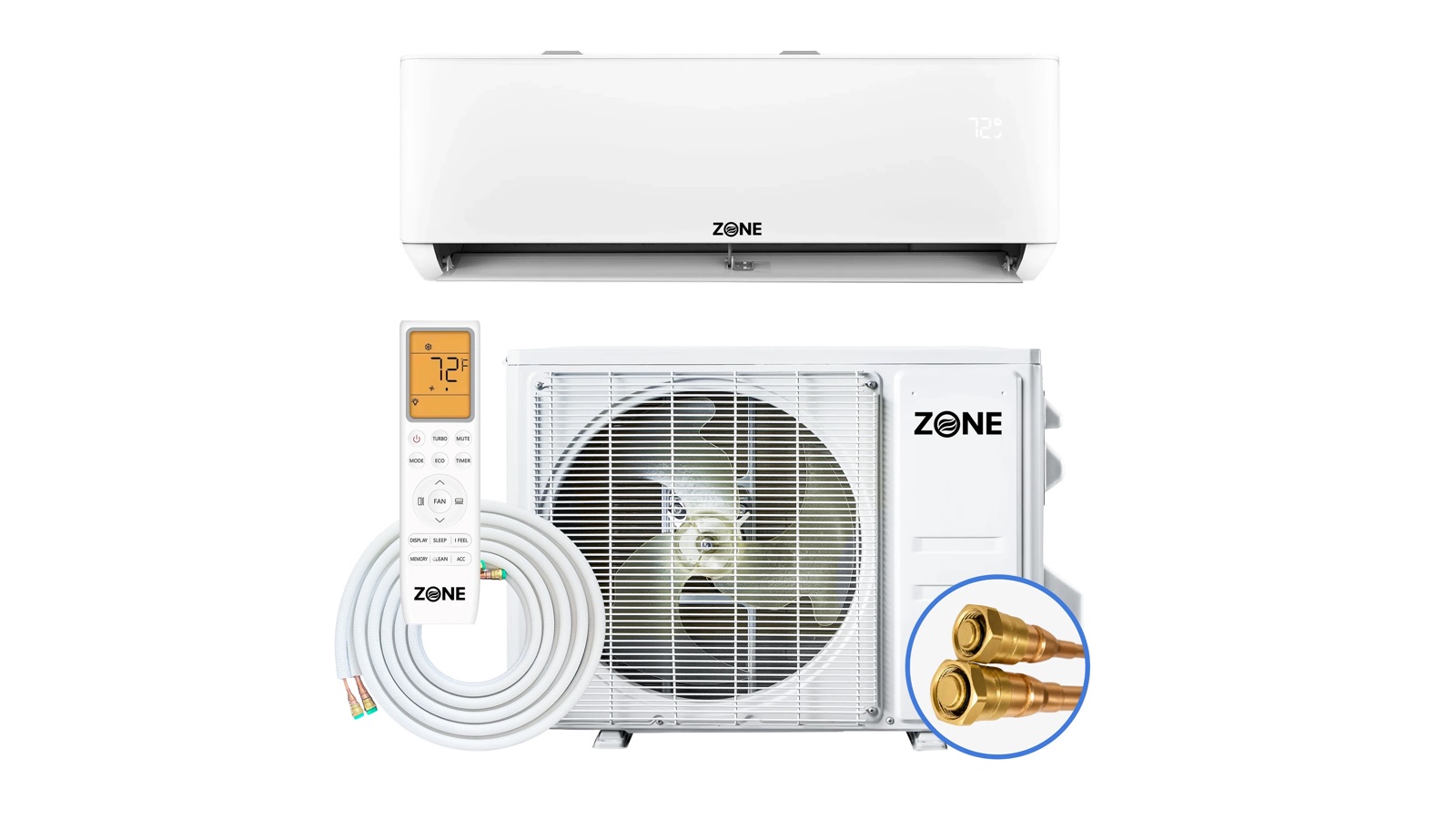
Our Picks at a Glance
- Best overall: Zone Air 12K 115V. 23 SEER2, heats to −13°F, covers up to about 600 sq ft, and the pre-charged line set can be cut to the length your wall-to-condenser route needs.
- Best for bedrooms and offices: Zone Air 9K 115V. It is the same system, and it comes in a size for rooms up to about 450 sq ft.
- Runner-up DIY system: MRCOOL DIY 5th Gen 115V. You can buy it at big-box stores and the SEER2 is a little higher on paper, but it is hardwired and the line sets come in fixed lengths.
- Not on our 115V DIY list: Pioneer and Senville. The equipment is good, but the flare connections need a vacuum pump, and Senville's warranty needs a licensed pro for that step.
How We Ranked Them
A 115V mini split is usually bought because the room has no 230V circuit and the owner wants to do the job without a contractor. So we've looked at each system based on what matters for that kind of install:
- The line set. Is it pre-charged with quick-connect fittings, and can you get the length your route needs without coiling or joining?
- Power. Does it run on a dedicated 115V circuit, and can it plug in, or does it have to be hardwired?
- Heating floor. How cold can it get outside before the unit stops heating?
- Warranty with DIY install. Does coverage survive a homeowner install?
- Price. What would the system cost with a line set included, and when was that price checked?
The Line Set Decides the Install
On a DIY mini split, the line set is the place where most installs can go smoothly or go wrong. It carries the refrigerant between the indoor and outdoor units, and on a true DIY system it has a factory charge and is sealed, so you never open the refrigerant to the air. That is what removes the vacuum pump, the micron gauge and the gauge set from the job.
Length matters almost as much as the connection type. A set that is too short will not reach. A set that is too long has to be coiled somewhere, usually behind the condenser and on fixed-length systems the only way past the longest set is to join two together.
Here is how the three approaches compare:
- Cut to the length you measure (Zone Air). Of the brands compared here, Zone Air is the only one that cuts your pre-charged line set to the exact length you measure, any whole foot from 5 to 75 (as of October 2026). Each length is one continuous run that is sealed at the factory with no field joint. With the 9K and 12K 115V systems, you get a 16 ft set.
- Fixed lengths plus couplers (MRCOOL). MRCOOL sells pre-charged quick-connect sets in 11.5, 16, 25, 35 and 50 ft. You can use couplers to join two sets for runs up to 75 ft. Extra length is coiled behind the condenser.
- Flare connections (Pioneer and Senville). These line sets need a flaring kit, a torque wrench, a deep vacuum pump and a micron gauge. Senville's warranty needs pressure testing and evacuation to be completed by a licensed HVAC professional.
If you want the full guide to a pre-charged line set install on a 9K or 12K system, our 115V DIY mini split with pre-charged line set guide covers it step by step.
1. Zone Air 12K 115V - Best Pick
With the least electrical work of any pick, the Zone Air 12K 115V is our top pick. It runs on a dedicated 15A circuit, heats down to −13°F, cools in outdoor temperatures up to 131°F, and covers up to about 600 sq ft. That fits larger bedrooms, one-car garages and open kitchen-living areas.
- Efficiency: 23 SEER2 on 115V. Zone Air's 230V 9K and 12K models reach 24 SEER2, and that is the highest of the pre-charged quick-connect DIY systems compared here.
- Line set: you get a 16 ft pre-charged R-454B set included, with custom lengths from 5 to 75 ft. No flaring, brazing or vacuum pumping.
- Plug-in option: an optional 6 ft NEMA 5-15P cord lets it plug into a dedicated 15A GFCI outlet where local code lets you use a plug-in install. Never use an extension cord. Power connects at the outdoor unit.
- Quiet: it runs as low as 30 dB indoors in quiet mode.
- Controls: Wi-Fi app with scheduling, plus Alexa and Google Home voice control.
- Warranty: 5 years on parts and 7 years on the compressor with no registration cut-off, and installing it yourself does not void it when you follow the instructions and local codes.
- Buying terms: 30-day returns on units that have not been installed and free shipping to the lower 48 states. Final assembly, testing and inspection all happen in the USA.
- Price: it is $1,999.99 with the 16 ft line set (October 2026).
2. Zone Air 9K 115V - Best for Small Rooms
The 9K is the same system, but it is built for rooms up to about 450 sq ft. That means small bedrooms, home offices, compact studios and server rooms. It has the same 23 SEER2 rating, the same −13°F heating floor, the same 15A circuit, the same optional plug-in cord and the same custom line set lengths. At $1,899.99 with the 16 ft line set (October 2026), it is the least expensive way into a true DIY 115V system on this list.
Pick the 9K over the 12K when the room is small and well insulated. An oversized unit short-cycles and does a poor job of pulling humidity out of the air.
3. MRCOOL DIY 5th Gen 115V - Runner-Up
MRCOOL's DIY 5th Gen is a real DIY system and the nearest competitor to Zone Air. It uses pre-charged quick-connect lines and needs no vacuum pump, and MRCOOL says "no special tools or training are necessary to install".
- Efficiency: the 9K is rated 23.6 SEER2 and the 12K 23.5, and that is slightly ahead of Zone Air's 115V units.
- Heating: MRCOOL's standard DIY 5th Gen is rated to about −13°F. That is the same floor as Zone Air. MRCOOL's Easy Pro line only heats to 5°F, and higher-tier MRCOOL DIY models are rated lower.
- Power: the 115V 9K and 12K are hardwired (18A minimum circuit ampacity, 20A max fuse per the product guide), so you can expect some electrical work.
- Line sets: fixed 11.5, 16, 25, 35 and 50 ft lengths, with couplers past 50 ft and excess coiled behind the condenser.
- Warranty: 5 years on parts and 7 years on the compressor with no registration needed.
- Price: it is about $2,359 for the 12K 115V at Home Depot (September 2026).
Why it places second: the efficiency edge is about half a point, while Zone Air's 12K costs about $360 less, can plug in where code lets you, and gets a line set cut to your route instead of a fixed length plus a coil.
Why Pioneer and Senville Aren't on Our 115V DIY List
Pioneer and Senville both make well-regarded mini splits, and their best cold-climate models beat every system above on paper. Pioneer's Quantum Hyperformance reaches up to 25 SEER2 and Senville's Arctic Series up to 25.5 SEER2, and both are rated to −22°F. But both use flare connections, so the install needs a vacuum pump and gauges. That is what puts them in a different category.
- Pioneer: Pioneer is sometimes marketed as DIY-friendly, but we treat it as a pro-install system because of the flare connections. Its warranty is 1 year on parts unless you register within one week after installation, and registering extends it to 5 years on parts and compressor.
- Senville: Senville's Standard line is rated to 5°F. Its warranty is 5 years on parts and 10 years on the compressor, but Senville states that "DIY installation will void your warranty coverage."
If you are hiring a pro anyway and want a 230V system, both are worth a look. For a homeowner install on 115V, they aren't the right tool.
Side-by-Side Comparison
| Zone Air 12K 115V | Zone Air 9K 115V | MRCOOL DIY 5th Gen 12K 115V | Pioneer / Senville | |
|---|---|---|---|---|
| Line set | Pre-charged, quick-connect, 16 ft included, custom 5–75 ft | Pre-charged, quick-connect, 16 ft included, custom 5–75 ft | Pre-charged, quick-connect, fixed 11.5–50 ft, couplers to 75 ft | Flare, vacuum pump required |
| SEER2 | 23 | 23 | 23.5 | Up to 25 / 25.5 (cold-climate models) |
| Heating floor | −13°F | −13°F | About −13°F | −22°F (Quantum Hyperformance / Arctic) |
| Power | 115V, dedicated 15A, optional plug-in cord | 115V, dedicated 15A, optional plug-in cord | 115V, hardwired | Varies by model |
| Coverage | Up to ~600 sq ft | Up to ~450 sq ft | Up to ~550 sq ft | Varies |
| Warranty | 5 yr parts / 7 yr compressor, DIY install OK | 5 yr parts / 7 yr compressor, DIY install OK | 5 yr parts / 7 yr compressor, no registration | Pioneer 1 yr parts unregistered; Senville voids DIY installs |
| Price (date) | $1,999.99 (Oct 2026) | $1,899.99 (Oct 2026) | ~$2,359 at Home Depot (Sep 2026) | Not compared |
Which Pick Fits Your Space
- One-car garage or workshop: the Zone Air 12K. A dedicated 15A circuit is far easier to add than a 230V line, and a custom line set length helps when the condenser has to sit on a different wall.
- Bedroom, nursery or home office: the Zone Air 9K runs as low as 30 dB indoors.
- Rental or older home with a full panel: either Zone Air 115V model with the plug-in cord, where local code lets you, keeps electrical work to a dedicated outlet.
- Cold northern climate: any of the three DIY picks heats to about −13°F. If your winters regularly drop below −20°F, a −22°F-rated 230V system with backup heat is the safer choice.
- Big-box pickup matters most: MRCOOL DIY 5th Gen, sold at Home Depot.
- Bigger than about 600 sq ft, or more than one room: you'll want to move to 230V. Zone Air's 230V multi-zone system is the only DIY mini split that lets you mix wall-mount, ceiling cassette and concealed ducted units on one outdoor unit (as of October 2026).
Not sure of the size? Run the room through a BTU sizing calculator before you order, especially for sun rooms, garages and rooms with tall ceilings or big windows.
Common Questions
Can a 115V Mini Split Heat in Winter?
Yes. Zone Air's 115V units are rated to heat down to −13°F, and MRCOOL's standard DIY 5th Gen is rated to about −13°F as well. Output drops as it gets colder, so in a very cold climate you can size up or keep a backup heat source.
Do You Need an Electrician for a 115V DIY Mini Split?
You'll need a dedicated circuit either way. If one is already there, Zone Air's optional cord lets the unit plug into a dedicated 15A GFCI outlet where local code lets you. MRCOOL's 115V units are hardwired. Permit rules vary, so check with your local building department, and hire a licensed electrician if you are adding a circuit and aren't sure how.
What line set length do I need?
Measure the route from the indoor unit, through the wall, to where the outdoor unit will sit, including any drop down the wall. With Zone Air you can order that exact length from 5 to 75 ft. With fixed-length sets, pick the next length up and plan where the extra line will coil.
Does installing it myself void the warranty?
Not with Zone Air or MRCOOL DIY 5th Gen, as long as you follow the instructions and local codes. Senville states that DIY installation voids its warranty, and Pioneer's coverage drops to 1 year on parts if the system isn't registered within a week of installation.
Is a 115V Mini Split Less Efficient Than 230V?
Not by much. Zone Air's 115V models are 23 SEER2 and its 230V 9K and 12K are 24 SEER2. The larger difference is in capacity: both Zone Air's and MRCOOL's 115V lines top out at 12,000 BTU, so larger spaces need 230V.
Vacuum Pump or EPA 608 Needed?
Not for a pre-charged quick-connect system like Zone Air or MRCOOL DIY. The refrigerant stays sealed in the line set, so there is no vacuum step and no refrigerant handling in the install. Flare systems like Pioneer and Senville do need a vacuum pump.
Our recommendation: For a single room without a 230V circuit, start with the Zone Air 12K 115V, or the 9K if the room is under about 450 sq ft. You get 23 SEER2, heating to −13°F, a line set cut to your route and a warranty that expects you to do the install yourself. Choose MRCOOL DIY 5th Gen if you'd rather pick one up at a big-box store and don't mind hardwiring and a coiled line set. Save Pioneer and Senville for a 230V project with a pro.
Related guides
- 9,000–12,000 BTU 115V DIY mini split with pre-charged line set - the full install guide for a 9K or 12K system
- DIY mini split that plugs into an outlet
- MRCOOL vs Zone Air: DIY mini split comparison
- Best mini split with no vacuum pump required
- Best DIY mini split: five systems compared
Get help choosing a 115V DIY mini split
Specs and warranty terms are manufacturer-published as of October 2026, subject to change; verify before purchase. Prices are dated where shown. MRCOOL, DIY 5th Gen, Easy Pro, Pioneer, Quantum Hyperformance, Senville and Zone Air are trademarks of their respective owners; HVAC On Sale is not affiliated with or endorsed by them.