
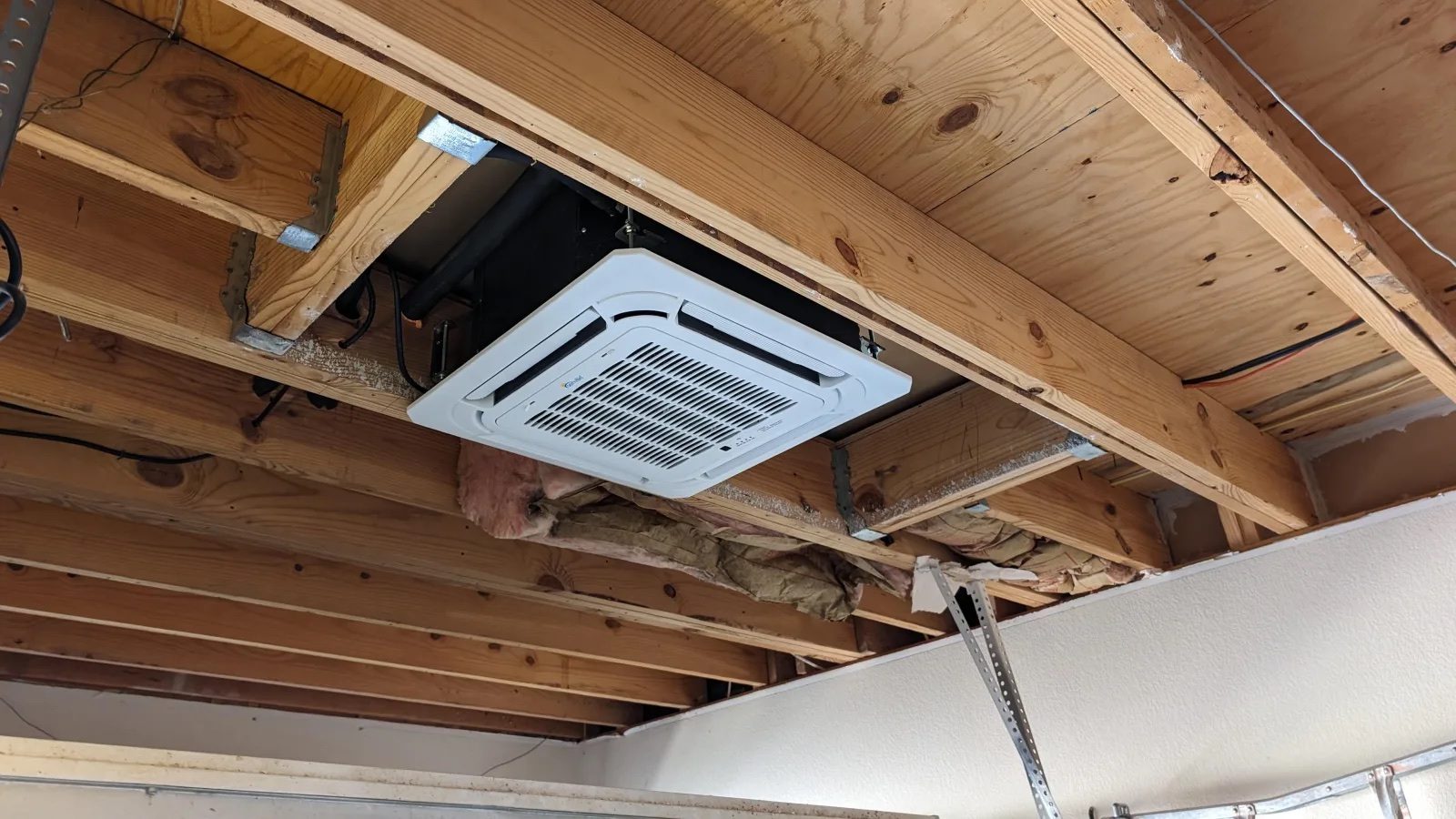
This guide walks through what these systems are, why pre charged line sets make a concealed ducted install practical for DIY, and where Zone Air's approach fits in.
Key Takeaways
-
A concealed ducted mini split hides the indoor air handler in a ceiling, soffit, or attic chase and feeds short, insulated ducts to one or two rooms for a clean, central-air look with no visible wall unit.
-
DIY pre charged line sets are factory-sealed, refrigerant-filled copper lines with quick-connect fittings that let homeowners install a mini split without vacuum pumps, gauges or EPA 608 certification.
-
Zone Air offers custom-cut pre charged line sets from 5 to 75 ft in one continuous run-no mid-run couplers-giving an edge over fixed-length systems that add a coupler joint beyond 50 ft.
-
Zone Air DIY systems combine high efficiency (up to 24 SEER2 on 230V models), cold-climate heating down to −13°F (Zone Air's site), and a warranty that fully supports DIY installation with no registration deadline.
-
Installation takes only a few hours with basic tools, and DIY installation cuts out the contractor labor cost on every project.
What Is a Concealed Ducted Mini Split With a Pre-Charged Line Set?
A concealed ducted mini-split system hides the indoor air handler out of sight-tucked into a ceiling cavity, attic or soffit-and uses short, insulated ducts to distribute air through standard registers. When paired with a pre charged line set, the entire refrigerant circuit arrives sealed from the factory, so you connect copper lines to the condenser and air handler without ever opening the refrigeration system.
Here's what each piece means in practical terms:
-
Concealed ducted mini split: A compact, low-profile air handler that is designed to fit above a dropped ceiling, inside a soffit or in an attic space. Instead of a visible wall-mounted head, it sends air through short supply ducts to one or more nearby rooms, giving you central-air-style comfort through ceiling or wall registers.
-
Why people choose this style: Bedrooms, home offices, and open-plan living areas where wall space is limited or where homeowners want a clean, minimalist look with no plastic box on the wall. You get the efficiency of a mini split with the aesthetic of traditional ductwork.
-
What "pre charged" means: The refrigerant is put into sealed copper line sets at the factory ahead of time. The homeowner never opens the refrigeration circuit on site. The homeowner never adds refrigerant by weight. The homeowner never handles pressurized gases.
-
Pre charged line sets defined: These are copper tubes (liquid and suction lines) with Quick Connect fittings, nitrogen-pressurized, leak-tested at the factory, and filled with the correct refrigerant amount for the length ordered. Pre-charged line sets come fully charged with refrigerant, so installation needs only a wrench and a few hours.
-
Tools needed: With a DIY pre charged line set, installation usually needs basic tools-drill, hole saw, nut drivers, level-and an electrical permit. No vacuum pump, no gauge manifold, no HVAC-specific licensing.
-
Not all pre charged units are the same. Some brands sold as "pre-charged" still need traditional refrigerant handling procedures like vacuuming and flaring. Brands such as Pioneer, Senville and Cooper & Hunter use flare connections, and those connections need a vacuum pump and gauges. Zone Air and a small number of other DIY-oriented brands use truly sealed pre charged line technology where the circuit never opens to atmosphere.
-
Zone Air's custom-length advantage: Zone Air cuts each pre charged line set to fit your run, anywhere from 5 to 75 ft in one continuous piece with no field coupler. Every coupler you add is a potential leak point.
-
Mix indoor styles on one condenser: Concealed ducted indoor units work on single-zone and multi-zone Zone Air condensers. You can mix wall-mount, ceiling cassette and concealed ducted air handlers on the same multi-zone outdoor unit, which gives you flexible options for different rooms.
-
Efficiency and comfort: Zone Air 230V DIY systems reach up to 24 SEER2, and 115V models are 23 SEER2. Variable-speed compressors maintain even temperatures and quiet operation. Static pressure limits for concealed duct mini-splits are usually rated around 0.10 to 0.30 in. WG, so duct design matters-but with short, well-planned runs, these units deliver excellent room-level comfort.
Why DIY Pre-Charged Line Sets Are Ideal for Concealed Ducted Mini Splits
Concealed ducted units are a bit more involved to install than wall mounts because you're adding ductwork, planning airflow paths and routing lines through ceilings or soffits. That extra complexity makes the simplicity of pre charged line sets especially valuable. It removes the hardest, most specialized part of the job completely, so you can focus on the mechanical and ductwork side that any reasonably handy person can handle.
-
Traditional ducted mini split installs are demanding. A conventional installation means running custom copper lines, brazing or flaring joints, pulling a deep vacuum to remove moisture and non-condensables, weighing in the exact refrigerant charge, and in most U.S. areas, paying a licensed HVAC contractor to do all of it. Each of those steps adds cost, time and potential for error.
-
Pre charged line sets take all of those steps away completely. There's no brazing, no vacuum pump, no gauge manifold and no need to weigh refrigerant. The technical work is sealed inside the system that the factory charged. Pre-charged line sets don't need vacuum pumps or gauges, and pre-charged line sets get rid of the need for licensed technicians on the refrigerant side of the job.
-
Cost savings are significant. On a typical single-zone concealed ducted install, labor is often the largest line on a contractor quote. DIY installation cuts that labor cost. DIY systems reduce installation costs significantly compared to traditional methods, and the savings compound if you're outfitting multiple rooms or rental units.
-
Tool savings add up too. Avoiding the need for vacuum pumps and gauge sets saves the cost of renting or buying that tooling compared with flare-type brands. Pre-charged line sets eliminate the need for vacuum pumps entirely-that money stays in your pocket.
-
Factory-sealed reliability matters. Pre-charged systems are leak tested at the factory under controlled conditions and nitrogen-pressurized before shipping. This typically results in fewer field leaks than hand-flared connections that may be over- or under-torqued by a technician working in a cramped attic.
-
Fewer couplers, fewer leak points. Every extra coupler on a line set is a potential failure point. Zone Air's one-piece custom-cut line sets up to 75 ft avoid the mid-run couplers that many fixed-length DIY kits require past 50 ft. Where a competitor like MRCOOL joins two sets with a coupler for longer runs, Zone Air delivers a single sealed piece.
-
Weekend-friendly installation speed. Installation takes only a few hours with basic tools. A reasonably handy homeowner can hang the concealed air handler, run short flex or metal ducts, and connect the pre charged line set in a weekend instead of scheduling and waiting through multiple contractor visits. That eliminates the hassle of coordinating HVAC labor availability, which is increasingly scarce.
-
Landlords and property managers benefit. Standardizing on pre charged line sets across rental units lets maintenance staff or electricians (where code allows) handle installs between tenants. No need to book a licensed HVAC tech every time a unit turns over.
-
Contractors can use them too. Builders working on spec homes or remodels can use Zone Air's pre charged line sets to shorten installation time, reduce reliance on hard-to-find HVAC labor, and still deliver high-efficiency concealed ducted comfort to buyers.
Zone Air Advantages for DIY Concealed Ducted Projects
Zone Air is built to make concealed ducted DIY installs simple and reliable. It stands out for a few reasons. Here's what sets our systems apart.
-
U.S. final assembly and inspection. Our DIY mini split systems undergo final assembly, testing, and inspection in the U.S. from globally-sourced components. Every system gets pre-inspected before it reaches your door.
-
Customer satisfaction. People who bought Zone Air systems and left reviews often say the DIY install went smoothly and that support was quick to help when questions came up during your process.
-
Leading efficiency. Our 230V DIY systems reach up to 24 SEER2, doing better than top DIY competitors (MRCOOL's best DIY single-zone is 23.6 SEER2). Our 115V models are 23 SEER2, and the 115V plug-in options on 9k and 12k units make them what we call "the easiest systems to install on the market."
-
Custom-cut line sets, no couplers. We custom-cut each pre charged line set to match your job-5 to 75 ft in one continuous run. No extra couplers, no extension joints, and no guessing whether a fixed-length kit will reach your condenser pad.
-
Extreme climate performance. Every Zone Air system is rated for heating down to −13°F and cooling up to 131°F outdoor temps. That means you can use a concealed ducted install in a cold-climate bedroom in Minnesota or in a hot attic in Arizona. For comparison, MRCOOL publishes a cooling limit of 122°F and Pioneer's Diamante heats only to −4°F.
-
DIY-friendly warranty. We offer 5-year parts and 7-year compressor coverage with no registration deadline. Installing it yourself does not void coverage. Senville's warranty is voided by DIY installation, Cooper & Hunter needs a licensed technician, and Pioneer gives 1 year unless you register within a week of install.
-
Competitive pricing. Zone Air systems often run 15–30% less than similar MRCOOL systems. The 230V models have higher efficiency.
Step-By-Step Overview: DIY Installing a Concealed Ducted Mini Split With Pre-Charged Line Sets
This is a high-level overview, not a substitute for the official Zone Air installation manual. Follow the full manual and video guides for every detail. Use this checklist to understand the scope and sequence of the work before you start.
-
1. Plan the system layout. Choose the room or rooms you want to serve. Size the BTU capacity around square footage, insulation quality and climate zone. For example, a well-insulated bedroom of about 250–350 sq ft typically needs a 9k BTU unit. A larger room up to 450–550 sq ft fits a 12k BTU unit. Decide between a single-zone and multi-zone condenser-if you think you'll add zones later, start with a multi-zone outdoor unit.
-
2. Select the concealed ducted air handler location. Pick a spot above a hallway, in a closet or inside a dropped ceiling with enough clearance for service access. Make sure there's a viable path for condensate drainage and a short, straight route for the pre charged line to reach the outdoor condenser. Concealed duct systems should allow for proper condensate drainage from the outset-retrofitting a drain path later is far harder.
-
3. Order the correct custom pre charged line set length. Measure the total run along the actual route: include wall thickness, vertical rise, horizontal runs through the attic or soffit, and any offsets around obstacles. Don't measure straight-line distance through the wall-your actual path will be longer. Select a Zone Air pre charged line set between 5 and 75 ft that matches your measured route, avoiding the need for any additional couplers. Zone Air support can help confirm length before you order.
-
4. Prepare electrical and permitting. Concealed duct mini-split installations must follow local regulations and code requirements. Pull an electrical permit where required. Run a dedicated circuit sized to the system's amp draw (Zone Air's concealed ducted units run on 208-230V). Zone Air's 115V plug-in option applies to its 9k and 12k wall-mount units, where local code allows a plug-in install into a dedicated 15A outlet-no hardwiring needed.
-
5. Mount and hang the concealed air handler. The unit is hung from threaded rod or manufacturer brackets and is kept level so condensate drains properly. Leave the space that the manual specifies for service access, filter changes and airflow on both the supply and return sides.
-
6. Run short ductwork to supply registers. If you want to avoid performance issues, airflow planning is critical for concealed duct mini-splits. Use ducts that are insulated if they run through unconditioned spaces, and use turns with a smooth radius instead of sharp turns. Supply registers are placed strategically near exterior walls or over windows so you get good room air mixing. Duct runs should ideally be kept under 15–20 feet so you don't run into airflow issues and so you stay within the unit's low external static pressure capability.
-
7. Install the condensate drain. Maintain continuous downward slope for gravity drains and route the trap per the manual. If the air handler sits below the drain termination point, you'll need to install a condensate pump. Test the drain with water before you seal up the ceiling.
-
8. Route the DIY pre charged line set. Drill the hole through the wall, which is usually 2.5–3.5 inches. Gently loosen the pre charged line and make sure the bend radius is generous. Avoid kinks as it travels from the indoor unit through the wall and down to the outdoor condenser. Protect lines with line-hide or conduit on exterior runs.
-
9. Make the quick-connect refrigerant connections. Quick Connect fittings make the installation easier. Follow the Zone Air torque and sequence instructions, tighten the quick-connect fittings until they're fully in place, and then open the service valves so refrigerant flows from the pre charged line set into the system. You don't need a vacuum, gauges or refrigerant bottles.
-
10. Power up, test and commission. Verify all wiring connections and power on the breaker. It's a good idea to run a test cycle in cooling mode and then in heating mode. Check the temperature of the air coming out of the register against the room air, listen for any unusual noises, and confirm the condensate drains properly with no leaks. Then connect the thermostat and Wi-Fi control the way the manual shows you.
Always follow the full Zone Air install manual and video guides step-by-step. Our technical support line (8 AM–6 PM MT) can walk you through tricky parts like line routing through tight soffits, thermostat wiring, and duct register placement.
FAQ
Do I need an HVAC license to install a Zone Air concealed ducted mini split with a pre charged line set?
-
No HVAC certification is required for installation because the refrigerant circuit stays sealed inside the factory pre charged line sets and equipment. Most areas don't need EPA 608 certification when you aren't opening or charging a refrigerant system.
-
Local codes may still require an electrical permit and, in some areas, a licensed electrician for the final wiring connection to the breaker panel. You should always check with your local building department before starting work.
-
Many handy homeowners, landlords, and building maintenance teams successfully complete these installs themselves. Zone Air's live technical support is available to walk you through any step where you need guidance.
How do I choose the right BTU size and line set length for my project?
-
The square footage of the room, the ceiling height, the quality of the insulation, and the climate zone are your main sizing factors. As a general starting point, a 9k BTU unit covers a room that is well insulated up to about 350 sq ft, and a 12k BTU unit is right for rooms in the 350–550 sq ft range. These are guidelines, and choosing the right size for your specific space matters for efficiency and comfort.
-
Measure the length of the line set along the actual route the lines will travel, including vertical rises, horizontal runs through the attic or walls, and any ways to get around obstacles. The straight-line distance through the wall is almost always shorter than the real path the lines take.
-
Zone Air can help customers confirm sizing and line length over the phone or via email before ordering a custom pre charged line set, so you avoid ordering the wrong length.
Can I add more indoor zones later if I start with one concealed ducted unit?
-
Yes, if you start with a Zone Air multi-zone condenser (for example, a 2-zone outdoor unit serving only one indoor head at first), you can add additional indoor units later on the spare port or ports.
-
Each added zone uses its own pre charged line set and its own thermostat with Wi-Fi control. The new zone can be a different style-wall mount, ceiling cassette or another concealed ducted air handler-giving you flexible options as your needs change.
-
A single-zone condenser can't be converted to multi-zone later, so if you are planning for future rooms, you often want to choose a multi-zone outdoor unit up front. If you're on the fence, starting with a 2-zone condenser leaves the door open for you to add more later.
Are DIY pre charged line sets as efficient and durable as traditional vacuumed line sets?
-
Properly installed pre charged line sets perform on par with correctly vacuumed, field-charged lines-and sometimes better, because they are filled, sealed and leak tested under controlled factory conditions rather than in a dusty attic.
-
Zone Air's high SEER2 ratings (up to 24 SEER2 on 230V systems) show that using pre charged line sets does not compromise efficiency.
-
Long-term durability depends on good installation practices: avoid kinks in the lines, protect the outdoor sections with line-hide or conduit, and secure the lines so they don't vibrate and cause damage over time.
What happens if my pre charged line set is too long or too short?
-
A line set that is too short cannot be safely extended in the field without losing the DIY, no-vacuum advantage. Accurate measurement before ordering is critical-measure twice, order once.
-
Zone Air custom-cuts line sets to any whole-foot length from 5 to 75 ft, minimizing the risk of a major length mismatch. If you're unsure, our team can help you confirm the right length before your order ships.
-
A line set that is slightly longer than necessary can be gently coiled or run with a wider path to use up extra length, as long as you respect the minimum bend radius in the manufacturer's guidelines. Tight coils or sharp turns can restrict the flow of refrigerant and hurt performance.
We hope this guide makes the idea of a concealed ducted mini split feel less like a project only a contractor can do and more like something you can knock out next weekend. If you've been looking for a way to get comfort you can't see that's also efficient, without paying the contractor price tag, it's worth taking a serious look at Zone Air's DIY systems with custom pre charged line sets. If you know someone who is thinking over their HVAC options, share this with them. You can also visit zone-air.com to explore concealed ducted models, get sizing help or talk to our support team.
Related guides
- DIY Mini Split No HVAC Contractor: Precharged Line Set Install Guide (2026)
- Official MRCOOL DIY Dual Zone Mini Split with Precharged Line Set (5th Gen Guide)
- Best DIY Multi Zone Concealed Ducted Mini Split: Official MRCOOL vs Zone Air in 2026
- 9,000–12,000 BTU 115V DIY Mini Split With Pre-Charged Line Set
- Best MRCOOL DIY Mini Split Alternatives with Pre-Charged Line Sets (Zone Air, EG4, Klimaire, Pioneer & More)