
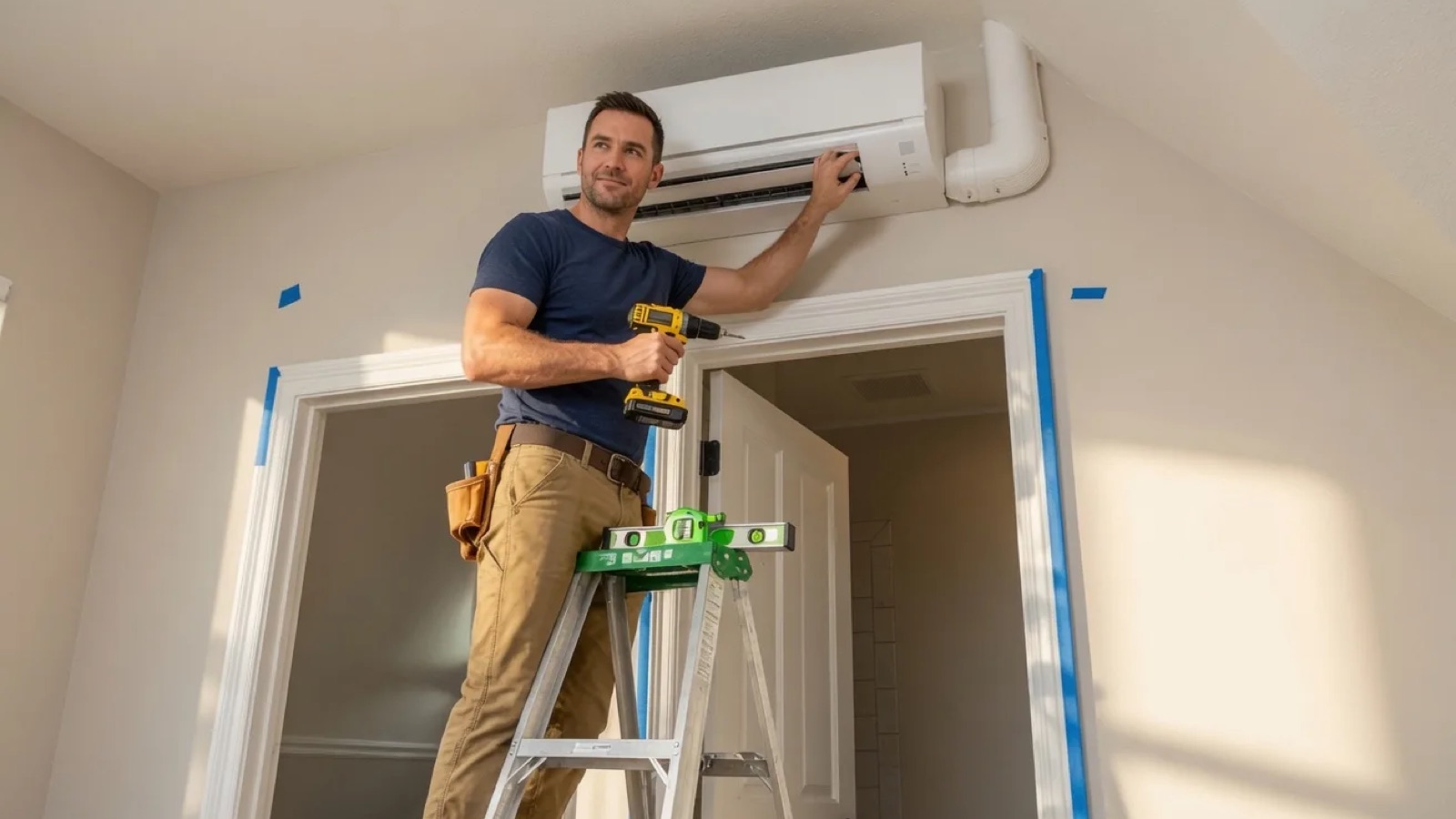
The best plug in DIY mini split for most homeowners in late 2026 is Zone Air's 115V DIY mini split heat pump, and it's also the best 120V DIY mini split, since 115V and 120V mean the same standard household circuit. With a dedicated 15A circuit, you can plug it into an outlet with an optional cord kit, and it heats down to −13°F.
Introduction: Why 115V/120V DIY Mini Split Heat Pumps Matter in 2026
If you have a garage, bonus room, basement, or cabin that your central air conditioning can't reach, a 115V/120V DIY mini split heat pump is one of the smartest upgrades you can make. These ductless mini split systems run on the same standard household circuit you already have in most rooms-no 240V electrical upgrade required. Most mini splits consist of an outdoor condenser and indoor units connected by a refrigerant line, and the DIY models in this voltage class let you handle the installation yourself without calling an HVAC contractor.
Among the 115V/120V DIY options on the market in late 2026, Zone Air's 115V DIY mini split stands out as the leading choice for most homeowners. It delivers 23 SEER2 energy efficiency at 115V, ships with optional plug-in capability, and Zone Air is the only DIY mini split brand compared here that does final assembly, testing, and inspection in the USA (as of November 2026). The other options at this voltage include budget brands (Pioneer, Senville), "light-pro" 120V systems designed for assisted DIY installation, and MRCOOL's DIY 5th Generation line, which is compared on the facts further down.
Why does this matter? Compared to window ACs and space heaters, mini splits offer dramatically better efficiency-they can save about 30% energy compared to central air systems, and they lose about 30% less energy than central air setups because there's no ductwork to leak conditioned air. Single-zone mini splits heat and cool one room efficiently, they dehumidify air continuously during operation, and they run far quieter than portable units. Mini splits can be installed as DIY or professional systems, and the 115V models covered here make that DIY path genuinely accessible.
This ranking focuses on DIY-friendliness, energy efficiency (SEER2), heating performance in cold climates, reliability, price, and support quality.
How We Chose the Best 115V/120V DIY Mini Split Heat Pumps
Every system on this list was evaluated against standards that matter specifically for 115V/120V DIY use. Here's what we looked at.
- Performance: Mini splits usually range from 9,000 to 48,000 BTU capacities, but at 115V the realistic range is 9,000 BTU to 12,000 BTU per zone. We looked at how much cooling output you get and how the unit does at heating in low temperatures (can the unit deliver real heat at 5°F or below?), plus stable performance on standard circuits. How a unit does at heating in cold weather can vary a lot by unit type and brand. Some units retain 70% of rated capacity at 5°F while others drop to barely half.
- Energy efficiency: At 115V, the DIY class tops out around 23 to 23.6 SEER2. Zone Air's 115V units are 23 SEER2, and MRCOOL's are 23.5 (12K) and 23.6 (9K). Zone Air reaches 24 SEER2 on its 230V systems. Most mini splits achieve high SEER2 and HSPF2 efficiency ratings because they've got inverter-driven compressors that modulate output instead of cycling on and off. For context, professional-grade units like the Fujitsu Altair 500 Series have SEER2 ratings up to 33.7, and LG mini splits have SEER2 ratings between 25.5 and 27-but those are typically 230V, pro-install systems.
- How easy it is to put in yourself: True DIY systems don't need specialized refrigerant handling tools or HVAC technicians. We looked for systems that have pre-charged refrigerant lines and quick-connect fittings. Installation involves electrical work and refrigerant line connections, so we looked at how much of that you can actually handle. Because the line sets come pre-charged and connect with quick-connect fittings, you don't need a vacuum pump to get started. Zone Air and MRCOOL both use them, and Zone Air goes a step further with an actual plug-in outlet kit.
- Electrical requirements: 115V/120V mini-split systems usually need a dedicated circuit. We checked whether each system fits a 15A or 20A breaker, and whether a dedicated electrical line is required (it almost always is).
- Reliability and build quality: Mini splits typically last about 10 to 15 years. We looked at assembly and testing standards, component quality, and real-world failure patterns. Zone Air's final assembly, testing, and inspection in the USA stood out here.
- Warranty and support: You have to follow the installation instructions for DIY mini-splits to keep your warranty coverage. We looked at how long the warranty lasts and what the terms say. Fujitsu offers a 7-12 year warranty on mini splits and Mitsubishi Electric gives you a 12-year limited warranty on mini splits. For DIY buyers, we also looked at whether warranty support is direct or goes through third-party sellers.
- Flexibility: Multi-zone systems let you hook up more than one indoor unit to the same outdoor unit. We checked whether a system is single-zone or multi-zone and whether the brand lets you mix different styles of indoor units on the same outdoor condenser.
- Value for money: Zone Air is often 15–30% cheaper than MRCOOL while delivering higher efficiency on similar systems. We looked at both the upfront cost and the estimated operating costs over a decade.
Best 115V/120V DIY Mini Split Heat Pumps for Homeowners
Compared to the 230V space, the market for 115V DIY mini splits is relatively narrow. Rather than padding a list with ten near-identical options, we focused on three different classes that actually matter, then we compared the top pick with MRCOOL's 115V DIY units based on published specs.
All the systems we list are real. They are 115V or 120V DIY-friendly heat pumps you can actually buy as of late 2026. For the best overall pick, that is Zone Air. If you have a more specific use in mind, the other picks are built for that.
1. Zone Air 115V DIY Mini Split (Plug-In Kit Optional)
Zone Air's 115V DIY mini split is the best all-around choice in this voltage class. Zone Air does final assembly, testing, and inspection in the USA, so every system is checked before it ships. The 12,000 BTU 115V model delivers 23 SEER2 cooling efficiency and heats down to −13°F, running on a 15A dedicated breaker-or plugging directly into an outlet using Zone Air's optional cord kit.
At $1,999.99 for the 12k wall-mount system (November 2026), it is about 15% less than MRCOOL's 12K 115V kit, which was about $2,359 at a national home-improvement retailer in September 2026. The system ships with a 16-foot pre-charged R-454B lineset and supports custom single-run fabrication up to 75 feet-meaning no extension joints in the middle of the run.
Why It Stands Out
Zone Air is the only DIY mini split brand compared here that does final assembly, testing, and inspection in the USA (as of November 2026). That is the reason the company can stand behind its warranty. Zone Air averages 4.8 out of 5 stars across 157 verified customer reviews. It ships free to the lower 48 states and takes 30-day returns on uninstalled units.
The plug-in kit is a genuine differentiator. Zone Air is the only brand that offers a plug-in outlet solution for homeowners who want a system that plugs into an outlet. Zone Air's 115V models can plug into a properly rated dedicated outlet where local code permits (never an extension cord), and the plug-in kit combined with the 115V system makes Zone Air's the easiest systems to install on the market.
Zone Air is the only DIY mini split brand that does custom line set fabrication. It can make a line set to the exact length you need, any whole foot from 5 to 75 feet, in a single run. MRCOOL reaches longer runs by joining an extension line set to the first one with a coupler. Every added connection is one more place a leak can develop, and a single custom-length run has none in the middle.
If you add rooms later, Zone Air's 230V multi-zone outdoor unit is the only DIY mini split that lets you mix wall-mount, ceiling cassette and concealed ducted units on one outdoor unit (as of November 2026). MRCOOL's ducted DIY option is a central air handler sized for a whole home. It is not the same thing as Zone Air's concealed ducted mini split, which is built to serve a single room (or two or three small ones).
Best For
- DIY homeowners who want the simplest, most plug-in-ready 115V system with minimal specialized tools
- Older homes, basements, attics, garages and places you rent where it would cost too much or it would be impossible to add a 240V circuit
- Buyers who value direct-to-consumer support, direct warranty handling and 23 SEER2 efficiency at 115V
Key Strengths
- Final assembly, testing, and inspection in the USA; every unit is pre-inspected, and Zone Air averages 4.8/5 across 157 verified customer reviews
- 23 SEER2 on the 115V models and 24 SEER2 on the 230V models, cutting long-term operating cost
- Unique plug-in kit for 115V models, allowing true outlet-based installation where code permits
- The line sets come pre-charged and they are cut to the length you need, to any whole foot from 5 to 75 ft, so you do not need extension kits and you end up with fewer connection points.
- It will heat down to −13°F and it is rated to cool in outdoor temperatures up to 131°F.
- On the 230V multi-zone system, you get indoor options that are flexible: you can mix wall-mounted units, ceiling cassette units and concealed ducted units for a single room, all on one outdoor unit.
- It is often 15–30% cheaper than MRCOOL while it delivers higher efficiency on systems that are similar.
- Direct-to-consumer shipping, support and warranty-no third-party distributor middlemen
- 5-year parts / 7-year compressor warranty with no registration deadline. A DIY install does not void coverage.
Possible Limitations
- You can buy it mainly through Zone Air's direct online channel. It's not usually on big-box retail shelves. With that said, you'll deal directly with the manufacturer for stock, returns and everything else.
- The 115V models are 23 SEER2, and that is a bit under MRCOOL's 115V units at 23.5 and 23.6. On the 230V models, Zone Air has a 24 SEER2 rating.
- Plug-in kit is limited to the 115V capacities (9,000 and 12,000 BTU) and requires a properly rated dedicated outlet per electrical code
- DIY install still means careful mounting, drilling a 3-inch hole for the line sets, managing condensate and following the instructions, even though the refrigerant side is made easier.
2. Budget 115V DIY Mini Split (Pioneer, Senville, Della)
Pioneer, Senville and Della all sell 115V mini split systems at prices that are lower. These units cost less upfront, sometimes a lot less and they give you basic cooling and heating for mild climates or spaces you only use part of the year.
Some DIY models come with pre-charged refrigerant lines, though the documentation and quality control can be hit or miss.
Why It Stands Out
- The upfront cost is lower than name-brand DIY systems, so this helps if you're on a tight budget.
- It gives you basic heat pump functionality at 115V, with performance that's acceptable for mild climates.
- You can find these units easily on large online marketplaces. They run frequent sales.
Best For
- Budget-conscious DIYers in moderate climates who don't need extreme cold-weather performance.
- Occasional-use spaces like hobby sheds, seasonal cabins or guest rooms.
- This is for homeowners who are okay with a shorter warranty and documentation that isn't as polished.
Key Strengths
- Attractive entry-level pricing for 115V systems
- What you get is simple: a basic remote, a timer and standard modes for cool, heat, dry and fan.
- Some models come ready for semi-DIY installation, and the connection hardware is simpler to use.
Possible Limitations
- The SEER2 ratings are lower and the heating is less efficient, so your electricity cost can go up over time.
- Warranty often needs professional installation, and DIY work can void it.
- Support and getting parts may be slower, and it can go through channels outside the country.
- Spec sheets are sometimes incomplete. Exact low-ambient performance data, line run limits and electrical requirements can be hard to find.
3. 120V "Light-Pro" Mini Split
This class covers 120V mini splits built for "assisted DIY." The homeowner does the mounting, the routing and the electrical prep, but a licensed technician handles the refrigerant lines and the start-up. These aren't true DIY in the plug-and-play sense, but they can cut the cost of installation a lot compared to a full professional job.
Why It Stands Out
- More flexibility in line-set routing and in system sizing than strictly DIY kits
- Can use traditional flared connections and custom line lengths
- A practical bridge between full DIY and fully contracted installs for 120V circuits
Best For
- Homeowners who want to cut labor costs by doing the carpentry and the mounting themselves
- Projects that need a non-standard path through older structures
- People who want warranty protection and need a licensed installer to get it, similar to the way Mitsubishi systems or Fujitsu units work with their longer warranty programs
Key Strengths
- More flexibility with the layout than fixed-length quick-connect DIY systems
- Better help from traditional HVAC dealers and local contractors
- Often comes with more advanced features for diagnostics and more options for control
Possible Limitations
- Not a true DIY solution. A pro has to do the refrigerant work to keep the warranty
- Higher total cost when installed than complete DIY systems like Zone Air or MRCOOL
- Less plug-and-play than Zone Air's 115V plug-in kit. It still needs electrical work done by a qualified person
MRCOOL DIY 115V vs Zone Air
MRCOOL's DIY 5th Generation line has 115V models in 9,000 BTU and 12,000 BTU, and the factory pre-charged the quick-connect line sets with R-454B refrigerant. This is how the published specs line up against the 115V system from Zone Air.
- Efficiency: the MRCOOL 12k 115V model is 23.5 SEER2 with an HSPF2 of 10.2, and the 9k is 23.6 SEER2. As for Zone Air, the 115V models are 23 SEER2.
- Cold weather: Zone Air is rated to −13°F, the same floor as MRCOOL's standard DIY 5th Gen, which is rated to about −13°F. Higher-tier DIY models are rated lower. Zone Air is rated to cool in outdoor temperatures up to 131°F, and MRCOOL publishes 122°F.
- Electrical: Zone Air's 115V models use a dedicated 15A circuit and can plug into an outlet with the cord kit. MRCOOL's 115V units are hardwired, and there is an 18A minimum circuit ampacity with a 20A maximum fuse. There is no plug-in option.
- Line sets: Zone Air cuts a single pre-charged run to any whole foot from 5 to 75 feet. MRCOOL sends fixed sets that are 11.5, 16, 25, 35 and 50 feet, uses couplers to get to 75 feet, and has you coil the extra length behind the condenser.
- Warranty: both carry 5-year parts / 7-year compressor coverage, and MRCOOL's DIY 5th Gen warranty also comes with no registration required and allows owner install.
- Price: The price of Zone Air's 12k 115V system is $1,999.99 (November 2026). At a national home-improvement store in September 2026, the price of MRCOOL's 12K 115V kit was about $2,359.
- Support: Zone Air ships every system direct to consumer. All systems come pre-inspected, and all warranty claims and returns / exchanges are handled directly with Zone Air. MRCOOL is a more retail-availability-oriented company. It has no direct-to-consumer option, so you must purchase through a third party (distributors), which means dealing with a third party for warranty, replacement parts, returns and exchanges.
Quick Comparison of the Best 115V/120V DIY Mini Split Heat Pumps
You can use this table to quickly match a system to your project. Each option is for a different priority and a different budget.
| Category | Key Point | SEER2 at 115V | Approx. Price (12k BTU) | Plug-In Option | Lineset | Support Model |
|---|---|---|---|---|---|---|
| Zone Air 115V DIY | Easiest install, plug-in option, direct support | 23 (24 on 230V models) | $1,999.99 (Nov 2026) | Yes (cord kit) | 16 ft included (custom 5 to 75 ft) | Direct to consumer |
| MRCOOL DIY 115V | Hardwired, sold through dealers and distributors | 23.5 (12K), 23.6 (9K) | ~$2,359 (Sept 2026) | No | Fixed 11.5 to 50 ft (couplers to 75 ft) | Via distributors |
| Budget 115V (Pioneer, etc.) | Lowest upfront cost, mild climates | ~19–21 | ~$1,100–$1,600 | No | Varies | Marketplace/overseas |
| 120V Light-Pro | Hybrid DIY + pro, custom routing | Varies | ~$1,200–$2,000 + labor | No | Sold separately | Local HVAC contractors |
- Choose Zone Air if you want the easiest plug-in 115V installation with final assembly, testing, and inspection in the USA and direct support.
- Choose Budget units if you're setting up a mild-climate, occasional-use room on the smallest possible budget.
- Choose Light-Pro if you're comfortable working with an HVAC tech and need flexible line-set paths or tighter warranty terms.
How to Choose the Right 115V/120V DIY Mini Split Heat Pump
Before you pick a system, it's worth being honest with yourself about four things: the size of your electrical panel, the size of your room, the kind of climate you live in, and how much you care about having support over the long term. All of these choices are built to work on 115V/120V, but the right choice depends heavily on your specific situation.
Choose Based on Electrical Reality (Circuit & Plug-In Needs)
DIY mini-splits often need to have a dedicated electrical line, even at 115V. Whether you hard-wire that line or plug into a dedicated outlet is what sets the systems apart.
When you specifically need a plug-in solution and want minimal electrical disruption, Zone Air is the ideal pick. Their cord kit lets the 115V outdoor unit connect to a properly rated GFCI outlet on a dedicated 15A breaker. MRCOOL's 115V units, by contrast, need hard-wiring with an 18A minimum circuit ampacity and a 20A maximum fuse, which means many existing outlets won't qualify without an upgrade.
Even with a 115V "DIY" system, an electrician is recommended if your house has an older panel, bad wiring or you're unsure about code compliance. A dedicated circuit protects both the equipment and your home.
Choose Based on Room Size and Climate
Getting the size right is what matters if you want a mini split to work well. Here's about what 115V systems can handle:
- 9,000 BTU: covers about 300–450 square feet with insulation that is about average
- 12,000 BTU: is covering about 450–550 square feet. Mini splits can cool rooms from 350 to 550 square feet depending on the model
- 24,000 BTU and above: usually needs 230V and/or multi-zone configurations
Spaces with a lot of heat load may need units with higher BTU ratings and better insulation-think about a room with floor-to-ceiling south-facing windows in Southern California, or a poorly insulated attic in an area with high humidity. When in doubt, size the mini split capacity up rather than down, especially if heating in cold climates is a priority.
Mini splits can operate efficiently in temperatures down to 5°F, and many 115V models are rated to function (at reduced capacity) as low as −13°F. If you're in a genuinely cold climate, pay close attention to HSPF2 ratings and the manufacturer's published heating output at 5°F-not just the big print temperature in the marketing.
For indoor unit style, a wall-mount works for most individual rooms. But if you later want to condition more rooms and a wall unit doesn't fit one of them in the way you want-like a ceiling-mounted cassette in a home office-Zone Air's 230V multi-zone system lets you mix wall-mount, ceiling cassette and concealed ducted units on the same outdoor condenser.
Choose Based on Long‑Term Costs and Support
A higher SEER2 rating directly translates to lower electricity bills. Over 10–15 years, the difference between a 20 SEER2 budget unit and Zone Air's 23 SEER2 115V system adds up on the electric bill, which helps offset the upfront price gap.
Warranty structure matters just as much. Zone Air handles every warranty claim and exchange directly. You call one company, talk to one support team, and get a resolution. MRCOOL routes everything through distributors, which introduces uncertainty. MRCOOL's Trustpilot profile shows 3.0/5 across 94 reviews (November 2026), with reviewers citing warranty denials on self-installed units, slow support response and shipping charges on warranty replacement parts.
If reliability and hassle-free support are high priorities, Zone Air's units, which get final assembly, testing, and inspection in the USA, are worth the investment.
Which 115V/120V DIY Mini Split Heat Pump Is Best for You?
This is the short version based on what you care about most:
- Choose Zone Air 115V DIY (with Plug-In Kit) if you want the easiest install, custom line sets and direct support from the manufacturer. This is the best choice for most homeowners conditioning one room or space on a standard circuit.
- Choose Budget 115V DIY Units if you're setting up a room in a mild climate that you only use now and then and you need the lowest possible upfront cost. You'll probably pay more in energy over time.
- Choose 120V Light-Pro Mini Splits if you're comfortable working with an HVAC tech and you need flexible line-set paths or strong warranty protection that needs professional installation.
In most single-room 115V scenarios, Zone Air has the best combination of ease, price and total ownership cost.
Final Thoughts
A 115V/120V DIY mini split heat pump can transform a hard-to-condition space into a year-round comfort zone without major electrical work or contractor bills. The market has matured enough that a homeowner with basic tools and a free weekend can install a high-performance cooling system that also heats efficiently in cold weather.
While several decent options exist at this voltage, Zone Air's combination of final assembly, testing, and inspection in the USA, 23 SEER2 efficiency at 115V (24 SEER2 on 230V), custom single-run line sets, a genuine plug-in kit, and direct warranty support make it the standout brand in 2026. Before you buy, confirm your electrical capacity (dedicated 15A or 20A circuit), measure your room to determine the right size mini split, and choose the system that balances ease of installation, energy efficiency, and long-term support for your specific situation.
Related guides
- DIY mini split that plugs into an outlet
- Concealed duct multi zone mini split easy installation - duct planning, placement and the DIY install walkthrough
- 115V mini split DIY installation (9,000 BTU) - 115V mini split DIY installation for a 9,000 BTU unit
- Senville AURA dual zone DIY mini split: easy-install guide - what the flare 2-zone kit takes to install, and the quick-connect alternative
- MRCOOL 115V DIY mini split guide - the 9K and 12K 5th Gen specs, with a Zone Air comparison
- Best 115V DIY mini split: our ranked picks - Zone Air vs MRCOOL, Pioneer and Senville on 115V