
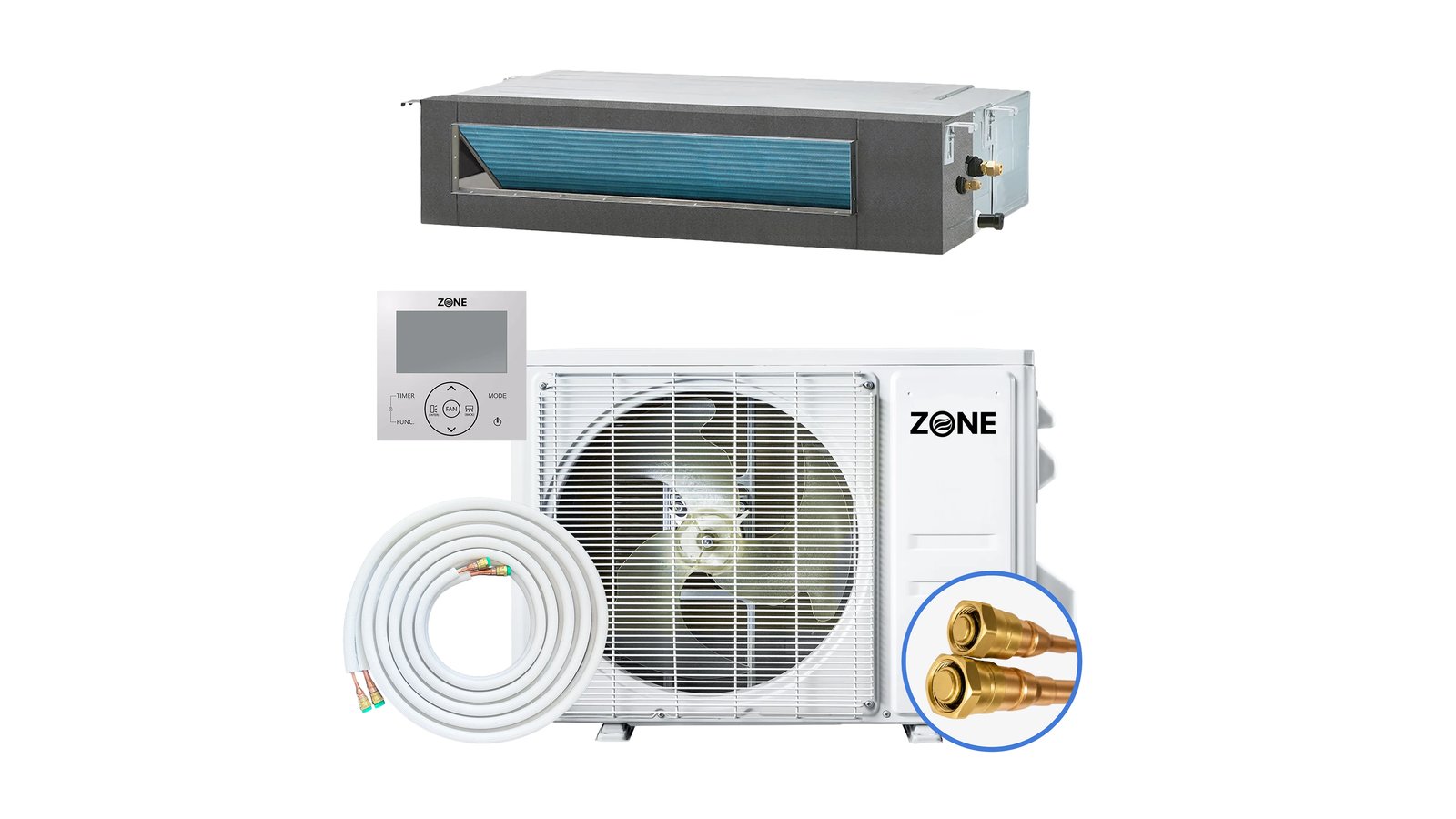
A DIY concealed duct mini split delivers central-air aesthetics with heat pump efficiency, and as of 2026, homeowners can install one without hiring a contractor. This guide breaks down how DIY concealed duct systems compare to MRCOOL DIY wall-mounted options, what components you need, and how to plan an installation that performs for years.
DIY a Concealed Duct Mini Split in 2026?
MRCOOL's DIY line is all about wall-mounted heads and ceiling cassettes that you put in using pre-charged Quick Connect line sets. True DIY concealed duct systems, where every indoor unit sits above the ceiling and pushes air through ducts and grilles, are a lot harder to come by.
You can absolutely get MRCOOL-style DIY convenience with a concealed ducted air handler when the system uses factory pre-charged line sets and quick-connect fittings. No vacuum pump, no refrigerant gauges, no licensed HVAC tech needed for the refrigerant side.
As of October 2026, Zone Air's Thin-Air line is the only DIY concealed ducted mini split on the market. MRCOOL doesn't sell a concealed-duct DIY unit. Its DIY line has wall heads, ceiling cassettes and a central DIY Hybrid Air Handler. Cooper & Hunter's warranty only applies to products installed by a licensed HVAC technician, so that limits its appeal for true DIYers.
The rest of this article looks at how concealed duct DIY lines up against MRCOOL DIY in install steps, energy efficiency, multi zone options and heat pump performance so you can figure out which fits your space.
Why Zone Air Is One of the Best DIY Concealed Duct Systems
Zone Air's Thin-Air line was built for homeowners who want ducted comfort with nothing on the walls and no refrigerant work. Here's what it brings to a DIY concealed duct install:
- Easy DIY refrigerant connections. The line sets come factory-sealed and pre-charged with R-454B, so there's no field flaring and no vacuum pump when you install per the instructions. Zone Air will also cut the line set to the length you measure, any whole foot from 5 to 75 ft.
- Fully concealed indoor unit. The air handler goes above the ceiling or in an enclosed space like a soffit or closet, and only the supply and return grilles show in the room.
- Ultra-slim. The 11,000 BTU Thin-Air is 7⅞ inches tall, so it fits some shallow ceiling cavities and soffits where a bulkier air handler won't.
- Flexible multi-zone. Concealed duct, wall-mount and ceiling cassette heads can be mixed on one outdoor unit, so you hide the units where looks matter and put a wall head in the garage or bonus room.
- Cold-weather heating down to −13°F. It also cools in outdoor temperatures up to 131°F.
- DIY-friendly warranty. 5 years parts and 7 years compressor, and installing it yourself doesn't void it.
What's a DIY Concealed Duct Mini Split in 2026?
A concealed duct mini split has a hidden ducted air handler indoors that connects to an outdoor unit with a refrigerant line set. Together they are a heat pump, giving both heating and cooling from one system. The variable-speed compressors in these units can adjust output on the fly, going up or down to match what the room actually needs instead of cycling on and off.
The air handler goes above a ceiling, in an attic or inside a soffit, with short duct runs to ceiling or high-wall supply grilles. Concealed duct mini splits keep your climate control out of sight, and since only the grilles show, it helps maintain a clean look in your home.
Compare that to standard MRCOOL DIY wall-mounted or cassette mini splits. Those sit out in the open on the wall or in the ceiling and don't use ductwork at all. Conditioned air is going straight into the room from the indoor unit.
What makes some concealed duct systems realistic DIY projects is the same thing MRCOOL's DIY line does: pre-charged line sets and quick-connect fittings that get rid of vacuum pumps and field refrigerant handling. These are still variable-speed inverter heat pumps that can cool efficiently in summer and heat through colder weather.
MRCOOL DIY vs Modern Concealed Duct DIY
As of October 2026, if you want a DIY-friendly mini split, you have two main paths: MRCOOL DIY 5th Gen systems and Zone Air Thin-Air concealed duct units.
Where MRCOOL DIY stands out:
- Wall-mounted and OuttaSight ceiling cassette indoor units that you put in yourself
- Multi zone support: MRCOOL's larger DIY condensers can run up to six zones
- The standard DIY 5th Gen is rated to about −13°F, and higher-tier DIY models go lower (−22°F on select single-zone units)
- Smart features including control through Alexa and Google Assistant
- The single-zone 18K system covers about 800 sq ft
- Self-installed systems keep the 5-year parts and 7-year compressor warranty, with no registration needed
- For ducted comfort, MRCOOL offers the DIY Hybrid Air Handler, a 24K or 36K furnace-style unit for upflow, downflow or horizontal installs that heats or cools up to 1,500 sq ft
Where concealed duct DIY systems can work best:
- You want completely hidden indoor equipment with no wall-mounted hardware
- Short duct runs and basic carpentry are within your comfort zone
- Factory pre-charged R-454B line sets give you a flexible solution similar to MRCOOL's Quick Connect approach
The MRCOOL DIY Hybrid Air Handler runs off a DIY Multi-Zone Condenser alongside ductless heads, but it's a central air handler, not a slim concealed unit like the Thin-Air. In its Olympus line, MRCOOL has slim ceiling-recessed duct units, and the catalog says those are "meant to be professionally installed." You might build a DIY hybrid setup: pair a ducted air handler for main spaces with wall heads or cassettes for a garage, bonus room or addition. With its own heads, Zone Air does the same thing: one 27,000 BTU outdoor unit runs 2–3 indoor units, and you can mix wall-mount, ceiling cassette and concealed ducted units on it. As of October 2026, no other DIY mini split lets you do that.
Outdoor Unit, Air Handler and Line Set
Every concealed duct mini split system has three core pieces of equipment: the outdoor unit, the indoor air handler and the line set connecting them.
Outdoor unit: The outdoor condenser has the inverter compressor. That compressor changes capacity based on demand. Modern units use R-454B refrigerant and meet current SEER2 standards. MRCOOL's outdoor units range from single-zone to multi-zone condensers supporting up to six indoor heads. Zone Air's 2- and 3-zone systems all have one 27,000 BTU outdoor unit.
Concealed ducted air handler: These slim-profile units can fit above ceilings or in soffits. Zone Air's 11,000 BTU Thin-Air model measures just 7⅞ inches tall (a 9,500 BTU size is also available). Inside, you'll find a coil, a blower and connections for supply and return ducts, condensate drain and control wiring. Thin-Air units take a rear or bottom return, have adjustable static pressure (0.1–0.4 in WG), and each one can feed 2–3 rooms. Indoor units must have proper clearance for maintenance and condensate drainage.
Line set: Both systems use pre-charged quick-connect line sets. The line set comes pre-charged with R-454B refrigerant, so you don't need field flaring, nitrogen purging or vacuum pump work. MRCOOL's catalog says "no special tools or training are necessary to install", and the same principle applies to Zone Air's quick-connect approach. MRCOOL sends fixed 11.5, 16, 25, 35 and 50 ft sets plus couplers for longer runs and has you coil the excess behind the condenser. Of the brands compared here, Zone Air is the only one that cuts your pre-charged line set to the exact length you measure, any whole foot from 5 to 75, and its 25 to 75 ft sets are each a single factory-sealed run with no coupler. On MRCOOL's multi-zone condensers, total line length is limited to 172 ft on the 3-zone unit and 221 ft on the 4- to 6-zone units, with 75 ft max to any one indoor unit, so keeping to maximum and minimum lengths is critical to protect compressor life.
Other necessary components include a wall sleeve for line set penetration, a condensate pump if gravity drain is impossible (Thin-Air units have one built in), mounting hardware, and communication wiring between indoor and outdoor units.
Planning Your DIY Concealed Duct Layout
Careful planning of installation is crucial for effective performance of ducted systems. Hanging a wall head is one thing, but with concealed duct work you need to decide where the air handler goes, where the ducts will run, and where the electrical runs will go before you start cutting.
Air handler location:
- Position it close to the rooms it serves so the duct runs stay short
- Make sure there's enough clearance for filter access and coil cleaning
- Check that the attic, closet or soffit has enough structural support
Duct runs:
- Keep branch runs under 10–15 feet per supply to avoid losing airflow (Zone Air's Thin-Air is rated for 15 ft max per supply run)
- Use smooth-radius turns and size ducts based on CFM requirements
- Ductwork in concealed mini split systems must be airtight to avoid leaks, so seal all connections with mastic and metal tape
- Proper duct sizing prevents noise and airflow issues in HVAC systems
Drainage:
- Slope gravity drains at least ¼ inch per foot
- Only use condensate pumps when gravity drainage isn't possible
Installation requires attention to local building codes and regulations. Run a basic load calculation (Zone Air has a free sizing calculator) or contact the manufacturer's support team to size BTU capacity correctly for each zone. Getting this right determines whether you need a single 9,500 or 11,000 BTU concealed unit or a 2–3 zone system on a 27,000 BTU outdoor unit.
Step-by-Step DIY-Style Installation Flow
This is an overview, not a replacement for your official install manual. All work must follow local building and electrical codes.
Concealed duct systems may be more complex to install than wall-mounted units, but the refrigerant side doesn't need special tools or training. A typical install goes like this:
- Set the outdoor unit on a level pad or wall brackets, securing it to meet local wind and earthquake requirements.
- Mount the concealed ducted air handler in the attic or chase on a platform or hang it from joists.
- Drill a wall penetration with a sleeve for the line set, condensate line and control wiring.
- Route the pre-charged line set with gentle curves and UV-resistant insulation. Connect the quick-connect fittings per torque specs without opening the refrigerant circuit.
- Attach supply and return ducts with mastic and metal tape. Install a return grille with filter access somewhere convenient. Insulate ducts in unconditioned spaces.
- Wire the system. A licensed electrician should usually handle new circuits, disconnect boxes and breaker sizing.
Zone Air's FAQ puts a concealed duct install at 6–8 hours, and duct fabrication and electrical work can stretch it into a weekend project. While concealed duct systems usually need professional installation when you're dealing with traditional refrigerant connections, pre-charged quick-connect systems remove that barrier for you.
Energy Efficiency, SEER2 and Operating Costs
Both brands have inverter heat pump technology for energy-efficient operation. MRCOOL's best DIY single-zone rating is 23.6 SEER2 (the 9K), and its 18K multi-zone condenser rates 23.9. Zone Air's 230V wall-mount systems reach 24 SEER2, the highest of the pre-charged quick-connect DIY systems compared here. Variable-speed operation is what keeps energy waste down on both.
For ducted units, the 3-zone Thin-Air rates 22 SEER2 and the dual-zone 19. MRCOOL's ducted DIY Hybrid Air Handler is listed at 19.4 and 15.7 SEER2 depending on size. Either way, both are way more efficient than window units or aging central air systems.
Zoned operation is where these systems save the most. Instead of cooling spaces you aren't using, multi zone or DIY hybrid configurations let you condition only occupied rooms. Current MRCOOL DIY and Zone Air systems both use R-454B refrigerant. That refrigerant has lower global warming potential than R-410A, so it matches current regulatory trends. ENERGY STAR status varies by model, so you'll want to verify the exact model before you bank on rebate eligibility.
Good insulation, sealed ducts and proper line set length all directly affect your monthly electric bills. Every unnecessary turn or uninsulated duct run eats into the energy efficiency your equipment was designed to deliver.
Cold-Climate and Hyper Heat Performance
Many 2026 inverter mini splits are true cold-climate heat pumps built for all-season comfort, not just air conditioners with small heat capability.
- MRCOOL's standard DIY 5th Gen is rated to about −13°F, its Easy Pro to 5°F, and higher-tier DIY models go lower: the single-zone DIY Hyper Heat operates down to −22°F
- MRCOOL's DIY multi-zone condensers operate to −13°F, with only the largest 55K unit reaching −22°F, since there's no multi-zone Hyper Heat
- Zone Air's Thin-Air concealed duct systems are rated for heating down to −13°F and cooling in outdoor temperatures up to 131°F (MRCOOL lists 122°F)
"Hyper Heat" means the system delivers high-capacity heating at low outdoor temperatures where standard heat pumps would lose significant output. Check manufacturer data sheets for COP and capacity curves at 17°F, 5°F, and below before choosing a model for your climate.
In very cold regions, you might combine a cold-climate mini split with a backup heat source or choose a DIY hybrid solution that uses existing ductwork for supplemental heating.
Multi Zone and DIY Hybrid Options
Modern systems can serve anywhere from one to six zones depending on the outdoor unit and indoor head mix. MRCOOL's largest DIY condensers can support up to 6 zones for heating and cooling, while concealed duct systems let you do multi zone independent temperature control across different rooms.
Multi zone configurations:
- MRCOOL DIY 5th Gen outdoor units support 2–6 zones with wall, cassette and hybrid air handler options
- Zone Air Thin-Air systems are built around 2–3 concealed ducted zones from a single 27,000 BTU condenser, and the same condenser takes wall-mount and ceiling cassette heads in any mix
DIY hybrid configuration:
A DIY hybrid air handler tied into existing ductwork handles main areas, while additional wall-mounted or cassette mini splits serve bedrooms, offices or a garage. MRCOOL DIY systems can support up to 6 zones, giving you significant coverage area flexibility. With Zone Air, the concealed unit itself can connect to existing ducts or take a fresh-air intake.
Line set planning matters: MRCOOL's 3-zone condenser lets you have 172 feet of total line set, while its 4- to 6-zone units let you have 221 feet. Map all indoor head locations and approximate line set lengths before you buy so you don't exceed maximum distances.
Controls, Smart Features and Everyday Comfort
You can still get the smart control experience you associate with MRCOOL DIY with a concealed duct DIY system. MRCOOL's wall heads integrate with Amazon Alexa and Google Assistant for voice control. The Hybrid Air Handler system comes with the MRCOOL Smart Wi-Fi Thermostat.
Each Zone Air concealed unit gets its own wired wall controller, with Wi-Fi control as an option, for scheduling, mode changes and fan control. Wall-head zones get features like Follow Me remote temperature sensing, while concealed duct outlets provide fixed-grille airflow directed by duct placement.
Real-world example: set back the temperature from your phone while you're away at the shop, then use zoning to keep bedrooms cool at night without cooling the whole house too much. That level of room-by-room control is the point of multi zone systems, whether they're concealed or wall-mounted.
Maintenance, Troubleshooting and Protecting Your Investment
DIY-friendly systems still need consistent maintenance. MRCOOL's warranty covers defects "under normal use and maintenance" and leaves routine maintenance like filter cleaning to the owner. The same goes for concealed duct installations.
Homeowner maintenance tasks:
- You can clean filters and clear condensate backups yourself. You should do this monthly during peak season
- Inspect and clear condensate drains and pumps every three months
- Gently rinse outdoor unit coils and keep vegetation at least 24 inches away
- Check for error codes on the indoor controller or app
When to call a pro:
- Refrigerant leaks need a certified technician, since opening a refrigerant circuit needs EPA 608 certification
- Compressor or fan motor failures need a licensed HVAC technician
- Recurring error codes that self-diagnostics can't resolve
Also covering the 24K Hybrid Air Handler, MRCOOL's DIY 5th Gen warranty is 5 years parts and 7 years compressor. Zone Air's warranty is also 5 years parts and 7 years compressor, with no registration deadline and installing it yourself doesn't void it. Zone Air also takes returns within 30 days on uninstalled units and offers live technical support from 8 AM to 6 PM MT. Keep digital copies of invoices, photos of key installation steps, and serial numbers to support future warranty claims or troubleshooting with technical support.
Is a DIY Concealed Duct Mini Split Right for You?
Concealed duct systems give you central-air looks with mini split energy efficiency, but they need more carpentry and planning than a single wall-mounted head.
You'll need to be:
- Comfortable with basic framing, drywall patching and power tools
- Able to follow step-by-step instructions for line set routing and mounting
- Willing to hire an electrician for code-compliant power connections
Concealed duct DIY works best when:
- You're remodeling and ceilings are already open
- You're building an addition and want hidden vents
- Wall-head looks are a deal-breaker in your living space
MRCOOL DIY wall or cassette units may work better when:
- You need a quick single-room install
- You want 4- to 6-zone installations where visible indoor units are acceptable
- Adding soffits or attic ductwork doesn't work in your home
The market for DIY concealed duct mini splits is changing fast. Zone Air has a one-page spec sheet for every system. Compare current specs, outdoor unit models and warranty terms for both MRCOOL DIY and concealed duct systems like Zone Air before you make a final decision. The cost savings from skipping a professionally installed system are real, but only if you choose equipment matched to your home's layout, climate and comfort needs.
Related Guides
- Best DIY multi zone concealed ducted mini split - MRCOOL vs Zone Air on multi-zone ducted setups
- Concealed duct multi zone mini split easy installation - duct plan and install steps for 2–3 zones
- MRCOOL vs Zone Air - the full DIY comparison
- Best mini split with no vacuum pump required - how pre-charged line sets work
Get a quote on a DIY concealed duct mini split
Specs and warranty terms are manufacturer-published as of October 2026, subject to change. Verify before you buy. MRCOOL®, Zone Air and the other brand names are owned by their own companies. HVAC On Sale is not connected with or backed by them.