
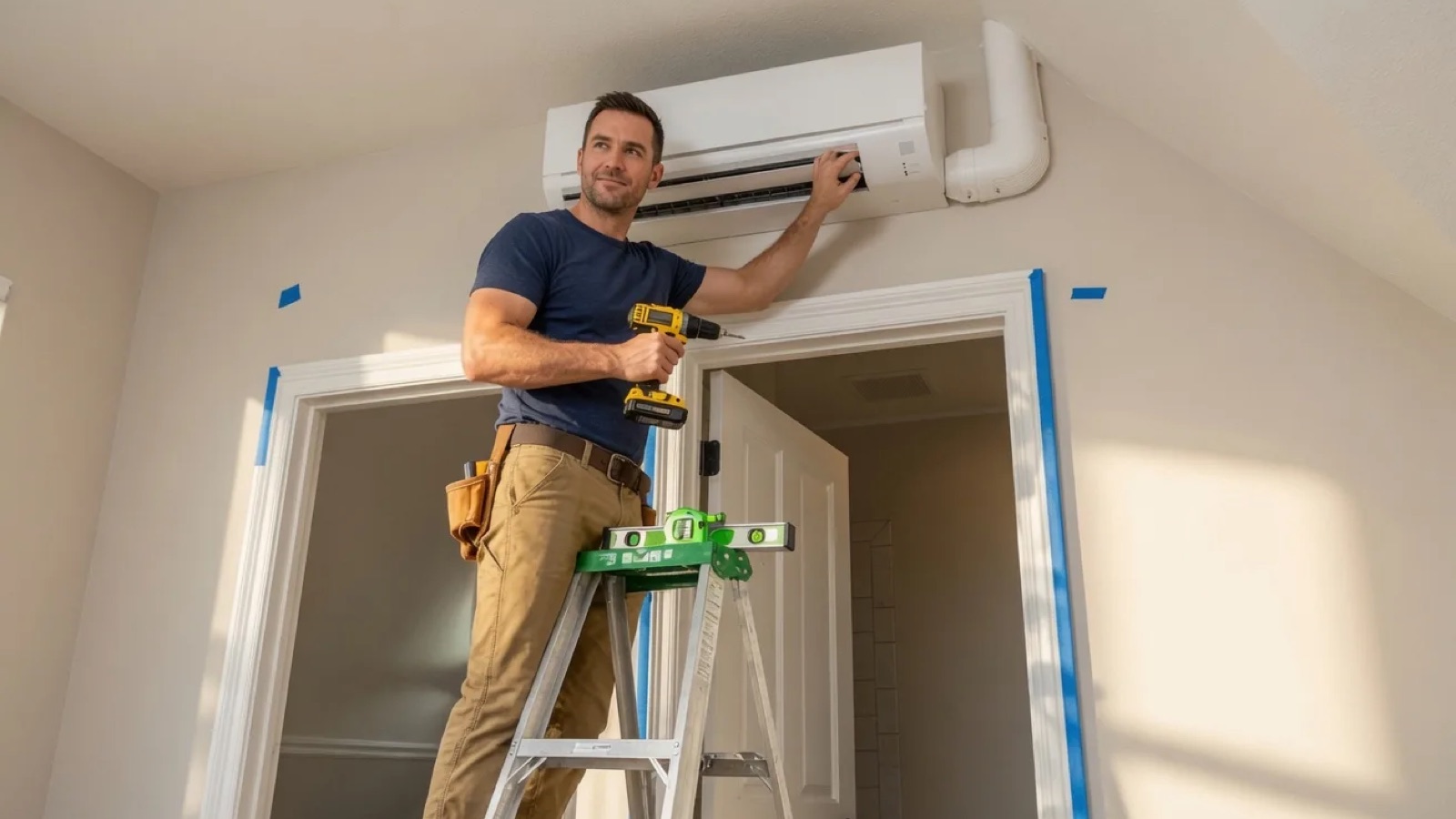
The best 12,000 BTU DIY mini split in 2026 is the Zone Air 12,000 BTU DIY system. Of the DIY brands compared here, it is the only one that does final assembly, testing, and inspection in the USA (as of November 2026). Zone Air is also the only DIY mini split brand that does custom line set fabrication, up to 75 feet in a single run. Its 230V model reaches 24 SEER2, and the company backs everything with direct-to-consumer warranty support and an average of 4.8/5 across 157 verified customer reviews.
A 12,000 BTU DIY mini split is a single zone mini split system designed to heat and cool roughly 300 to 550 square feet, making it the sweet spot for bedrooms, home offices, garages, and bonus rooms. Unlike traditional HVAC systems that rely on ductwork (where duct losses account for about 30% of central air conditioning energy consumption), a ductless mini split delivers conditioned air directly to the room. Mini splits cost between $3,000 and $5,000 to install when you hire a contractor. DIY systems exist to eliminate most of that labor cost, letting homeowners handle the job themselves with pre-charged refrigerant lines and basic tools.
This guide compares leading 12k DIY systems on installation difficulty, energy efficiency, and warranty so you can choose confidently.
How We Chose the Best 12,000 BTU DIY Mini Splits
Not every mini split that has a "DIY" label on it actually makes the cut. Many cheap online-only units were left out of this comparison due to poor support, unclear warranties or the expectation that you'll need a licensed HVAC technician to finish the install. With so many new competitors now offering similar features, only a handful genuinely deliver on the promise of installation that a homeowner can actually do. This list focuses on 12,000 BTU single-zone heat pump systems that are sold as DIY or homeowner-installable and that were sold in the U.S. in 2026.
Core Evaluation Criteria
Installation friendliness. The market for DIY mini splits is mostly made up of pre-charged quick-connect systems. True DIY mini splits can be put in without specialized HVAC tools and usually do not need a vacuum pump or EPA certification. We looked for systems that have pre-charged, quick-connect line sets and clear manuals. Many 12,000 BTU units run on 115V circuits that are good for DIY installation, and we gave extra credit for plug-in options and having both 115V and 230V configurations. Standard DIY mini splits often use refrigerants that are friendlier to the environment, like R-454B and some DIY systems give you different refrigerant options to make the unit more efficient and help it perform better. That said, a mini split installation usually needs a dedicated electrical line, and local building codes may require permits for electrical work and installation compliance.
Energy efficiency and performance. High SEER2 ratings show greater energy efficiency in HVAC systems. In January 2023, the SEER2 rating replaced the older SEER ratings, and it measures how efficient HVAC units are in different operational scenarios. For a 12k system used daily, your target SEER2 rating is 18 or higher. On MRCOOL's budget DIY Select tier, the DIY models compared here start at about 17.5 SEER2. At 24 SEER2, Zone Air's 230V 12K is the top of the range. Mini splits are more energy-efficient than central air systems and can save up to 60% energy compared to electric resistance heat. We also evaluated cold-climate heating performance, since mini splits can lose efficiency in freezing conditions, and a system rated to operate at −13°F matters if you live in colder climates. Mini splits can dehumidify air continuously during operation, an important factor for high humidity regions. We also thought about noise levels: a quiet indoor unit matters in a bedroom. It matters less in a garage.
Warranty and long-term reliability. Most traditional mini splits need a licensed technician to complete installation to keep the warranty valid. We examined compressor and parts warranty length, whether DIY install voids coverage, and whether you deal directly with the brand or through a retailer. Mini splits can last about 10 to 15 years, so warranty structure matters a lot. Most mini splits range from 9,000 to 24,000 BTU, and at the 12k size, warranty terms vary widely across manufacturers.
Total cost of ownership. We compared upfront equipment pricing, plus installation materials and tools you still need as a DIYer. Zone Air is often 15–30% cheaper than comparable MRCOOL models. Projected energy savings over 10 to 15 years based on SEER2 differences at typical usage were factored in. For example, running a 24 SEER2 system versus a 20 SEER2 system for 1,000 cooling hours per year gives you kWh savings you can measure that add up over a decade.
Flexibility and configuration options. We looked at your options for line set length (custom lengths versus fixed-length runs) and how that affects the risk of leaks. We also looked at indoor unit styles (wall mount, ceiling cassette, ducted concealed) and whether you can mix multiple indoor units on compatible multi-zone condensers for future expansion across individual rooms.
Brand reputation and support. With an average of 4.8/5 across 157 verified customer reviews, Zone Air gets reviews that often mention the help they got from support. One review on the Zone Air reviews page is titled "Thanks Customer Support" and reads, "Great customer service and support. Worked with me to help me order over the phone." We looked at how responsive and helpful tech support is for DIYers, especially during installation and warranty claims.
Best 12,000 BTU DIY Mini Splits for 2026
This comparison is about single-zone 12k DIY systems, and each one is the best pick for a certain kind of buyer or situation. We picked four brands and categories so that none of them overlap, and Zone Air is our top choice.
1. Zone Air 12,000 BTU DIY Mini Split (Top Pick - Overall Best)
A single-zone 12k DIY heat pump system with final assembly, testing, and inspection in the USA, custom lineset fabrication, up to 24 SEER2 efficiency on 230V, and direct-to-consumer support.
Why It Stands Out
Zone Air does final assembly, testing, and inspection in the USA, so every system is checked before it ships. It's the only DIY mini split brand compared here that does (as of November 2026), and that's why the company can stand behind its warranty.
The standout feature is custom lineset fabrication. Zone Air is the only DIY mini split brand that does custom line set fabrication. It can build a factory pre-charged R-454B quick-connect line set to any whole-foot length between 5 and 75 feet in a single run. MRCOOL ships fixed-length line sets (11.5, 16, 25, 35, and 50 ft) and reaches longer runs by joining an extension line set to the first one with a coupler. Every extra quick-connect extension adds another potential leak point in your refrigerant line. A single custom-length run has no connection in the middle.
Zone Air is also the only brand that offers a plug-in outlet solution for homeowners who want a system that plugs into an outlet. Its plug-in kit for the 115V 12k model lets you plug the system into a dedicated 15A outlet where local electrical code allows a plug-in install (never an extension cord). MRCOOL's 115V 12K is hardwired. The plug-in kit combined with the 115V system makes Zone Air's the easiest systems to install on the market: no hardwiring, and no 230V line or panel upgrade in many cases.
At 24 SEER2 on 230V, Zone Air is the highest-efficiency pre-charged quick-connect DIY system of the brands compared here (MRCOOL's DIY 5th Gen 12K is 23.5). Over 10 years of daily use, that efficiency gap versus a 20 SEER2 competitor translates to hundreds of dollars in reduced energy costs. The 115V Zone Air 12K is rated 23 SEER2.
Zone Air's warranty covers 7 years on the compressor and 5 years on parts with no registration deadline, and DIY installation does not void coverage when installed per instructions. Zone Air ships every system direct to consumer. All systems come pre-inspected, and all warranty claims and returns / exchanges are handled directly with Zone Air, with no third-party distributor in the middle.
Zone Air is also the only DIY mini split that lets you mix wall-mount, ceiling cassette, and concealed ducted units on one outdoor unit for multi-zone setups (as of November 2026). MRCOOL's ducted DIY option is a central air handler sized for a whole home. It is not the same thing as Zone Air's concealed ducted mini split, which is built to serve a single room (or two or three small ones).
Best For
- Homeowners who want the highest-quality DIY 12k system and are comfortable with ordering direct from the company online
- Installations where the exact length of the line set matters: finished basements, long runs to detached garages, and tricky paths between two stories
- People who want the cost of running the unit to stay low and want quiet operation in bedrooms, offices and studios that run many hours a day.
- Buyers who want strong warranty support with no runaround and don't want to deal with third-party sellers.
Key Strengths
- Final assembly, testing, and inspection in the USA, with every system checked before shipping.
- With a 24 SEER2 rating, the 230V 12k is the highest of the pre-charged quick-connect DIY systems compared here, so it'll cut your long-term utility bills.
- Custom, factory-built linesets up to 75 ft so you have fewer connections and fewer potential refrigerant leaks.
- 115V plug-in kit option so many homeowners can avoid running a 230V line, upgrading the panel and hardwiring the unit.
- You can mix wall-mount, cassette and ducted concealed indoor units on the multi-zone condensers that are compatible.
- For returns, exchanges and warranty claims, Zone Air sells direct to consumers and handles it all itself.
Possible Limitations
- It's sold direct online, so there's no in-store pickup.
- That 24 SEER2 rating is for the 230V model. The 115V 12k is 23 SEER2, which is a hair under MRCOOL's 115V 12K at 23.5.
- The premium efficiency might be too much for a space you don't use much, like a weekend workshop where a cheaper, lower-SEER2 system would probably do fine.
- The DIY name still thinks you're okay with basic electrical work and carpentry. If you're not experienced, you might still end up hiring an electrician for the circuit or outlet.
2. MRCOOL DIY 12,000 BTU (Sold at Dealers and Retailers)
MRCOOL sells DIY mini splits with pre-charged Quick Connect line sets through dealers, distributors and retailers like Home Depot and Lowe's.
Why It Stands Out
MRCOOL is a more retail-availability-oriented company. With Quick Connect technology, the core refrigerant connections are easy for you if you're a first-time DIYer, and there are a lot of third-party videos and guides that show real-world installations. MRCOOL sells split systems across several product levels, from the budget DIY Select up to the MRCOOL DIY 5th Gen line.
Best For
- Homeowners who'd rather buy from a local dealer or retailer and use store credit cards and financing.
- DIYers who value abundant third-party installation videos.
- Users who are okay dealing with store policies and manufacturer warranty terms.
Key Strengths
- There are frequent sales and package deals, plus in-store pickup at the stores that carry it.
- Quick Connect technology makes the core refrigerant connections simpler for you to do.
- SEER2 efficiency in the low-20s range on newer 12k models (the MRCOOL DIY 5th Gen 12K reaches 23.5 SEER2).
- The MRCOOL DIY 5th Gen warranty is 5 years on parts and 7 years on the compressor, with no registration required, the same main term as Zone Air's.
- Line sets are available in several fixed lengths that work for many basic setups.
Possible Limitations
- Lineset extensions increase the number of connection points and potential leak sources compared with a single custom-length run from another brand like Zone Air.
- Warranty support can be broken up. MRCOOL has no direct-to-consumer option, so you must purchase through a third party (distributors), which means dealing with a third party for warranty, replacement parts, returns and exchanges.
- MRCOOL's Trustpilot profile shows 3.0/5 across 94 reviews (November 2026). Reviewers there describe warranty claims turned down on self-installed units and slow answers from support.
- With a 17.5 SEER2 rating, the budget DIY Select line drops well below what makes sense for daily-use spaces, and its warranty is 1 year on parts and 2 years on the compressor.
3. Pioneer 12,000 BTU DIY-Oriented Mini Split (Best Budget Import)
Pioneer is a value-oriented brand with competitive pricing and DIY-leaning kits that may still need some pro tools for the best install.
Why It Stands Out
Pioneer's lower upfront pricing is attractive if you are on a strict budget. With broad online distribution, the brand offers frequent discounts and deals on 12k BTU ductless system kits. Efficiency sits around SEER2 20, which is better than basic window AC units (they weigh 40 to 80 pounds or more and block your view) and older central ac systems.
Best For
- Buyers who want to keep the price down and still get a ductless heat pump, but are less focused on better efficiency or premium support.
- DIYers who are comfortable with renting or getting a vacuum pump and manifold set if that is required.
- Occasional-use spaces like workshops and bonus rooms where every kWh you save is less critical.
Key Strengths
- The price point is attractive, often several hundred dollars less than premium DIY brands.
- Solid performance for mild to moderate climates, with coverage for both heating mode and cooling mode.
- There is a variety of wall-mount indoor units that fit the look of typical bedrooms and offices.
Possible Limitations
- It's not always a true tool-free DIY system, because some models expect pro-style evacuation and commissioning. That means mini splits need professional installation in those cases if you want the best performance.
- Compared to brands like Zone Air, the warranty terms are shorter or more limited, especially for DIY installs.
- For the support, the parts availability and the documentation, these may feel less streamlined than what you get from direct-to-consumer specialists.
4. Generic "Amazon-Only" 12,000 BTU DIY Mini Splits (Best Avoided for Warranty-Sensitive Buyers)
This category covers various 12k DIY mini split AC units that don't cost much and that most people haven't heard of. You mostly buy them through online stores. They usually don't make the "best" list if you're looking for something for serious long-term use.
Why They Stand Out (and Why They Don't)
The prices are extremely low and there are frequent flash deals, so they're tempting. Some promote "no vacuum required" or "pre-charged" but they don't give you much technical detail or certifications. Because the brand names and support channels change a lot, long-term warranty coverage gets complicated. DIY mini splits still need expertise for proper installation, and these units rarely give you the support to back that up.
Best For
- Short-term installations where long-term reliability matters less: temporary work areas, rental properties you fix up and sell where future support isn't a priority.
- You can handle this if you're a highly skilled DIYer who can diagnose and repair issues on your own if the brand goes away.
Key Strengths
- Lowest initial equipment cost among 12k systems labeled as DIY.
- You can order online in a simple way, with fast shipping and easy returns in the first 30 days depending on what the platform's policies are.
Possible Limitations
- Opaque or short warranties, often 1 to 5 years, with limited help on what DIY installation voids.
- There is little to no live technical support. You may have to use generic email with slow response.
- Unknown manufacturing quality and not many owner reviews compared with established brands.
Quick Comparison of the Best 12,000 BTU DIY Mini Splits
Use this table as a fast reference so you can compare how easy the installation is, how efficient the unit is, and what the warranty looks like, all at a glance. For context on non-DIY alternatives: Mitsubishi Electric gives you a 12-year limited warranty on its mini splits, though you need a professional to install mitsubishi systems. Fujitsu mini splits come with warranties of 7 to 12 years, and the SEER2 ratings for the Fujitsu Altair 500 Series are between 21 and 26. LG mini splits can have warranties that last up to 12 years, and the SEER2 rating for the LG Artcool Deluxe is between 25.5 and 27. Mirage mini splits have a 6-year warranty. These are all excellent systems, but none of them are designed for DIY installation.
| Feature | Zone Air 12k | MRCOOL DIY 12k | Pioneer 12k | Generic Amazon 12k |
|---|---|---|---|---|
| Approx. SEER2 | 24 (230V) / 23 (115V) | 17.5 (MRCOOL DIY Select) to 23.5 (MRCOOL DIY 5th Gen) | ~20 | 14–19 (often unclear) |
| Lineset approach | Custom single run, 5–75 ft | Fixed lengths 11.5–50 ft + couplers | Fixed lengths, may need vacuum | Fixed lengths, details vary |
| Power options | 115V plug-in capable and 230V | 115V hardwired and 230V (model dependent) | Mostly 230V | Varies |
| DIY friendliness | True pre-charged, no vacuum | Pre-charged Quick Connect | Semi-DIY, may need pro tools | Claims vary, often misleading |
| Warranty structure | 7 yr compressor / 5 yr parts, direct with Zone Air | 7 yr compressor / 5 yr parts on MRCOOL DIY 5th Gen (2 yr / 1 yr on MRCOOL DIY Select), through dealer/distributor | 1–5 yr, through seller | 1–3 yr, often unclear |
| Approx. price (2026) | Often 15–30% less than comparable MRCOOL models | ~$2,359 (MRCOOL DIY 5th Gen 115V, September 2026) | ~$1,100–$1,500 | ~$700–$1,200 |
- With the Zone Air 12,000 BTU DIY, you've got the best overall pick for easy installation, 24 SEER2 efficiency on 230V, and direct warranty support.
- MRCOOL DIY 12,000 BTU. Best if you'd rather buy through a dealer or store.
- Pioneer 12,000 BTU. Best if upfront cost matters most and you can handle a semi-DIY install.
- Marketplace "no-name" 12,000 BTU units. Only for short-term or test projects where you're okay with the warranty risk.
How to Choose a 12,000 BTU DIY Mini Split
A 12,000 BTU rating is just the starting point. Proper sizing, electrical limits and usage patterns should guide your final choice. Think through three main decision factors, then check them against the comparison above.
Choose Based on Your Space and Climate
A 12,000 BTU mini split covers 300 to 550 sq ft under standard conditions. That range assumes average insulation, 8-foot ceiling height and moderate outside air temperature. Adjust BTU requirements for high ceilings and sunlight exposure, because south-facing rooms with large windows need more capacity. Add 20–30% BTU for garages, and 10–15% for humid climates with persistent high humidity. Mini splits come in fixed steps of 12,000, 18,000, and 24,000 BTU, so if your room size calculation lands at 14,000 BTU, you'll likely round up to 18,000. Oversizing a mini split causes short cycling and humidity issues: the system cools too fast, shuts off and never runs long enough to dehumidify properly.
When does a high-efficiency system like Zone Air (up to 24 SEER2 on 230V) make sense versus a lower-SEER2 budget model? If the unit runs daily in a bedroom, home office or studio, the energy savings compound quickly and maximum efficiency pays for itself. For an occasionally used workshop, a cheaper unit with a lower SEER2 may be enough space conditioning at a lower upfront price.
For cold climates, look for strong heating performance at 5°F and below if the unit serves as primary heat. Zone Air is rated to heat down to −13°F, the same floor as MRCOOL's standard DIY 5th Gen. Higher-tier MRCOOL DIY models are rated lower. In hot climates, Zone Air is rated to cool in outdoor temperatures up to 131°F (MRCOOL publishes 122°F). Central air is cheaper per square foot if ductwork already exists, but mini splits avoid duct losses, saving about 30% energy, and they work as both a mini split air conditioner and a heat pump for year-round comfort.
Choose Based on Installation Constraints
Voltage options for mini splits often include 115V and 230V configurations. Zone Air's 115V plug-in kit helps you avoid a 230V line or a panel upgrade: the unit plugs into a dedicated 15A outlet where local code allows. If your space only has 230V available or you prefer hardwired connections, both Zone Air and MRCOOL offer 230V 12k models. Professional installation can cost between $2,400 and $6,000 depending on complexity and region, so the DIY path offers substantial savings on labor costs and installation costs.
Lineset routing is where Zone Air's custom single-run fabrication shines. If your outdoor compressor sits 40 feet from your indoor unit, a fixed-length brand has you buy the next size up and coil the excess, and on longer runs join two line sets with a coupler, adding connection points and leak risk. Zone Air builds one sealed line to the exact length. For southern California ranches with long exterior runs or two-story homes with the outdoor condenser on the ground and the air handler upstairs, this is a meaningful advantage.
Even with DIY refrigerant lines, hiring an electrician for the electrical wiring still makes sense in many situations. Local codes may require a permit for a new dedicated circuit, and getting that right protects both your home and your warranty.
Choose by Warranty, Support and Long-Term Cost
The cheapest upfront unit may cost more in the long run if warranty coverage is weak or support is hard to access. Zone Air's direct-to-consumer model means one phone number, one company, one point of accountability. Its 4.8/5 average across 157 verified customer reviews reflects that approach. Contrast this with multi-layer retailer and distributor models where responsibility can bounce between the store, the distributor and the manufacturer, introducing unnecessary uncertainty when making an expensive purchase.
Think in terms of 10 to 15 years of ownership. A system with 24 SEER2 running 1,500 hours per year uses roughly 17% less electricity than a 20 SEER2 system and around 25% less than an 18 SEER2 system. Over a decade, that difference adds up to hundreds, sometimes thousands, of dollars in reduced energy costs. Mini splits can cool multiple rooms with one outdoor unit if you eventually expand to a multi-zone setup, and Zone Air's ability to mix wall, cassette and concealed ducted indoor units on the same condenser gives you flexibility that no other DIY mini split offers for larger spaces or multiple rooms down the road (as of November 2026).
The perfect system is not just the one with the best specs on paper. It's the one backed by a company that answers the phone when you need help.
Which 12,000 BTU DIY Mini Split Is Best for You?
- You'll want to choose Zone Air 12,000 BTU DIY if you want the easiest install, 24 SEER2 efficiency on 230V, custom linesets and direct warranty support from the company that built it. It's the best specific model for homeowners who care about long-term value and quality.
- Choose MRCOOL DIY 12,000 BTU if you'd rather buy from a dealer or a store, knowing that warranty support goes through third parties.
- Go with Pioneer 12,000 BTU if you want the lowest upfront cost and you don't mind a more hands-on semi-DIY install that may need pro tools.
- Avoid no-name marketplace 12k DIY units unless you accept higher risk around parts, support and long-term reliability. For light commercial applications or any space where time offline is costly, these are not the right choice.
Final Thoughts
For most homeowners serious about long-term comfort and low energy bills, a well-supported diy mini split system like Zone Air's 12,000 BTU model, at 24 SEER2 on 230V, is the best value in 2026. Mini splits are a good alternative to central air conditioning if you want to cool one room or a few individual rooms, and the DIY path gets rid of most of the cost of professional installation. But going after the lowest price tag rarely makes sense when you think about what you actually get, because warranty gaps, efficiency losses and support headaches over a decade of ownership can cost you far more than you saved.
Plan your installation in advance. Measure the route for your lineset, check that your electrical panel has enough space, check your room's square footage and ceiling height, and use brands that give you direct technical support during setup. Correct sizing and careful attention to installation details matter far more than saving a couple hundred dollars upfront, and choosing a brand with strong warranty backing means you are covered if a part fails inside the warranty term.
Related guides
- Best Black Friday mini split heat pump deals - Black Friday 2026 mini split heat pump deals on 12000 BTU DIY systems
- 12,000 BTU DIY mini split heat pump - one-room heating in a cold climate, sizing and install
- 9,000–12,000 BTU 115V DIY mini splits with pre-charged line sets
- 115V mini split DIY installation (9,000 BTU) - 115V mini split DIY installation for a 9,000 BTU unit
- DIY multi zone mini split specs and sizing
- MRCOOL 115V DIY mini split guide - the 9K and 12K 5th Gen specs, with a Zone Air comparison
- Best DIY mini split 18000 BTU systems - the 18K models side by side